What Are Meta Broad Categories and When Can You Use Them?
Advertisers confuse broad categories with broad targeting all the time, which leads to poor targeting decisions. Today, we get into what broad categories are, how Meta builds them, when to use them, and when to skip them entirely.


Meta is constantly building a picture of its users, tracking what they engage with, what they write on their profiles, and what they click across the web.
Broad categories are derived from that data, and for advertisers, they're among the most accessible targeting inputs available.
That's why today we're walking you through broad categories so you can decide if it's an option you want to use in your campaigns.
Key takeaways
- Broad categories are targeting inputs, and their effectiveness depends on how you combine them with other settings.
- Meta assigns users to broad categories based on profile data, behavioral signals, and activity tracked across Facebook, Instagram, and the web.
- Broad categories sit at the top of the interest hierarchy, meaning they pull in large audiences that include many sub-interests beneath them.
- They work best for new campaigns with limited pixel data, awareness campaigns, and audience testing, but are a poor fit for niche products or down-funnel campaigns.
What are broad categories on Meta?
Broad categories are high-level interest groupings that Meta creates based on user activity.
That information consists of details from their profile, the pages they've liked, and the content they've engaged with across Facebook, Instagram, and the broader web.
Meta also factors in self-reported profile data, such as education, job title, and relationship status, alongside inferred behavior from page likes, post engagements, and visits to websites with Meta tracking pixels.
Categories represent general topics such as business, fitness, or technology, and each includes several narrower interests.
Because of that, broad categories sit higher in the targeting hierarchy, which means they contain very large audiences and include many sub-interests.
In Ads Manager, broad categories live inside the Detailed Targeting section under the ‘browse tree’.
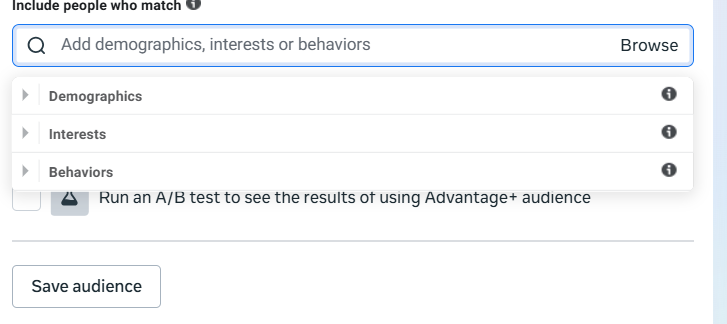
When you open that dropdown, you'll find a wide range of topics to target, each with subcategories beneath them, and those subcategories have more specific ones under them, too.
Here are examples of categories you can expect to see from Meta when building your audience targeting.
| Category | Category |
|---|---|
| Business and Industry | Food and Drink |
| Shopping and Fashion | Mobile Device User |
| Education | Hobbies and Activities |
| Sports and Outdoors | Purchase Behavior |
| Entertainment | Parents |
| Technology | Digital Activities |
| Family and Relationships | Relationship |
| Travel | Consumer Classification |
| Financial | Life Events |
| Expats | Fitness and Wellness |
Broad categories vs. broad targeting
These two terms get mixed up often, but they're not the same thing.
Broad targeting means setting only the basic parameters like age, gender, and location, and letting Meta's algorithm handle the rest.
With this strategy, you don’t add any interest, behavior, or detailed demographic layers. Meta decides who sees your ads based purely on its own signals and optimization logic.
Broad categories, on the other hand, are specific interest inputs you select in the Detailed Targeting section of Ads Manager.
You still make an active targeting decision, just at a higher level of the interest hierarchy. In essence, you're telling Meta the general topic space your audience belongs to, and Meta fills in the rest from there.
So while both involve giving Meta room to optimize, broad targeting hands over full control, and broad categories give the algorithm a starting point.
When should advertisers use broad categories?
Broad categories are not a Facebook ads targeting strategy on their own. They're more of a targeting input or a signal you give Meta to define the interest space your audience sits in.
How you combine them with other targeting settings determines their effectiveness.
Broad categories tend to work well in these situations:
- Launching a new campaign with limited historical data. When your pixel is fresh, or your account doesn't have enough conversion data for Meta to optimize effectively, broad categories give the algorithm a starting point without over-constraining delivery.
- Running awareness campaigns. Awareness campaigns prioritize reach over precision. Broad categories are great for this goal because they reach large audiences across a general-interest space.
- Testing new audiences. If you're exploring whether a new interest area is worth pursuing, broad categories let you cast a wider net before committing to more specific targeting.
However, broad categories are not the right move for every campaign.
If you're running a highly niche product or operating in a space where audience precision is critical, such as B2B or regulated industries, the large audience pools that come with broad categories can work against you.
You might end up paying to reach people who have a general interest in a topic but no authentic interest in what you're selling, which, as you can guess, will end up in wasted ad spend.
Final thoughts on Meta broad categories
To reiterate, broad categories are not, in and of themselves, a targeting strategy.
They're an input you use to point Meta in the right direction, and how well they work depends on how you combine them with the rest of your targeting settings and campaign objectives.
Use them when you're working with limited data, testing new interest spaces, or running campaigns where reach is more important than precision.
It's better to avoid using them solely on their own when your product needs a specific audience or layered targeting.
To learn more about Facebook ads targeting, check out our guide on targeted advertising and how to set it up.
FAQs
Broad targeting means running ads with only basic parameters set, like age, gender, and location, with no interests, behaviors, or detailed demographics added. Meta's algorithm decides who sees your ads based entirely on its own.
Broad categories are a specific interest input you select inside Detailed Targeting. Broad targeting skips that layer entirely and hands full control to Meta's algorithm.
Meta tracks user activity across Facebook, Instagram, and the broader web, including page likes, post engagements, profile data, and website visits via tracking pixels. It uses that data to place users into interest groupings that match their behavior and self-reported information.
Sources
- Jon Loomer. Broad Categories
- Cropink. Facebook Ads Targeting
- Cropink. What is Targeted Advertising?
Damaris is a Digital Marketing Specialist who writes about digital marketing and performance marketing. At Cropink, she creates data-driven content to help businesses run better ad campaigns for better performance and ROI.
Leszek is the Digital Growth Manager at Feedink & Cropink, specializing in organic growth for eCommerce and SaaS companies. His background includes roles at Poland's largest accommodation portal and FT1000 companies, with his work featured in Forbes, Inc., Business Insider, Fast Company, Entrepreneur, BBC, and TechRepublic.
Related Articles

How Can Cropink Help?
Start with Cropink is easy and free
No credit card required