Creative Ad Design: 12 Examples, Ideas, and Lessons for Better Campaigns
Creative advertising campaigns often outperform standard ads by capturing attention and increasing brand recall. Examples like Red Bull Stratos generated global media coverage, while simple concepts like FedEx’s delivery visual or Mercedes stability ad drove millions of views and strong brand recognition.


Every marketer reaches the same wall. The blank canvas before a new campaign. You have a product, a budget, and a deadline.
According to a meta-analysis of nearly 450 campaigns by NCSolutions and Nielsen, creative quality drives 49% of a brand's sales lift from advertising. More than targeting, reach, and media spend combined.
This guide breaks down 12 real ad examples by the creative move behind each one, with patterns you can borrow and apply to your own campaigns.
Key takeaways
- Creative quality drives 49% of ad sales lift, more than targeting or media spend.
- Most effective ads share four traits: one idea, one visual hook, one brand cue, and fast message delivery.
- There are 8 reusable creative patterns that work across budgets and industries.
- Every big-brand concept in this guide has a smaller-budget equivalent you can adapt.
- Digital formats require the same concept compressed, not a different concept entirely.
- Ecommerce brands can apply one visual concept across an entire catalog using dynamic ad tools.
- Brands testing 20 or more ad variations per month produce 65% higher ROAS than those testing fewer than 10.
What Is Creative Advertising?
A creative ad does one thing efficiently. It makes a point in a way the audience did not see coming. That moment of surprise, contrast, or delight is what earns attention and drives recall.
For marketers, the working definition is this. A creative ad pairs one clear idea with one memorable visual, keeps the brand signal visible, and delivers a message that lands in under three seconds.
Ads that evoke strong emotional reactions outperform non-emotional ads by 23%, according to Nielsen research.
What Makes a Creative Ad Work?
Most effective creative ads share four traits. A single clear idea that fits in one sentence. A visual hook where the image or video does the heavy lifting and copy only supports. A visible brand cue through color, logo, product, or tone. And fast message delivery where the point lands before the audience can scroll or look away.
How to Make Creative Ads
There is no single formula for creative advertising, but there is a reliable process. Most teams that produce strong work move through the same five steps before they produce anything.
- Start with one audience tension. What does your target audience feel, fear, or want? Name one specific thing, not a general category.
- Choose one creative angle. Pick from the pattern list in the next section. Visual metaphor, product out of context, pop-culture hook, or another device that fits the tension you identified.
- Keep one brand cue visible. Decide early what single element makes this unmistakably your brand. It could be a color, a shape, a product feature, or a tone of voice.
- Design for the actual format. A concept that works on a billboard may not work as a standard static image or a 6-second pre-roll. Build for the placement, not the idea in the abstract.
- Test one bold concept against one safer version. The bolder concept teaches you something either way.
Compelling messaging and storytelling is the top creative priority for 64% of brands and agencies, per a Digiday and Celtra study.
8 Creative Ad Ideas You Can Test
These are not categories for sorting old campaigns. They are reusable patterns, each one proven across different industries and budgets.
- Visual metaphor. Replace the product or its benefit with a visual stand-in that makes the message obvious at a glance.
- Exaggerated comparison. Push a product benefit or a competitor gap to an extreme to make the contrast unavoidable.
- Product out of context. Remove the product from its expected environment to force a fresh look.
- Role reversal. Put your product in the hands of an unexpected user or apply it to an unexpected problem.
- Social tension. Tap into a real cultural conversation your audience already cares about.
- Pop-culture hook. Borrow a character, a reference, or a format that your audience already has a relationship with.
- Interactive concept. Give the viewer a choice and let the story branch based on their input.
- Context-aware placement. Use the physical or digital environment as part of the message.
Ads with storytelling elements increase recall by 85%.
12 Creative Ad Examples and What Each One Teaches
The examples below are grouped by pattern. Each entry covers the creative move behind the ad, why it worked, and how a smaller team could adapt the same idea.
Pattern: Visual Metaphor
The creative device: replace the product or its benefit with a visual stand-in.
Best for: communicating a benefit that is hard to show directly.
Budget requirement: low. The idea does the work, not the production.
Visual metaphors work because they force the viewer to complete a mental connection. Research from Frontiers in Psychology found that ads requiring this kind of active decoding produce stronger positive attitudes toward the ad, better brand recognition, and higher purchase intent than ads presenting a stand-alone image.
1. FedEx
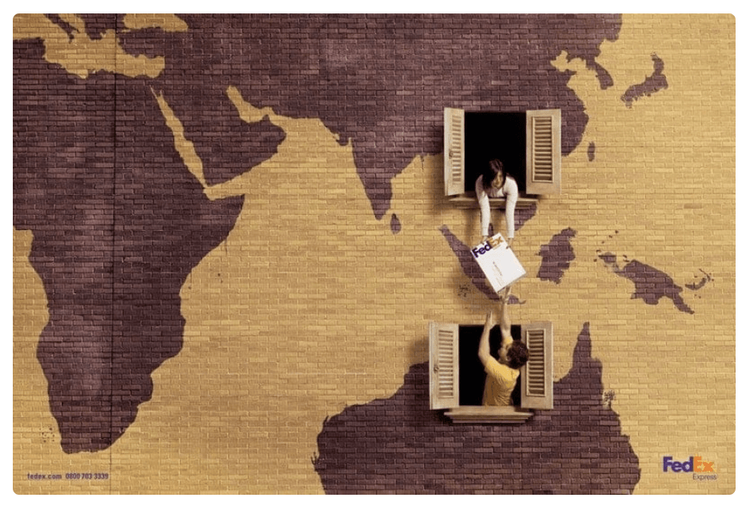
A print ad shows two people handing a package through adjacent windows. The world map on the wall behind them reveals that one window is in Asia and the other is in Australia.
The creative move
Visual metaphor. Distance and speed are compressed into a single image with no additional copy.
Why it works
The benefit of fast global delivery is communicated in one glance. There is no headline explaining the concept because none is needed.
How to adapt it
Pick one product benefit and find the most compressed visual way to show it. Pair a product image with one visual element that makes the benefit obvious without extra copy. In a static ad, this works as a before-and-after or a side-by-side contrast.
2. Volkswagen Park Assist
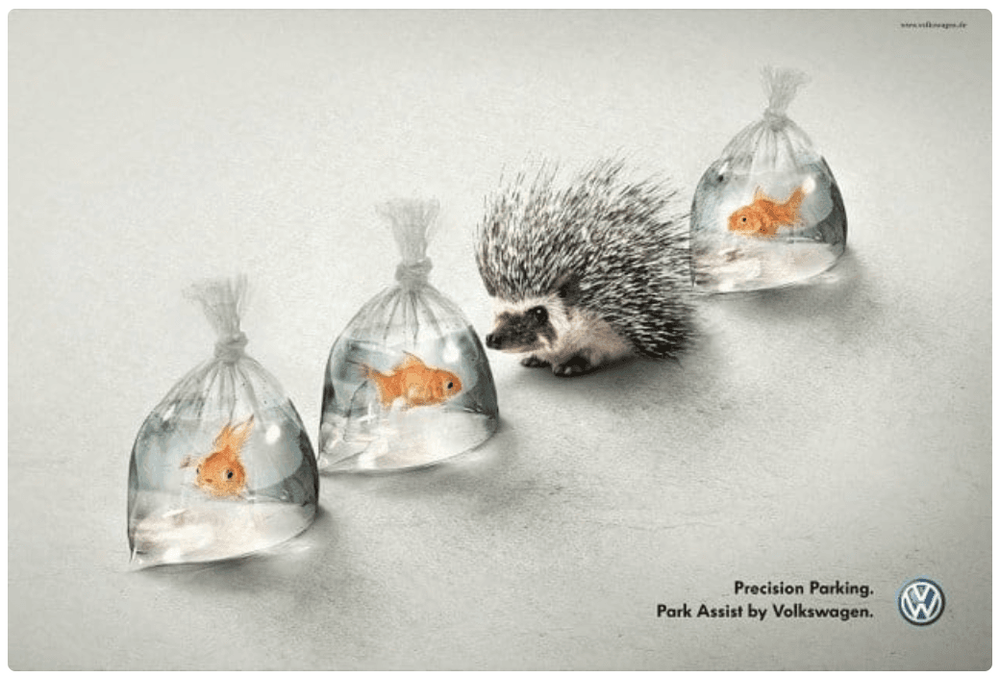
The ad shows a hedgehog standing in line with goldfish in water-filled bags. The implied consequence is immediate. The spikes will puncture the bags. Paired with the headline about parking assistance, the reader instantly pictures a car being scratched in a tight spot.
The creative move
Implied consequence. The ad never shows the problem directly. It lets the viewer complete the thought.
Why it works
Participation makes the message stick. When a viewer finishes the idea themselves, they own it.
How to adapt it
Show the risk, not the disaster. Find a visual that implies what happens if the viewer does not use your product. Stop the image one step before the consequence and let the headline land the point.
Pattern: Product Out of Context
The creative device: remove the product from its expected setting and place it somewhere surprising.
Best for: commodity products that need a fresh angle.
Budget requirement: low to medium. Styling and photography are the main cost.
Placing a product in an unexpected environment forces a fresh look at something familiar. This disruption is a direct trigger for the kind of attention that leads to recall.
3. Barilla

For a New Year campaign, Barilla arranged spaghetti into the shape of a firework against a deep blue background with the words Happy New Year underneath.
The creative move
Product out of context. The pasta is recognizable, but it is not in a bowl or a kitchen. It has become a firework.
Why it works
The unexpected placement creates a moment of delight. The brand does not need to say anything about quality or taste because the visual itself communicates creativity.
How to adapt it
Take your product and place it in a completely different visual context, a celebration, a natural landscape, a historical scene. Let the product carry the image without explanation.
4. Colgate
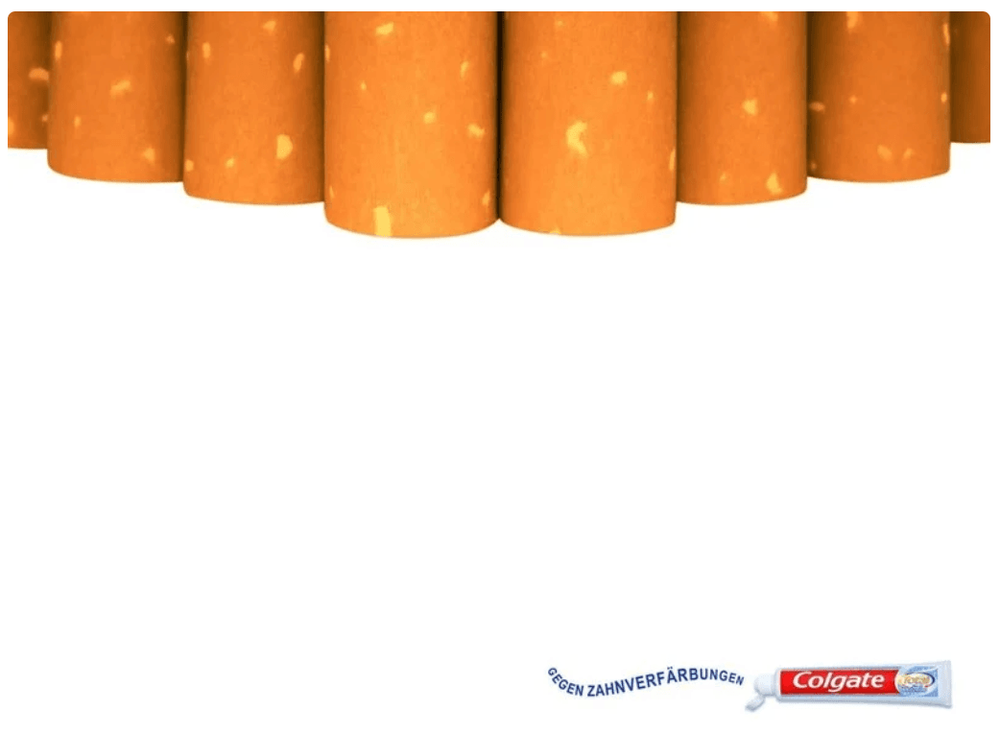
A series of print ads shows cigarettes arranged to form discolored, yellowed objects. The Colgate logo appears in the corner with a message about whitening.
The creative move
Name the problem and show the solution. The ad skips the lecture on smoking health risks and focuses only on the visible, immediate side effects it can fix.
Why it works
It does not moralize. It identifies one specific, solvable problem and points directly at the product as the answer.
How to adapt it
Narrow your problem down to the most specific version your product solves. Do not address the full category of issues. Address the one thing you actually fix, and show it clearly.
Pattern: Pop-Culture Hook
The creative device: borrow a character, reference, or format your audience already has a relationship with.
Best for: brands targeting a specific cultural community or generation.
Budget requirement: low to medium. The reference does the heavy lifting.
52.8% of consumers reported better recall for emotional ads versus only 47.2% for rational ads, according to a 2025 study published in the International Journal for Multidisciplinary Research.
5. Band-Aid
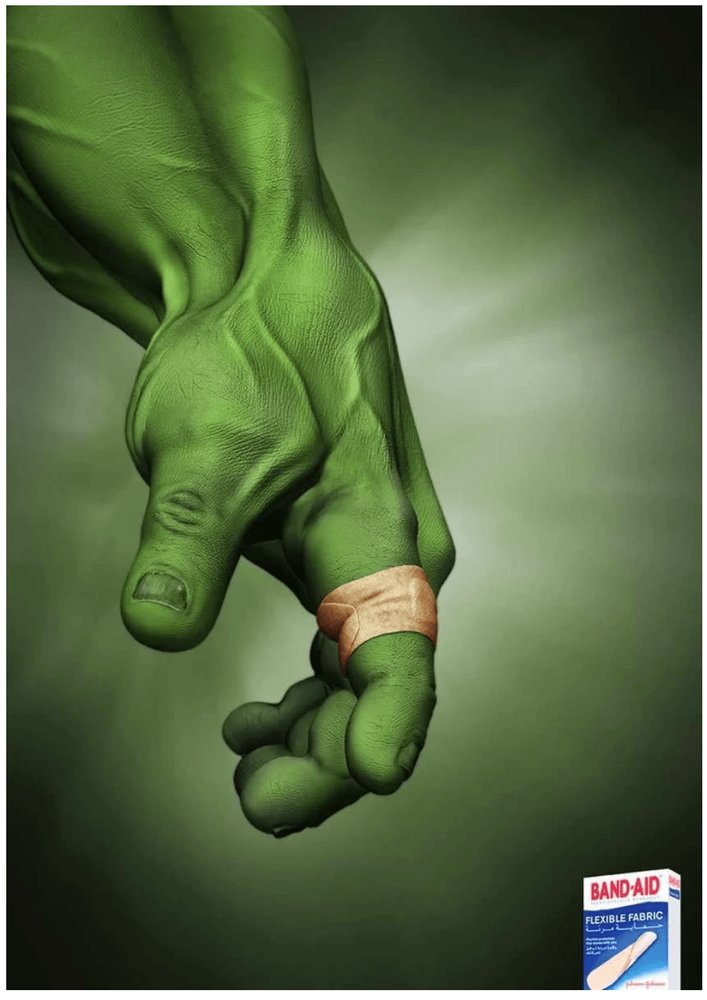
The ad shows the unmistakable fist of the Incredible Hulk with a standard skin-tone Band-Aid wrapped around one finger.
The creative move
Pop-culture hook paired with role reversal. Even the most powerful superhero is not immune to a cut finger.
Why it works
Hulk is a character with strong recognition. The ad borrows that recognition and adds a single, human detail that makes the viewer smile.
How to adapt it
Find a well-known character, archetype, or cultural moment and place your product inside it. The character should have a built-in emotional tone that transfers naturally to your brand.
Pattern: Brand Power
The creative device: withhold the expected brand completion and let the audience fill it in.
Best for: brands with an established slogan, color, or visual identity.
Budget requirement: low. The brand equity is the budget.
6. KitKat
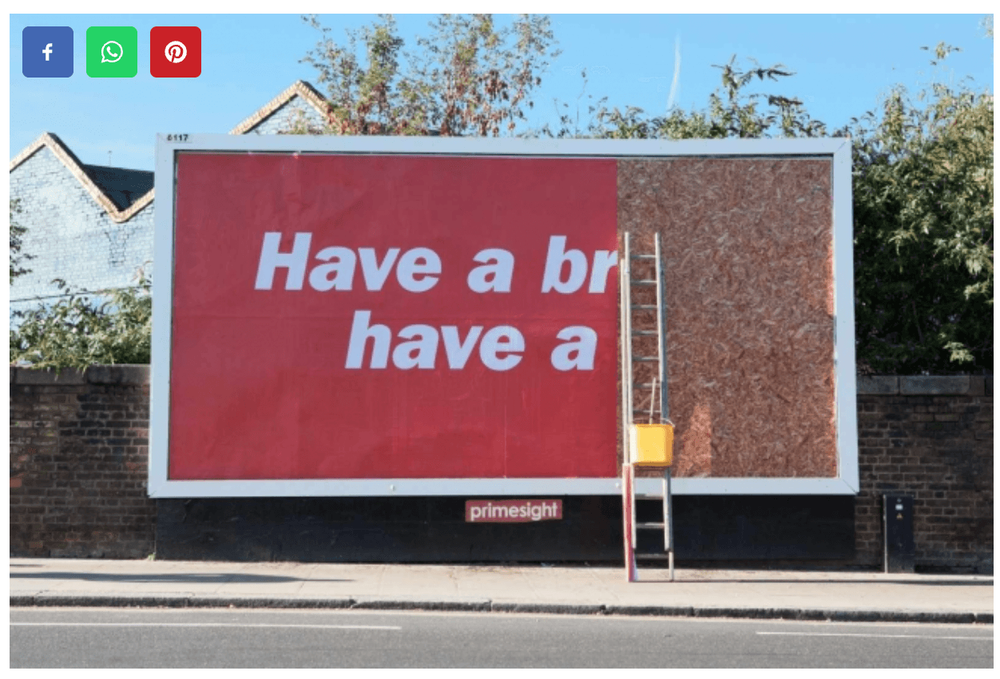
A billboard shows the KitKat slogan half-finished, as if the installer took a break before completing the job.
The creative move
Leverage established brand recall. The ad barely needs to say anything because the audience already knows the slogan.
Why it works
The format matches the message. A break in the installation process communicates "have a break" without stating it.
How to adapt it
If your brand has a recognized phrase, color, or shape, use it to say something without saying it. Interrupt the expected format and let the audience complete the thought. A consistent brand kit makes this pattern far easier to execute across every format.
Pattern: Interactive Concept
The creative device: give the viewer a choice and let the experience branch from there.
Best for: digital-first campaigns where participation can be built into the format.
Budget requirement: medium. Execution requires more planning than a static concept.
67% of marketers say interactive videos drive more engagement than traditional linear video content. 62% of viewers spend more time watching videos that allow them to make choices during playback.
Interactive ad formats have a 36% higher engagement rate than static image ads, and interactive ad spending grew by more than 27% year-over-year in 2025.
7. Hell Pizza
In 2010, the New Zealand pizza brand launched a YouTube-only ad where viewers followed a delivery driver through a zombie apocalypse by choosing which path to take at each decision point.
The creative move
Interactive branching narrative. The ad gives the viewer agency, so the experience becomes personal.
Why it works
Participation drives retention. A viewer who makes a choice inside your ad remembers the brand because they were part of the story.
How to adapt it
In paid social, this translates to carousel ads where each card offers a different version of the product or scenario, and the final card delivers the CTA based on where the viewer lands.
Pattern: Context-Aware Placement
The creative device: use the physical or digital environment as an active element of the message.
Best for: outdoor, experiential, or platform-native digital campaigns.
Budget requirement: medium to high for outdoor. Low for digital-native executions.
80% of consumers say they are likely to take action after seeing a creative or visually engaging out-of-home ad.
8. Global Coalition for Peace
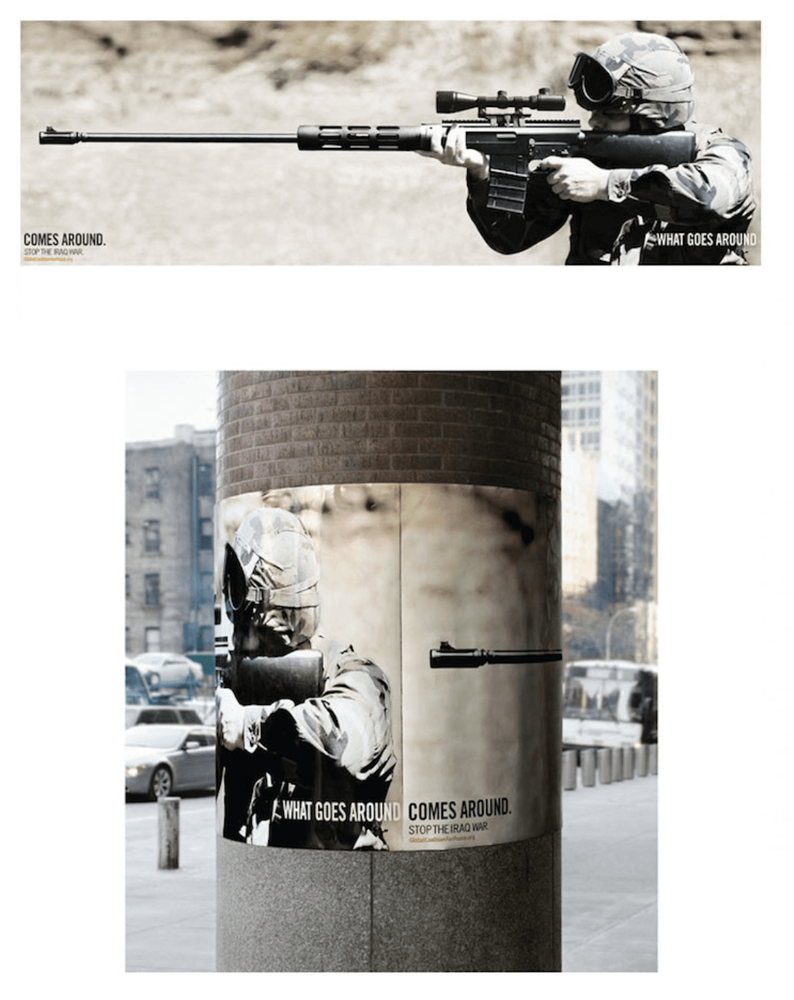
A horizontal image of a soldier aiming a sniper rifle is wrapped around a round advertising pillar. From the front, the rifle appears to point outward. From the side, it becomes clear the barrel is aimed at the soldier himself.
The creative move
Environment as message. The physical shape of the placement changes the meaning of the image.
Why it works
The message, that violence circles back to the one who starts it, cannot land in a flat format. It only works because of the cylindrical surface.
How to adapt it
In digital, this means designing for the specific platform. A concept that uses a vertical scroll reveal on Instagram Stories, or a format that shifts with user interaction, can create the same effect.
Pattern: Social Tension
The creative device: enter a real cultural conversation and take a clear position.
Best for: brands with a strong point of view and a defined audience.
Budget requirement: low to medium. Conviction matters more than production value.
9. Gillette
The ad opens with scenes of bullying, workplace harassment, and passive bystander behavior. It cuts to men stepping in, intervening, and setting a better example. The brand message ties back to its slogan about being the best a man can get, expanding it from personal grooming to personal conduct.
The creative move
Social tension paired with brand storytelling. The brand enters a real cultural conversation and takes a clear position.
Why it works
The ad forces a reaction, which earns attention. Polarizing content, when it is grounded in genuine brand values, drives disproportionate reach.
How to adapt it
Identify one cultural tension that is relevant to your audience. Take a position that fits your brand values honestly, not as a trend. Then connect that position back to the product in a way that does not feel forced.
Pattern: No Product Required
The creative device: lead with an idea, a world, or a contrast instead of the product itself.
Best for: brand-building campaigns where positioning matters more than direct response.
Budget requirement: varies. The Apple 1984 ad cost millions. The principle costs nothing.
71% of audiences can recall the brand featured in branded content without prompting, per Capital One research.
10. Apple 1984
The ad, shown once during the 1984 Super Bowl, depicts a dystopian world where a lone athlete destroys a projected image of conformity. Apple is never named. The Macintosh is never shown.
The creative move
Pure brand positioning. The product does not appear because the idea is the product.
Why it works
The ad defines the brand by contrast. IBM is the monolith. Apple is the disruption.
How to adapt it
Ask what your brand stands against, not just what it stands for. When you have a clear enemy, you do not need to show the product. You need to show the world your product pushes back against.
11. Red Bull Stratos
Red Bull sponsored Austrian skydiver Felix Baumgartner's jump from the stratosphere in 2012. He fell approximately 24 miles, broke the sound barrier without an engine, and reached 843.6 miles per hour. The event was broadcast live and covered by media worldwide.
The creative move
Brand as experience. The product is not sold. An idea connected to the product, that Red Bull gives you wings, is demonstrated at the most extreme scale imaginable.
Why it works
The event created content that could not be ignored. Every news outlet covered it. The brand received coverage it could not have bought directly.
How to adapt it
Find the most extreme, real-world demonstration of what your product enables. Commission or sponsor it. The content that comes out of it becomes your campaign.
12. Mercedes-Benz Chicken
Without sophisticated CGI, Mercedes-Benz filmed chickens with cameras mounted on them. Because chickens naturally stabilize their heads even when their bodies move, the footage demonstrated how the car stability system worked.
The creative move
Unexpected analogy. A barnyard animal explains a premium automotive feature.
Why it works
The contrast between the subject and the product creates humor and memorability. Jaguar even released a counter-ad, which doubled the original reach at no cost.
How to adapt it
Find the most unlikely real-world analog for your product benefit. The wider the gap between the analogy and the product category, the more memorable the execution.
How Creative Design Helps Ad Performance
Creative advertising is not decorative. It affects measurable outcomes at every stage of the funnel.
Video ads increase brand recall by 71% compared to display ads, which show only a 45% recall rate.
- Thumb-stop rate. A genuinely unexpected visual stops the scroll before any copy is read. This is the first metric of creative effects and the hardest to fake with polish alone.
- Value communication speed. A strong visual metaphor communicates a product benefit in under one second. A text-heavy ad cannot compete at that speed in a paid social environment.
- Offer clarity. Creative framing reduces cognitive load. When the visual does the heavy lifting, the viewer reaches the CTA with less friction.
- Brand recall. Ads built around a single, clear creative idea are more likely to be remembered after a single exposure. Brands running both print and digital campaigns together see a 31% increase in overall message recall.
- Earned reach. Campaigns with genuine creative concepts generate reactions, shares, and media coverage that extend beyond the paid media buy.
A 10% increase in average viewer focus across ad formats correlates with a 17% increase in consumer spending, underlining the financial value of engaging creative.
Brand lift and direct-response lift work differently. Brand campaigns like Red Bull Stratos build long-term recall and association. Direct-response campaigns like the Volkswagen print ad drive immediate intent.
Strong creativity helps both, but the mechanism differs. Measure them separately.
For a broader view of how these numbers stack up across channels, the advertising statistics landscape shows where creative investment tends to pay off most.
How to Adapt Big-Brand Ideas for Digital Marketing
Most of the examples above were built for TV, print, or outdoor. The pattern behind each one still applies in digital, but the format demands translation.
Video ads under 15 seconds see a 53% higher completion rate than ads over 30 seconds. Short-form video now accounts for 57% of all video ad placements in 2025.
Static image ads need the concept compressed into a single frame. The creative move must land in one image. The visual metaphor and product-out-of-context patterns are best suited here. For a full breakdown of dimensions and specs, Facebook ad sizes and specs covers every placement.
Short video ads between 6 and 15 seconds work best when they build toward one reveal. The interactive and role-reversal patterns work well here because they earn the final frame.
Carousel ads suit the interactive-concept pattern well. Each card advances a scenario and the final card delivers the CTA. Catalog carousels showcasing multiple products reach an average 1.49% CTR on Meta platforms, compared to 0.88% for single-image ads.
Paid social creative benefits most from the social-tension and pop-culture-hook patterns, which drive the highest organic amplification. A structured Facebook ads strategy helps ensure the creative concept is matched to the right audience and objective.
Brands testing 20 or more new ads per month achieve 65% higher ROAS than those testing fewer than 10.
One principle applies across all formats. The concept must survive compression. If the creative move only works at full size, at full length, or with full context, it will not perform in a digital placement. The choice between dynamic ads vs static ads often comes down to this exact question.
How to Apply Creative Ad Design to Product and Catalog Ads
You do not need a Red Bull budget to use a strong ad idea. For ecommerce teams, the real challenge is turning one visual concept into repeatable creatives across many products and offers.
Dynamic creative optimization boosts CTR by 32%. Personalized ads drive 80% higher engagement than non-personalized formats.
A single strong concept, say a product-out-of-context visual style or a consistent color metaphor, can be applied across an entire product catalog if the production system supports it. The creative decision happens once and the execution scales.
For catalog ads, the creative layer sits on top of the data layer. The visual template carries the brand concept. The product data feed pulls in the elements that vary by product, including pricing, promo badges, review scores, shipping details, and extra images.
Advantage+ Shopping Campaigns on Meta deliver 17% lower cost per acquisition than manual campaigns for brands with mature catalogs and strong creative diversity.
Some ad ideas work once. Others can be turned into a system. For ecommerce brands, that is where Cropink fits naturally. You can connect your product feed, build one visual template using dynamic templates, and generate catalog ads that pull in product data including pricing, promo badges, ratings, extra images, and shipping details across Meta, TikTok Ads, and Snapchat Ads.
A good ad idea is usually simple. The hard part starts when a team needs to apply that idea across hundreds of products without losing clarity or brand consistency. That is where creative systems matter.

CEO at Cropink
Elements worth including in a catalog ad template include the product name, logo, promo badge, regular price, discounted price, lowest price in the last 30 days, extra product images, product rating, and delivery information.
5-Point Creative Ad Design Checklist
Before publishing any creative, run it through these five checks.
- Visible in one second. Can a viewer understand the core idea without reading any copy? If not, the visual is not carrying enough weight.
- The brand cue is clear. Is the brand identifiable without a logo? Color, product shape, or tone should make the source obvious.
- Visual does the heavy lifting. The image or video communicates the benefit. Copy confirms it; copy does not lead.
- The concept survives in a static format. If it only works as a video, build a version that also works as a still. Static reach is often higher.
- One variable identified for testing. Before scaling, name the single element you will test first, whether that is the headline, visual metaphor, format, or CTA.
FAQ
What is creative ad design?
Creative ad design is the process of pairing an unexpected visual idea with a clear brand message to produce an ad that earns attention. It is not the same as visual design quality. An ad can be technically polished and creatively flat. The creative element is the idea that makes the viewer stop, not the production value.
What makes an ad creative instead of just visually attractive?
A visually attractive ad is easy to look at. A creative ad is hard to forget. The difference is the underlying idea. Creativity in advertising means finding a way to express a familiar message that the audience has not seen before. Craft supports that idea but does not replace it.
How do you design a creative ad for digital marketing?
Start with one audience tension and one creative pattern, such as visual metaphor, product out of context, or pop-culture hook. Design for the specific placement before anything else. Then check that the concept survives compression into the smallest version of the format. Interactive and video formats produce the strongest engagement numbers, but a strong idea in a static format will outperform a weak idea in a video.
What are the best creative ad ideas for brands with small budgets?
Visual metaphor, product out of context, and implied consequence are the three patterns that require the least production spend. All three rely on the idea doing the work rather than effects, talent, or locations. The Mercedes-Benz chicken campaign is a useful reference. No CGI, no celebrity, no location shoot, just a concept that transferred naturally to the product feature being sold.
How can ecommerce brands make creative product ads?
Start with one visual template that expresses a clear concept, then apply it across your product catalog. Dynamic catalog ads let you maintain a consistent creative style while automatically pulling in the product data that changes between SKUs, including name, price, promo badge, rating, and shipping details. The concept is designed once and scales from there.
How do you turn ad inspiration into a usable ad concept?
Identify the creative pattern behind the ad you admire, whether that is visual metaphor, role reversal, or context-aware placement, and then ask whether the same pattern applies to your product and your audience tension. If it does, strip everything specific to the original brand and rebuild the structure around your own brief. Looking at product ads to borrow from can help accelerate that process.
What ad formats work best for creative concepts on paid social?
Carousel ads work well for interactive-concept patterns, with catalog carousels averaging a 1.49% CTR on Meta. Short videos are best for reveal-based or social-tension ideas. Static image suits visual metaphor and product-out-of-context patterns because the idea must land in a single frame. Test the same concept across at least two formats before deciding where it performs best.
How many creative directions should you test before scaling one?
Most teams test two to three distinct creative directions at a time, not just variations of the same direction. A direction means a different creative pattern or angle, not a different headline on the same image. Brands that test Facebook ads at a rate of 20 or more new ads per month achieve 65% higher ROAS than those testing fewer than 10.
Conclusion
Good creative does not require a massive budget or a famous agency. It requires a clear idea, a pattern that fits the product, and a format that lets the concept land.
The 12 examples in this guide all started with a simple question. What is the most unexpected way to make this point? Some answered it with a metaphor. Some with a pop-culture reference. Some by removing the product entirely. The pattern was always there before the execution.
The harder part for most teams is not the idea. It is turning one good concept into a system that runs across products, placements, and audiences without losing what made it work in the first place.
If you are working on catalog or product ads, Cropink lets you build that system without starting from scratch on every SKU. Connect your product feed, set your creative template once, and let the data layer do the rest across Meta, TikTok Ads, and Snapchat Ads.
Ready to turn your next creative idea into a full campaign? Try Cropink for free and see how far one good concept can go.
Sources
- Polay Ads. The Role of Emotions in Ad Recall
- eMarketer. Marketers Lean into Storytelling Over Branded Content to Combat Ad Fatigue
- Marketing LTB. Digital Advertising Statistics 2026: 92+ Stats & Insights
- Frontiers in Psychology. Revealing Unconscious Consumer Reactions to Advertisements That Include Visual Metaphors
- International Journal for Multidisciplinary Research. The Role of Emotional Advertising in Shaping Consumer Behavior
- Zebracat. 150+ Video Marketing Statistics
- Zebracat. 250+ Advertising Statistics That Prove What Works
- Starti. Interactive Ads: The Future of Personalized, Data-Driven Brand Engagement
- StackAdapt. OOH Advertising Statistics Every Marketer Should Know
- medianug.. Maximize Ad Impact: 4 Best Practices Using Ads with Statistics
- Bestever. 5 Creative Carousel Ad Examples (and Why They Work)
- MHI Growth Engine. Meta Ads Benchmarks for Ecommerce 2026
- NCSolutions / Marketing Charts. Creative's Still the Biggest Driver of Sales
Ansherina helps brands create powerful digital marketing and performance marketing strategies. With a passion for ad design and audience engagement, she is dedicated to making brands more visible and impactful.
Leszek is the Digital Growth Manager at Feedink & Cropink, specializing in organic growth for eCommerce and SaaS companies. His background includes roles at Poland's largest accommodation portal and FT1000 companies, with his work featured in Forbes, Inc., Business Insider, Fast Company, Entrepreneur, BBC, and TechRepublic.
Related Articles

How Can Cropink Help?
Start with Cropink is easy and free
No credit card required