Facebook Ads Library: How to Use It to Spy on Any Competitor
All ads that your competitors are running on Facebook are publicly searchable. This guide shows you how to find them, what to analyze, and how to turn that research into better ads for your brand.


There’s no shortage of brands running ads on Facebook. In fact, 91% of marketers use the platform, and for 40% of them, it’s the most profitable one they have.
That tells you two things. One, your competitors are here. Two, they’re making money from it.
Facebook Ads Library is Meta's free tool for searching every active ad across Facebook, Instagram, and Messenger by brand, keyword, or product.
In this guide, you'll learn how to search the library effectively, which filters to use, what to look for in competitor ads, and the library limitations to know about.
Key takeaways
- The Facebook Ads Library lets you filter active ads across Meta's platforms by advertiser name, product keyword, or target market, so you can zero in on what competitors are running.
- The most actionable insights from the FB ad library will come from identifying repeated formats, messaging angles, and CTAs across multiple competitors, as these patterns show what's already resonating with your target audience.
- The ad library shows you the ads that are running, not if they’re effective. Metrics such as CTR, conversions, and spend are unavailable.
What is the Facebook Ads Library?
The Facebook Ads Library, also known as Meta Ads Library, is Meta’s way of giving users more transparency into the ads across the Meta ecosystem. It shows every active ad running across Facebook, Instagram, Messenger, and Meta’s other platforms.
For advertisers, this is a great resource for understanding the types of ads companies in your industry are creating. You can spot messaging patterns, study your competitors’ creative strategies, and even find content gaps to explore in your ad messaging.
However, Facebook Ads Library does not give you any insights into performance metrics or spending. You’ll need a 3rd party spy tool to access that data.
Access the ads library here: facebook.com/ads/library
Each ad listing on the ad library gives you helpful details like:
- Library ID — the unique identifier for that specific ad
- Active status — whether the ad is currently running or turned off
- Start date — when the ad first went live
- Platforms — where the ad is being shown (Facebook, Instagram, etc.)
- Creative variations — if a brand is testing different creatives for the same ad
- Ad content — image or video, the full copy, and the CTA
The example below shows you what an ad looks like on the FB Ads Library.
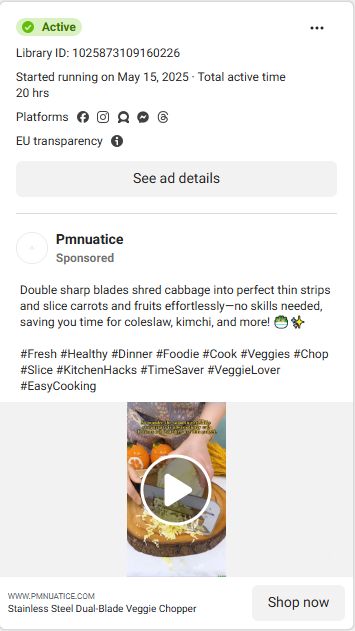
Clicking an ad opens a pop-up with more details, such as the full caption and headline. If the ad targets users in the EU, you’ll see additional data, such as age, gender, and location targeting.
This level of competitive intelligence typically costs thousands with paid tools, but Meta offers it for free.
How to use Facebook Ads Library
Most people use the library for competitor research, but you can also use it for ad inspiration, market trends, or positioning ideas.
If you're looking to spy on competitors (and you should be), here's how to do it effectively:
1. Choose the region and category
Start by selecting the region you want to target. For example, if you’re in the US but trying to break into the UK market, choose the UK. This will ensure you see what local competitors are running.
Next, set your category.
Unless you fall under Meta’s special categories like politics, housing, employment, or finance, it’s best to leave it as ‘All.’
2. Search by advertiser, keyword, or product phrase
One of Facebook Ads Library's main strengths is that you can search for ads by brand name, keyword, or product.
- Search by advertiser’s name when you already have a good idea about who your competitor is. When you enter their name in the search bar, it will show all the active ads they have running. It’s a good place to start when you need more insights into a competitor’s ad strategy. You’ll be able to spot the ad variations they have, their creative strategy, offers, etc.
- Searching by keyword is better when you’re conducting broader marketing research. Usually, searching this way shows you ads that include that keyword in their copy or headlines. You’ll find this method handy when you want to learn how the market positions a certain keyword. When you’re more interested in the copywriting side of your ads, this is the best way to search the ads library.
- The final method is searching by the product phrase. This method gives you access to ads with that exact product. For example, if you search for a posture corrector, most ads will be selling that item. With this method, you’ll be able to see the product angles, ad formats, offers, and imagery that competitors are using.
3. Filtering your Facebook Ads Library search
Once you’ve searched by keyword, you can refine your results using filters.
Meta lets you filter only these six attributes:
- Language
- Advertiser
- Platform (Facebook, Instagram, Messenger, etc.)
- Media type (video, image, or no media)
- Active status
- Impressions by date range

4. Analyze the ads
Now that you’ve filtered by location, category, and searched the product or keyword, it’s time to make sense of what you’re seeing.
Primarily, you want to focus on the creatives used, how long the ads have been running, and targeting information if available.
Look at how many ads are showing up. If it’s just a few, it might mean your keyword is too specific. If there are lots, it’s a sign that you’re in a competitive space.
You should also analyze how recently the ads were launched.
Newer ads show what’s currently trending. Older ads that have been running for weeks or months may indicate they’re performing well, since most advertisers won’t keep spending on ads that aren’t working. However, supplement that data with performance metrics for a more transparent idea of whether an ad works.
Now it’s time to get into the specifics.
Use this five-step process to dissect the ads you get from the Facebook Ads Library.
Check what ad format is prevailing
Are the ads mostly videos, carousels, or single images? This tells you what formats brands in this space are betting on. For example, if most ads are short videos, that’s a strong clue that video is converting well for this product.
Pay attention to the quality of the visuals, too. Are they polished and studio-shot, or raw and user-generated? Do they show the product in use, or just list features? All these questions will help you understand what content resonates with your target market.
Study the hooks
What does the ad lead with in the first line of copy or the first two seconds of video? Are the ads leaning more toward a pain point, or are they leading with a product demo? If you notice there’s a prevailing hook, note it down and test it with your own ads.
Read the copy like a buyer, not a marketer
Look at the language in the headlines and primary text. What benefits are being highlighted?
Don’t forget to make a note of any patterns you see. If multiple ads are repeating the same phrases, that’s probably a pain point worth noting.
Also, pay attention to the length of the ad copy. Is it short and punchy, or longer and story-based? This tells you a lot about how much education the buyer needs before they take action.
Check the call to action
Study what most ads are asking people to do. Are CTAs saying ‘Shop now,’ ‘Learn more,’ or ‘Buy Now’? This gives you a sense of how aggressive or soft the pitch is in this space.
What is the offer?
It’s also important to analyze how your competitors are trying to win over customers. Look at whether it’s more discount codes, one-get-one-free offers, free shipping, or guarantees like money-back. This information will play a huge role in whether you create ads that are compelling enough for customers in your industry.
Don’t forget to analyze what the final destination of the ad is.
If most ads lead to a product page directly, it tells you that the buying process might be simple and fast. If they lead to longer landing pages or quizzes, it might mean customers need more convincing before buying. Use this information to help map your own buyer journey.
A 5-step competitor ad tracking worksheet for Facebook Ads Library
Use this tracking worksheet to log each ad you review. Fill in one row per ad, and aim to cover at least five to ten ads before drawing conclusions.
You can use the notes column to record an unexpected angle, a claim no one else is making, or a creative format that stands out from the rest of your results.
| Advertiser | Format & Style | Hook | Offer | CTA | Landing Page | Notes |
|---|---|---|---|---|---|---|
| Brand A | Short video, UGC | Pain point ("tired of...") | 20% off, limited time | Shop Now | Product page | Running 6+ weeks, likely converting |
| Brand B | Static image, polished | Product demo | Free shipping over $50 | Learn More | Long-form landing page | Long copy; audience may need educating |
| Brand C | Carousel, studio-shot | Bold claim ("the last X you'll ever buy") | Bundle deal | Buy Now | Quiz funnel | Testing multiple creatives simultaneously |
Facebook Ads Library in action: Two search results examples analyzed
Here are the ad results we get when we search for the keyword ‘vegetable chopper’.
Read on to see what we can learn from it.

- Video is the dominant format. Every ad in the first two rows is a short video. That tells us that video converts, or at least performs best for this product.
- The messaging is focused on saving time and avoiding hassle. Every ad immediately starts with a pain point, then offers the product as a fast, mess-free solution. This tells us the audience cares about efficiency, versatility, and cleanliness. If you were selling a similar product, you’d want to test those same angles.
Let's see another example, this time from the cosmetics industry.
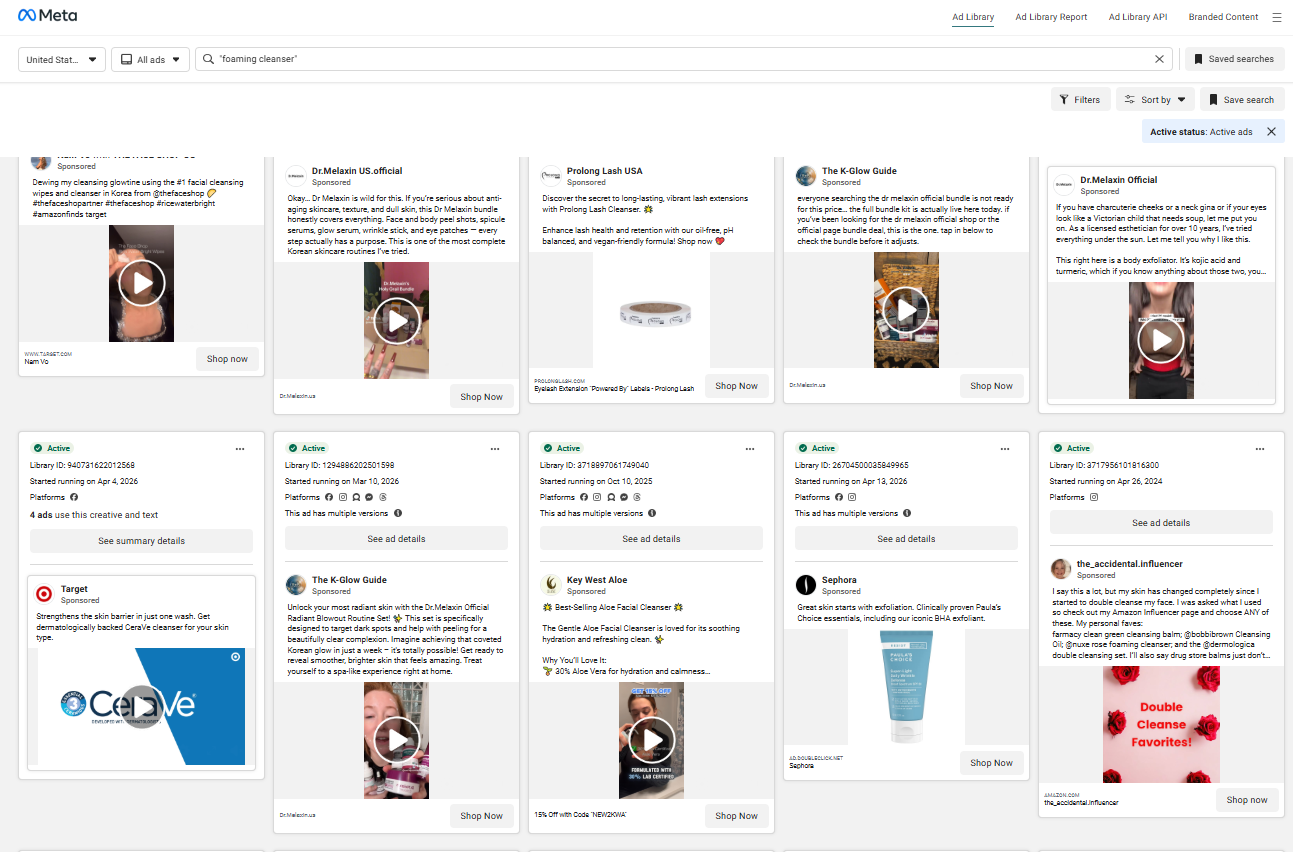
- Video is still the dominant format. These videos are mostly UGC-style, but you’ll still come across polished brand content like those two from Sephora and CeraVe.
- Advertiser mix: There's a notable mix of large retail brands (Target, Sephora) and smaller DTC skincare brands (Dr.Melaxin, Key West Aloe, Prolong Lash). It shows this is a high-competition keyword, with established players and smaller brands competing for the same audience.
- Hook patterns are leaning more toward credibility signals. Most ads include phrases like ‘clinically proven,’ ‘licensed esthetician for over 10 years,’ ‘dermatologically backed,' etc., in their copy. That tells you that audiences in this industry typically need to trust you before they can buy.
- CTA is direct and to the point. I clicked on the CTA buttons, and most led to the product page with the option to purchase immediately. It suggests that a short, direct path to purchase is the norm in this category.
Step one is to reverse engineer high-performing ads. If you see an ad that's getting a ton of engagement, don't just copy it. Recreate the formula so it works for your audience. To do this, look for common patterns across multiple ads. Look at their storytelling, their social proof, whether they're creating urgency, and the creatives they’re using. Once you spot the patterns, use them as your blueprint for your ads.

Bridget O’Rourke, Content Strategist at HubSpot Marketing
These two products are just tiny examples of what you can get from the Facebook Ads Library.
If you want more details, click each ad and study its targeting and creative elements. Details, such as reach and demographics, are only visible if the brand is running ads in the EU region.
The alternative is to use 3rd-party Facebook ad spy tools, which usually include performance and engagement details.
Don’t forget to save your search. If you plan to revisit a product or keyword later, hit the ‘Save Search’ button at the top right and name your search so it’s easy to find later.
Turn competitor insights into catalog ads faster
Let's say your FB ads library research shows that ads in your industry contain polished visuals, prominently feature the product image, and include a discount. Your next step is to create an ad that follows that pattern while keeping your unique selling point intact.
You can start from scratch, of course, but if you want to create multiple ads quickly, it's best to use an enriched catalog ads creation platform, such as Cropink.
Head to cropink.com/templates and choose a template that matches the conditions you spotted.
The example below is an excellent starting point since it has a prominent product, a polished look, a discount code, and an extra description box for your USP.
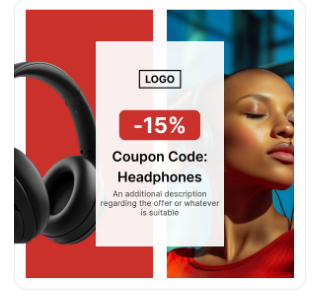
You can also use Cropink's design editor to swap in your logo, adjust the color palette to match your brand, update the discount value, and pull in the right product images.
Since the Cropink connects directly to your product feed, every product gets an ad that follows the same structure, with the correct image, price, and details automatically pulled in.
As you test the ads you're creating, use your performance data plus the insights from the library to keep refining your ad templates in Cropink. Using this formula will guarantee that you never run out of Facebook ad ideas because you have insights from the ad library and Cropink to help you scale and test multiple ad versions.
Ads Library is useful because it shows what messages and formats brands are betting on right now. But the real leverage comes later: once you spot a pattern, you need a fast way to turn that insight into repeatable creatives across your catalog.

CEO at Cropink & Feedink
Facebook Ad Library use cases
How do you actually use the Facebook Ads Library for your business? These are our top five ways to use this Meta Ads Spy tool.
1. Competitor intelligence
Stop guessing what your competitors are up to with their Meta ad strategy. You can filter the library by their business name and see exactly what they're running right now. You can get data on:
- Active ads and when they launched
- How many creative versions they are testing
- Which platforms they're running on (Facebook, Instagram, Messenger, etc.)
- Ad copy, visuals, and CTAs
- Age, gender, and location targeting (EU-targeted ads only)
2. Fill in the gaps
Sometimes the most valuable insight isn't what everyone's doing but what they're missing. Check to see which gaps your competitors are not addressing. This mostly applies to ad creatives, such as copy, videos, or images.
Doing so will give you untapped messaging opportunities that often lead to lower CPCs and higher conversion rates because you're addressing a need your competitors are ignoring.
3. Ad inspiration
When you’re low on ideas, use the Facebook Ads Library to study active ads in your industry and the prevailing patterns that competitors are using. It’s an easy way to find fresh concepts and adapt them for your brand.
4. Improve your product positioning
What words and phrases are your competitors using in ads? Which benefits are they highlighting? What pain points are they mentioning the most?
The patterns you spot in the library will tell you how the market is already framing a product and where there might be room to position yours differently.
5. Get a better understanding of your own ads
The Facebook Ads Library is super useful when analyzing your own ads, since you can see all your active Meta ads at once. You’ll be able to quickly see which formats, hooks, and creatives your brand uses the most. And when you pair it with your performance data, you’ll know whether your efforts are yielding a profitable ROI.
What Facebook Ads Library can and cannot tell you
The Facebook Ads Library is a great resource, but it has several limitations.
It’s useful when you just want to analyze the creative and messages, and for understanding how long brands run their ads. You can also access the demographics that ads are targeting if they are running in EU locations.
However, the library does not provide performance metrics such as CTR, CPA, or ROAS. You’ll have to use a paid third-party tool to access these metrics.
The filter system is also limited, as you cannot filter by impressions or industry.
FAQs
Is Facebook Ads Library data accurate and updated in real-time?
The Facebook Ads Library pulls data directly from Meta’s ad system, so it’s accurate and regularly updated. New ads typically appear within 24 hours of being published.
How can I use Facebook Ads Library to find winning products?
Search product-specific keywords and analyze which ads have been active the longest. Pay attention to recurring ad angles, formats, and messaging. Products with multiple active creatives or longer run times are usually worth investigating.
Is Facebook Ads Library the same as Meta Ads Library?
Yes, Meta Ads Library is just another name for the Facebook Ads Library.
Can I search Facebook Ads Library by keyword or only by advertiser name?
You can search the ad library by advertiser name, keyword, or product.
Can I see inactive ads in Facebook Ads Library?
By default, Facebook shows only active ads. However, you can remove that filter to see inactive ads that competitors ran before.
Can I see how well a competitor’s ad is performing?
No, Facebook does not provide performance metrics for ads in its library.
How do I use Facebook Ads Library to find competitor ads in my niche?
Search the library using keywords and product names relevant to your niche. This pulls up every advertiser currently running ads around those terms, which gives you a direct view into who is competing for the same audience.
What is the difference between Facebook Ads Library and a paid ads spy tool?
The Facebook Ads Library is free, and it does not provide performance data. However, many paid tools, such as Minea and BigSpy, provide more detailed performance and engagement data in their ad libraries.
Explore more ways to improve your Meta ads:
- 7 Facebook Ads Spy Tools
- Facebook Ads Cost
- Frequency Facebook Ads
- Facebook Ads CTR
- Facebook Dynamic Product Ads
- Facebook Catalog Ads
Final thoughts
The Facebook Ads Library is no doubt a powerful source for ad inspiration, but it’s only the first step to creating converting ads.
Once you've done the hard part of uncovering patterns and messages, don't waste that intelligence by starting your creative process from scratch.
Cropink can help you create high-converting Meta ads faster and more easily with ready-to-use templates and smart catalog tools that bring your ideas to life.
Turn your competitive intelligence insights into your advantage.
Try out the free forever plan and see how much faster you can go from Facebook Ads Library research to live campaigns with Cropink.
Sources
- Cropink. Business on Facebook Statistics
- Meta. Facebook Ads Library
- Cropink. Best Facebook Ads Spy Tools
- HubSpot Marketing. How to Spy on Your Competitors' Facebook Ads (Step-by-Step)
Damaris is a Digital Marketing Specialist who writes about digital marketing and performance marketing. At Cropink, she creates data-driven content to help businesses run better ad campaigns for better performance and ROI.
Leszek is the Digital Growth Manager at Feedink & Cropink, specializing in organic growth for eCommerce and SaaS companies. His background includes roles at Poland's largest accommodation portal and FT1000 companies, with his work featured in Forbes, Inc., Business Insider, Fast Company, Entrepreneur, BBC, and TechRepublic.
Related Articles


How Can Cropink Help?
Start with Cropink is easy and free
No credit card required