8 Brilliant Product Ad Examples to Steal Ideas From
Coca-Cola generated 12 million+ media impressions with Share a Coke, Dove doubled global sales between 2004 and 2007, and Dollar Shave Club attracted millions of views with a single launch video. Learn what made these product ads memorable and how to apply the same thinking to your own campaigns.


Some ads are so good that they are unforgettable, no matter how many years have passed.
For example, Share a Coke campaign generated more than 12 million media impressions, Old Spice's 'The Man Your Man Could Smell Like' caused a 60% YoY sales increase, and Dollar Shave Club's 'Our Blades Are F**ing Great' was so witty it broke their site and brought in 12,000 orders in the first two days.
Was there a secret ingredient to these ads, or did these brands understand their customers well enough that they saw themselves in the ad?
This mini case study takes you through eight product ads examples from well-known brands and what you can borrow for your own campaigns to make them just as memorable.
| Example | Main idea | Lesson to borrow | Best for |
|---|---|---|---|
| Always — #LikeAGirl | Challenged a belief that girls had grown up hearing | Build your campaign around a belief, fear, or frustration your audience already has. | Brands with products tied to identity, confidence, or lifestyle |
| Coca-Cola — Share a Coke | Turned a bottle into a personal experience | Give people a reason to interact with your product. | Personalized products, gifting, seasonal campaigns |
| Old Spice — The Man Your Man Could Smell Like | Used humor to reach the person shopping for the product | Speak to the person making the shopping decision, while keeping the end user in mind. | Household products, gifts, family purchases |
| Snickers — You're Not You When You're Hungry | Connected the product to an everyday situation | Tie your product to a moment your audience experiences regularly. | Convenience products, food, beverages, and everyday essentials |
| Dove — Real Beauty | Joined a conversation that its audience already cared about | Start with a customer problem, then show how your product fits into it. | Lifestyle and personal care brands |
| Absolut — Bottle Campaign | Repeated one recognizable visual for decades | Find one recognizable brand element and use it consistently. | Brands building long-term recognition |
| Amazon — Alexa Lost Her Voice | Showed what life would be like without the product | If customers already understand your product, demonstrate its value in an unexpected way. | Well-known products and established brands |
| Dollar Shave Club — Our Blades Are F**ing Great | Used humor to challenge an overcomplicated category | Use humor to make your product feel refreshingly simple next to competitors. | Challenger brands, startups, DTC ecommerce |
What Are Product Ads?
Product ads promote a product or product line and give customers a reason to buy, try, compare, or remember it.
Unlike brand ads, which build awareness and trust in a company, product ads help show customers why they should choose a product. They can appear as social media ads, search ads, display ads, video ads, product listing ads, or catalog ads.
Famous product ad examples include Coca-Cola's Share a Coke, Snickers' "You're not you when you're hungry," and Dollar Shave Club's launch campaign.
Use product advertisements when you need to:
- Increase sales
- Encourage product trials
- Differentiate products from competitors
- Keep products top of mind for future purchases
Unforgettable product ad examples to learn from
Product ads can be as simple as showing a product with a price discount or as ambitious as encouraging people to search through stacks of Coca-Cola bottles to find one with their own name or the name of someone they care about.
The product advertising examples below show how brands have made ordinary products more desirable, memorable, or interesting enough to talk about.
You'll also learn why each campaign worked and what you can borrow for your next product advertising campaign.
1. Always #Like a Girl
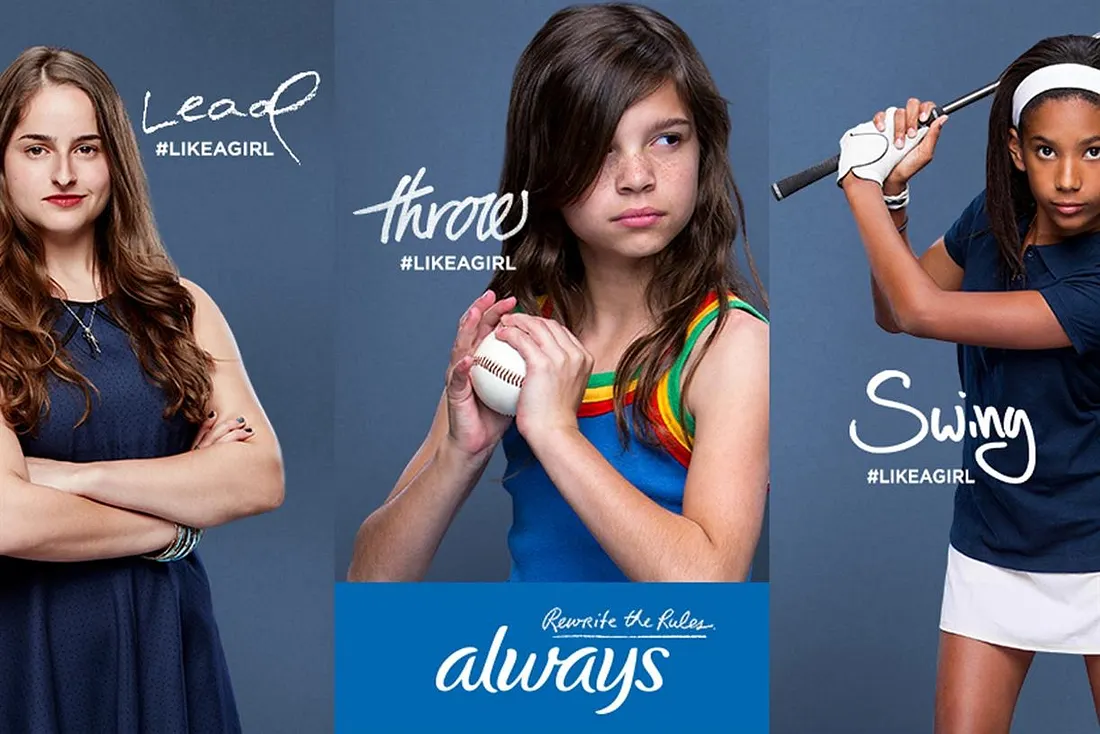
Always used #LikeAGirl to challenge a phrase that had become an insult. The campaign did not promote sanitary pads directly. It made the brand part of a conversation its audience already cared about.
The idea was inspired by findings highlighted by Leo Burnett, the advertising agency behind the campaign.
Judy John, CEO and CCO of Leo Burnett Canada, explained that girls' confidence drops significantly during puberty, much more than boys', and many do not regain it until much later in life. Since girls entering puberty are one of Always' primary audiences, the campaign addressed a challenge they were already experiencing.
The ad drew inspiration from everyday phrases many girls grow up hearing, such as, 'You throw like a girl,' 'You run like a girl,' and 'You cry like a girl.' The idea was to change the meaning of the phrase from an insult into something positive.
Launched in 2014, the campaign became one of Always' most recognizable advertisements.
According to Always, 94% of girls surveyed said the campaign helped them feel more confident, and three times as many associated the phrase 'like a girl' with something positive after seeing the ad.
What to borrow: Find the belief, fear, or frustration connected to your product category, then make that tension the heart of your campaign. It will give people a reason to relate more to your brand and, in extension, your product.
2. Coca-Cola's Share a Coke campaign
By 2011, Coca-Cola Australia had a problem.
Half of young adults and teens had not bought a Coca-Cola in the previous month, and the brand was struggling to remain relevant with younger consumers.
Working with Ogilvy, the brand launched the Share a Coke campaign, where Coca-Cola replaced its logo with more than 150 of the country's most popular names. The campaign encouraged people (especially young people) to find a bottle with their own name or the name of someone they cared about.
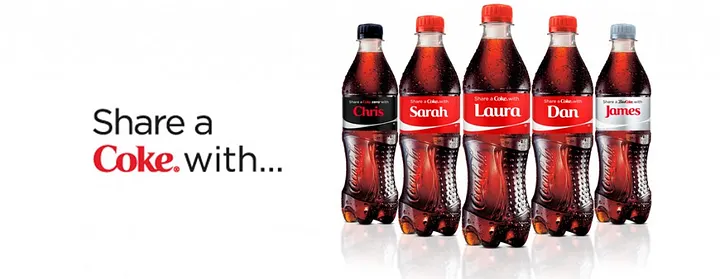
As the campaign expanded worldwide, each market received its own list of names to reflect its local audience.
The product campaign became a treasure hunt.
People searched through supermarket shelves looking for their names, bought bottles for friends and family, and shared photos online. Coca-Cola kept the momentum going by introducing kiosks where people could print custom bottles. The queues stretched for hours, and the results show it was a huge hit.
- 870% increase in Facebook traffic
- More than 12 million media impressions
- More than 378,000 custom Coke cans printed
- 7% increase in young adult consumption within three months in Australia
- 3% increase in transactions
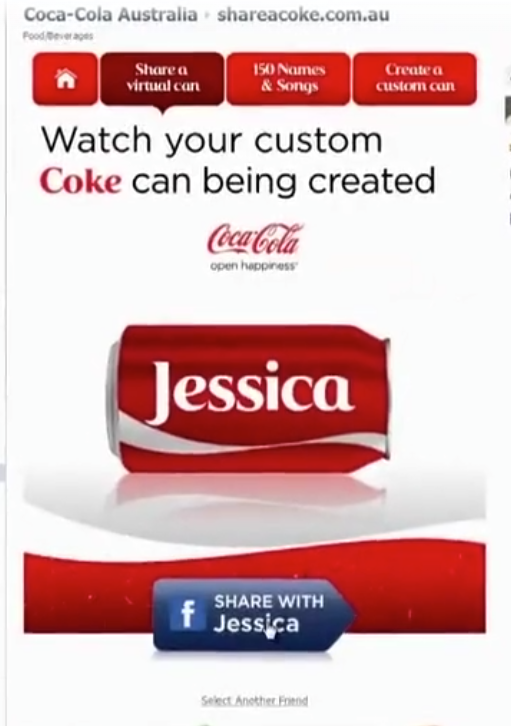
The original digital version of the campaign.
What to borrow: Give customers a reason to interact with your product aside from buying it. Coca-Cola turned finding a bottle into part of the experience. For you, think about what people can search for, collect, customize, or share. Those instances will give customers another reason to engage with your product and another reason to talk about it.
3. Old Spice 'The Man Your Man Could Smell Like'
Old Spice launched 'The Man Your Man Could Smell Like' in February 2010 to promote its Red Zone After Hours Body Wash. The campaign starred actor and former NFL wide receiver Isaiah Mustafa, who was introduced as an over-the-top, confident character.
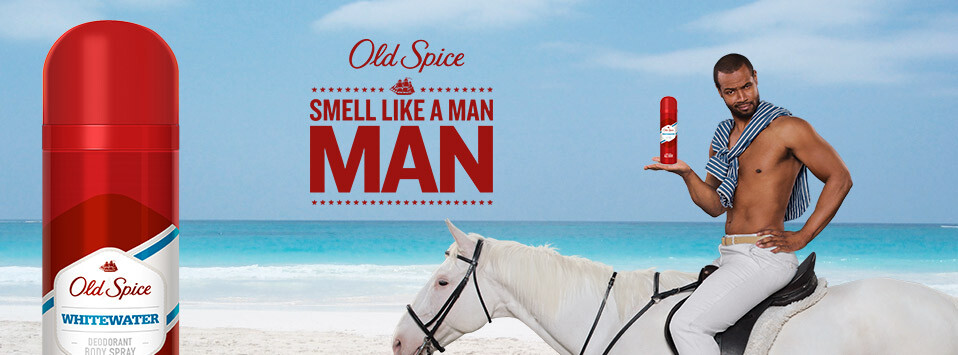
One of the campaign's smartest decisions was targeting women.
Wieden+Kennedy, the agency behind the campaign, identified that women accounted for around 60% of body wash purchases.
The creative was written to appeal to the person shopping for the product while still keeping the man using it at the center of the story.
The campaign first launched online during Super Bowl weekend before expanding to television.
The brand also released personalized video responses to fans on social media, giving the campaign a second wave of attention.
Before long, the Old Spice commercials were being referenced and parodied across television, online platforms, and pop culture, including Sesame Street.
The campaign delivered far more than Old Spice had planned:
- The original sales target was a 15% increase.
- By May 2010, sales of Old Spice Red Zone Body Wash had increased 60% year over year.
- By July 2010, sales had doubled.
What to borrow: Know who makes the buying decision. The person using your product is not always the person paying for it. When those audiences differ, your message should speak to the buyer while keeping the user part of the story.
4. Snickers 'You're not you when you're hungry'
'You're not you when you're hungry' is one of the most recognizable product advertising slogans ever created. Launched during Super Bowl XLIV in 2010, the campaign turned a common experience into a memorable reason to buy a Snickers bar.
The creative team started with one truth: hunger changes how people think and behave.
They then connected that observation to the product by showing people acting completely out of character until they ate a Snickers. In the campaign, the product was positioned as the answer to an everyday problem that almost everyone has experienced.
Everyone already knew Snickers, so we didn't need simple brand awareness: we needed fame. … We concluded that driving fame—in particular, getting more and more people talking about the brand—would deliver penetration growth and drive sales.

Global Head of Strategy for Mars at BBDO
That thinking influenced the entire campaign. One 30-second Super Bowl commercial starring Betty White generated 91+ days of media coverage. It kept people talking about the brand long after the game ended.
The idea was flexible enough to work across different markets.
While the message stayed the same, the people appearing in the ads changed to match local audiences and cultural references, which helped the campaign stay familiar and the core idea intact.
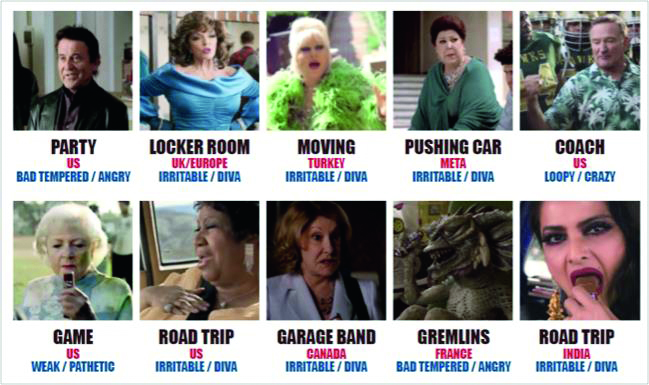
Like other product ads examples in the list, this campaign gained impressive traction as well.
- More than 91 days of media coverage from a 30-second commercial
- Global sales increased by 15.9% in the first full year
- Market share grew in 56 out of the 58 markets where the campaign launched
- The campaign contributed to an additional $376 million in Snickers sales over two years
What to borrow: Connect your product to a situation your audience already experiences. The best product ads make your product the first thing people think about when a familiar moment happens.
5. Dove Real Beauty Campaign
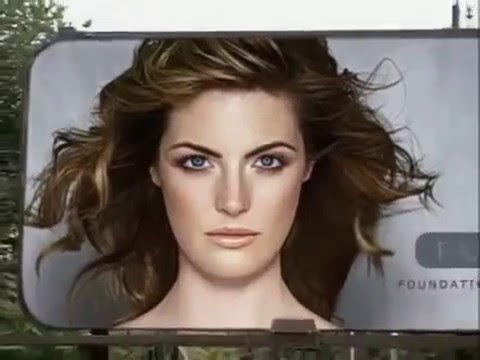
The Dove Real Beauty Campaign differs from most examples on this list. It is primarily a brand campaign, created to reshape how people think about beauty and the values Dove stands for.
At the same time, it supported Dove's growing range of personal care products, so it’s a useful example of how brand advertising can strengthen product demand.
The campaign launched in 2004, following Dove's commissioned research that found that only 2% of women considered themselves beautiful. That data became the foundation for a long-running series of campaigns that challenged narrow beauty standards and celebrated women of different ages, body types, and backgrounds.
Over the years, Dove continued building on the same idea through campaigns such as Evolution (2006), which revealed how heavily beauty images are edited before reaching the public, Pro-Age (2007), featuring unretouched women over 50, and Real Beauty Sketches (2013), where women discovered they viewed themselves far more critically than strangers did.
More recently, Dove pledged not to use generative AI to create or alter images of real women in its advertising.
The campaign earned widespread attention and was able to achieve:
- More than $150 million in earned media
- Evolution received 1.7 million views in its first month, becoming YouTube's most-watched video in October 2006
- Dove's global sales grew from $2 billion to $4 billion between 2004 and 2007
What to borrow: Find the challenge your customers experience before they start shopping. Dove recognized that many women struggled with unrealistic beauty standards and then ran years of campaigns based on that understanding. Your campaign will feel more relevant when it starts with a real customer problem instead of product features.
6. Absolut Vodka: Absolut bottle campaign
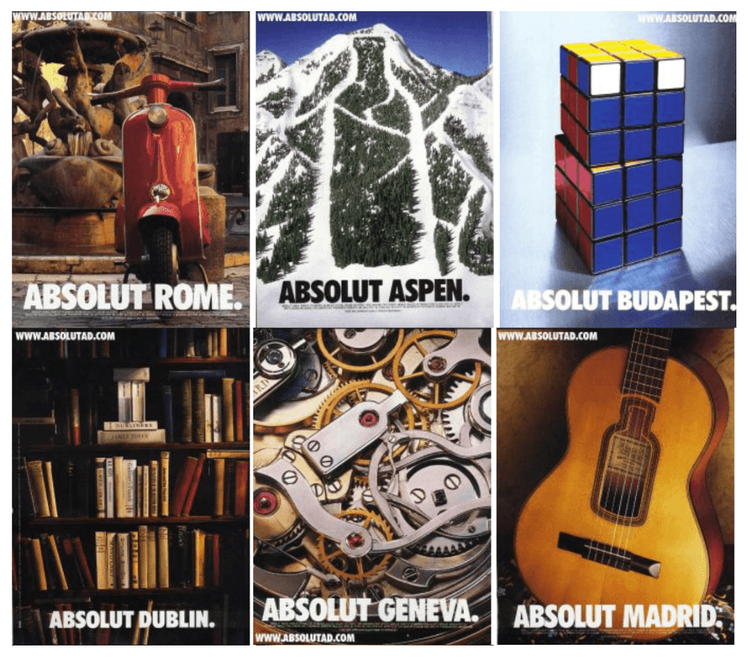
Most advertising campaigns have a short lifespan. Not Absolut. Their bottle campaign ran for more than 25 years and produced over 1,500 variations, and it never lost its identity.
Absolut’s idea was remarkably simple.
Rather than changing its message every year, Absolut kept returning to the same bottle shape and found new ways to place it in culture, current events, cities, and art.
The bottle became the hero of every ad.
One of the best-known examples is 'Absolut Budapest,' where the bottle takes the form of a Rubik's Cube, paying tribute to Hungarian inventor Ernő Rubik. Other ads used landmarks, holidays, pop culture, and local traditions.
The campaign helped transform Absolut from a relatively unknown vodka brand outside of Sweden into one of the world's best-selling premium vodkas. In fact, US sales grew from 10,000 cases in 1980 to more than 4.5 million cases a year by 2000.
What to borrow: Find one thing people instantly recognize about your product, then keep finding new ways to use it. It can be your packaging, logo, product shape, signature color, or mascot.
7. Amazon Alexa: Alexa Lost Her Voice
How do you advertise a voice assistant that millions of people already know?
Amazon answered that question by taking Alexa's voice away.
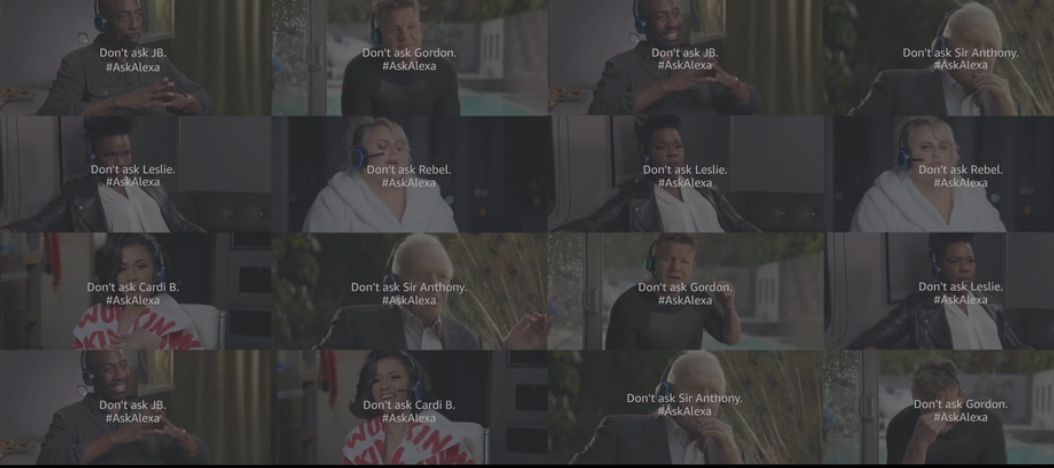
Released during the 2018 Super Bowl, the ad opens with Alexa losing her voice, leaving Amazon scrambling for (not-so-effective) replacements.
Gordon Ramsay insults people asking for cooking advice, Cardi B happily overshares, Anthony Hopkins terrifies anyone looking for reassurance, and Rebel Wilson turns ordinary requests into uncomfortable conversations.
Each celebrity fails, reminding viewers what Alexa normally does so well.
The Super Bowl commercial was only the start.
Amazon kept people engaged with more than 200 pieces of social content and hidden Easter eggs that encouraged fans to keep sharing and talking about the campaign.
The campaign generated massive attention:
- More than 1.5 billion media impressions
- More than 1 million Easter egg interactions
What to borrow: Don't feel like you have to explain every product feature. If customers already understand what your product does, look for an unexpected way to demonstrate its value. Sometimes showing the opposite creates a more convincing impression than showing the product working perfectly.
8. Dollar Shave Club: Our blades are F**n Great
Dollar Shave Club launched in 2012 with a product most people would call ordinary. Competing with established razor brands meant the company needed a product introduction that people would remember and relate to.
The launch video did exactly that.
Founder Michael Dubin walked viewers through a warehouse, delivering deadpan jokes while taking aim at an industry obsessed with expensive razors, unnecessary features, and over-the-top marketing.
The video was produced on a modest budget, yet it spread rapidly online, proving that a memorable idea can travel much further than an expensive production.
The launch advertisement became one of ecommerce's best-known success stories:
- More than 12,000 orders within the first two days
- Millions of views and shares after the video launched
- Introduced Dollar Shave Club as a serious challenger to established razor brands
What to borrow: Humor gets attention, but it works best when it supports the message. Dollar Shave Club used comedy to make competitors look overly complicated while making its own product feel refreshingly simple. If your product solves a problem in a simpler, faster, or more affordable way, don't be afraid to have a little fun at the category's expense.
How to create a product ad
The product campaigns we've looked at all took different directions.
Coca-Cola made people search for a bottle with their name on it. Old Spice made shoppers laugh. Dove challenged beauty standards. Snickers turned an everyday feeling into one of advertising's most memorable taglines.
Every campaign gave people a reason to notice the product and remember it months after the ad ended.
You can apply the same thinking to your own ads.
1. Start with one idea
Resist the urge to fit every selling point into one ad.
Think about:
- What makes this product interesting?
- What would make someone stop and engage?
- What would make them tell a friend about it?
Your answer might be a discount, a funny observation, a surprising use case, an emotional story, or something customers already struggle with. Pick one direction and build the ad around it.
People are far more likely to remember one interesting idea than five product features competing for attention.
2. Make the creative support the idea
Your creative should help people understand the message within a second or two.
If you're promoting a sale, the discount should be one of the first things shoppers notice. If customers love your product, bring those reviews into the ad. If the design is what sets your product apart, let the product take center stage.
Everything in the creative should reinforce the same message.
3. Keep experimenting
The first version of an ad may not be the most effective.
Try different headlines, offers, layouts, images, and calls to action. These changes can completely change how people respond, and every test teaches you something about your customers.
A great product ad gives shoppers a reason to stop and consider the product. In catalog advertising, the challenge is doing that across every SKU. The creative has to use the data already in the feed, like price, discount, rating, delivery, or product category, and turn it into something people understand instantly.

CEO at Cropink & Feedink
You probably don't have a Super Bowl budget for each of your products
The Betty White Snickers commercial is estimated to have cost between $4 million and $5 million to run.
Few ecommerce brands can justify that kind of investment for one campaign, let alone for hundreds of products in a catalog.
But that doesn't mean your product ads have to look ordinary.
The product ad examples in this article show that people notice products for different reasons. Coca-Cola made a bottle personal, Dollar Shave Club used humor, and Old Spice created a character people remembered.
Your catalog ads don't necessarily need to copy those campaigns, but they should still give shoppers a reason to engage.
And that's why your creatives are super critical.
As you can see in the examples below, Cropink can help your ecommerce brand turn your product feed into creatives that shoppers find helpful. Let’s walk through three instances.
Make your discounts prominent
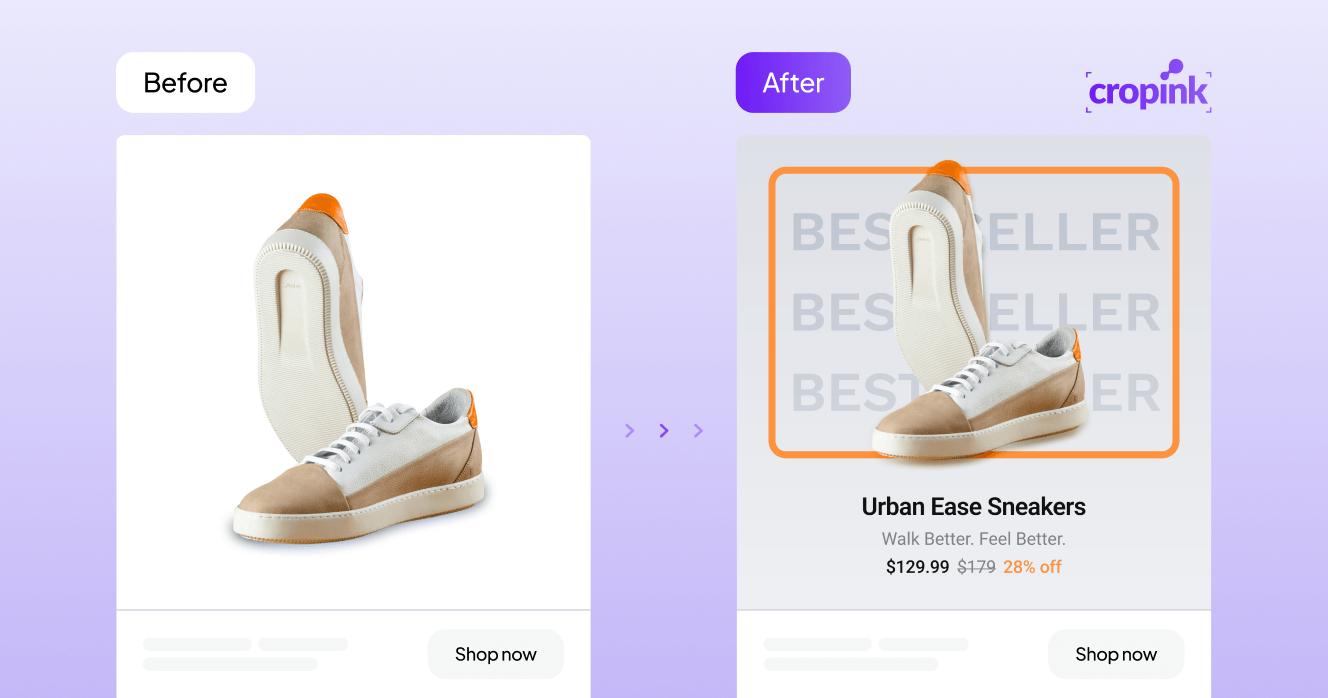
A sale can be easy to miss if it's hidden on the product page. Bringing the discount into the creative, as in the ad above, gives shoppers a reason to pay attention. No one likes to miss a good deal after all.
Let the customer proof sell alongside the product
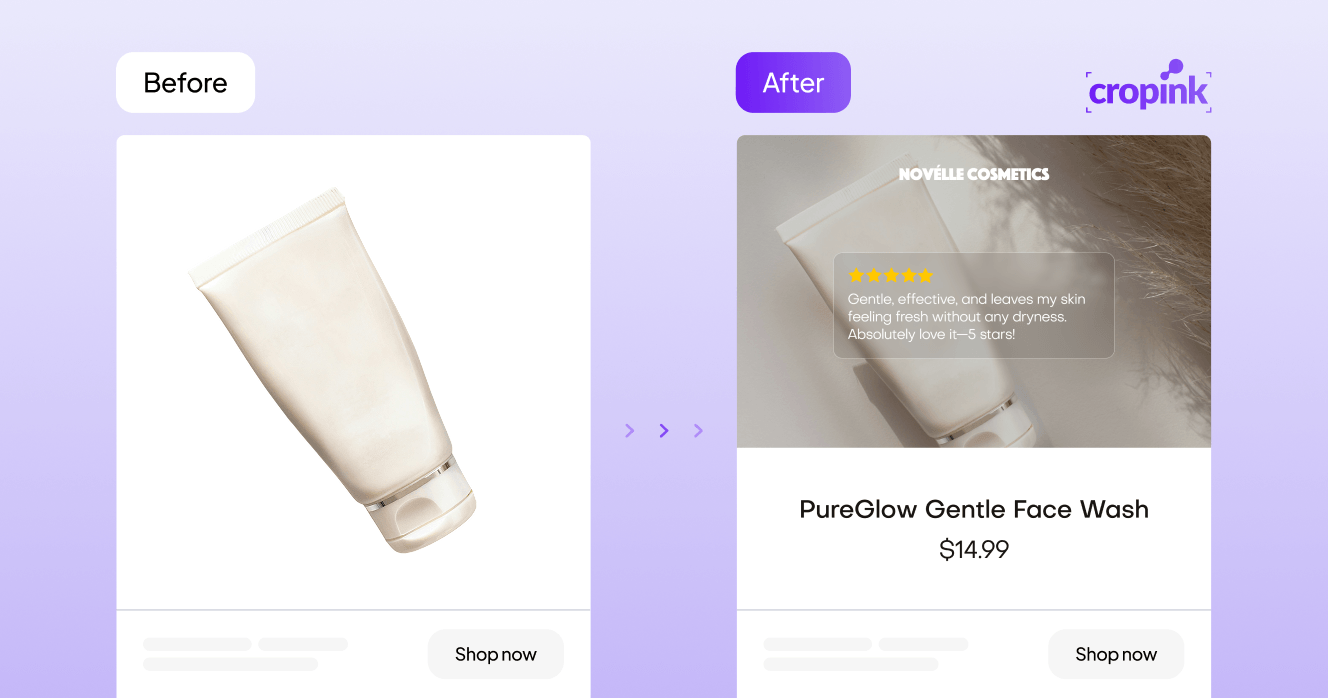
Reviews, ratings, and testimonials influence buying decisions, but shoppers shouldn't have to hunt for them. Adding social proof to the creative helps answer one of the biggest questions people have before clicking: Has anyone else bought this, and did they like it?
Turn product information into visual hooks
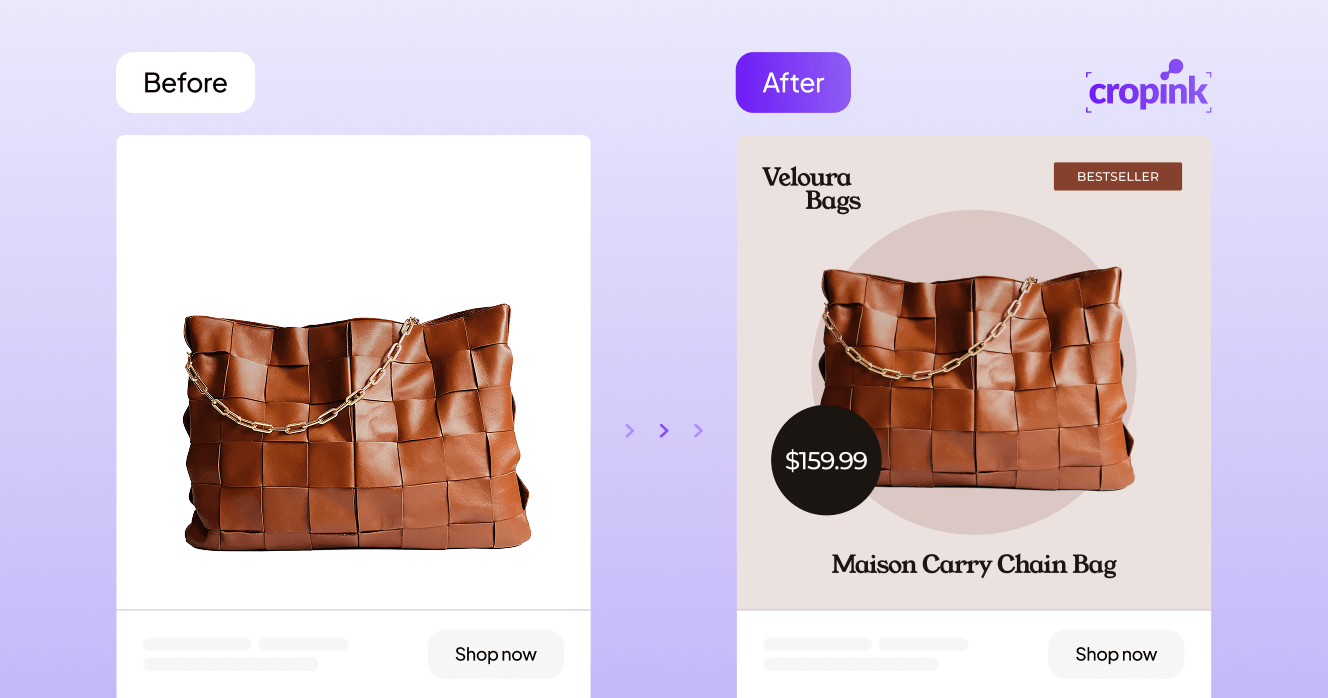
Every product feed contains information that can help sell the product. Turn your prices, ratings, delivery, and offers into visual callouts that shoppers notice in a split second. Spot how engaging the after version is just because we added the title, price, labels, and some color.
Wrapping up on product advertisement examples
It's possible to create great, memorable ads, but it requires your brand to have an intimate understanding of its customers' needs and problems, and how the product fits into that.
For your next campaign, try picking one inspiration from these brands and customizing it to your products' specifics.
- Always #LikeAGirl: build your campaign around a belief or frustration your audience already holds.
- Coca-Cola Share a Coke: give people a reason to interact with the product beyond buying it.
- Old Spice: know who's actually making the purchase, and speak to them.
- Snickers: connect your product to a moment your audience already experiences.
- Dove: start with a customer problem instead of a product feature.
- Absolut: find one recognizable element and repeat it until it becomes shorthand for your brand.
- Amazon Alexa: if people already know what your product does, show the effects of its absence.
- Dollar Shave Club: use humor to make your product feel simple next to an overcomplicated competitor.
These brands never had to reinvent their product to make people care. They found the one thing that needed to be said and repeated it over and over.
Even if you don't have a Super Bowl budget, there's always something you can do to make your creatives interesting enough, relatable, or relevant. Cropink can help you with that part. Learn more about how you can use your product feed and the power of Cropink to make more memorable product ads.
FAQs
What is a product ad?
A product ad promotes a specific product or product line and gives people a reason to buy, compare, try, or remember it.
What is an example of a product advertisement?
Coca-Cola's Share a Coke campaign is an excellent product advertisement because it turned a mass-produced product into something personal. It contributed to a 7% increase in Australian young adult consumption within three months.
What are the best product advertisement examples?
Good examples include Coca-Cola's Share a Coke (personalized bottles), Old Spice's humor, Snickers' hunger-based tagline, Dove's Real Beauty campaign, Absolut's recognizable bottle shape used across 1,500 variations, and Dollar Shave Club's launch video.
How do you write an advertisement for a product?
Start with the target buyer, the product benefit, and the buying trigger. Then write one message that explains why the shopper should pay attention to that particular product.
What is the difference between a product ad and a brand ad?
A product ad encourages people to buy or consider a specific product or product line. A brand ad, on the other hand, influences how people feel about the company as a whole.
How can ecommerce brands create product ads at scale?
The easiest way to create product ads at scale is to connect your product catalog to a feed-based creative platform such as Cropink. That platform will then automatically pull product information and turn it into on-brand creatives that stay up to date as your catalog changes.
Source
- Ogilvy. Share a Coke Coca-Cola
- Wieden Kennedy. Old Spice: Smell Like A Man, Man
- Campaign. Case study: How fame made Snickers' 'You're not you when you're hungry' campaign a success
- The Inquisitive Mind. The good, the bad, and the ugly of the Dove Campaign for Real Beauty
- Business Insider. 21 of the most clever Absolut vodka print ads
- Jimmy Pardi. Alexa Loses Her Voice
- Hubspot. How Much Does a Super Bowl Ad Cost [& Does It Get ROI]? A Data-Backed Deep Dive
Damaris is a Digital Marketing Specialist who writes about digital marketing and performance marketing. At Cropink, she creates data-driven content to help businesses run better ad campaigns for better performance and ROI.
Leszek is the Digital Growth Manager at Feedink & Cropink, specializing in organic growth for eCommerce and SaaS companies. His background includes roles at Poland's largest accommodation portal and FT1000 companies, with his work featured in Forbes, Inc., Business Insider, Fast Company, Entrepreneur, BBC, and TechRepublic.
Related Articles

How Can Cropink Help?
Start with Cropink is easy and free
No credit card required