Color Theory in Advertising: How Colors Influence Buying Decisions
Color is your most powerful silent salesperson. 85% of buyers choose products based on color, and ads in color are read 42% more than black-and-white. This guide breaks down color theory in advertising with 8 real brand examples, the science behind each color, and how to apply it to your product ads today.


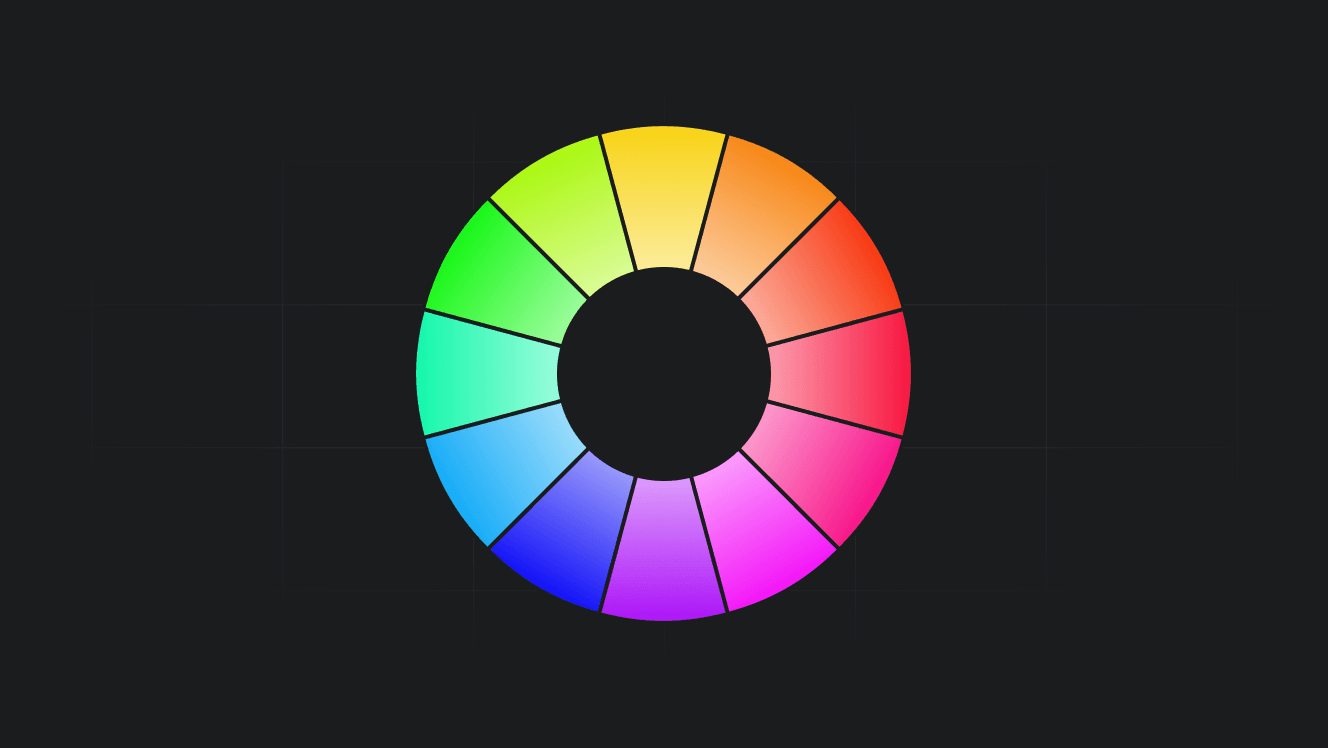
85% of purchase decisions are influenced by color, and consumers form a first impression within 90 seconds of seeing a product with up to 90% of that judgment based on color alone.
Yet most advertisers still treat color as a design preference rather than a conversion lever.
This guide breaks down color theory in advertising with 8 real brand examples, the psychology behind each color, and how to apply it to your ad creative right now.
Key takeaways
- 85% of purchase decisions are influenced by color alone before a single word is read.
- Ads in color are read 42% more often than black-and-white equivalents.
- Color increases brand recognition by up to 80% when applied consistently.
- Red CTA buttons outperform green by up to 34% in conversion rate tests.
- The right color choice depends on your audience, category, and platform not personal preference.
What Is Color Theory in Advertising?
Color theory is the framework that explains how colors interact, how they are perceived, and how they influence emotion and behavior.
In advertising, it is not just about making things look attractive. It is about using color deliberately to trigger a specific psychological response in the viewer before they consciously process your message.
Think about it this way: you feel a McDonald's red-and-yellow ad before you read it. You trust a bank with a deep blue logo before you know anything about its rates.
That pre-conscious processing happens within 100 milliseconds of exposure and it directly shapes whether someone clicks, buys, or scrolls past. It is the invisible layer behind every high-performing ad creative.
The Numbers Behind Color in Advertising
Here is why color belongs in every ad strategy conversation, not just the design brief:
- 85% of purchase decisions are influenced by color alone.
- 80% increase in brand recognition from consistent use of signature colors across all touchpoints.
- 42% more impressions for color ads vs. black-and-white equivalents.
- 34% conversion lift from red CTA buttons vs. other colors in A/B tests.
- 90s is how long it takes consumers to form a judgment about a product and 62 to 90% of that judgment is based on color alone.
- 23% revenue growth for brands that maintain consistent color presentation across all marketing channels.
These are not soft, fuzzy design metrics. These are revenue figures. For the full picture of how visual decisions connect to conversion performance, the advertising statistics resource has the wider context.
The 8 Core Colors in Advertising and What They Actually Do
Each color carries a specific psychological payload. Here is what the research says about each one and the brands that have used it to commercial advantage:
| Color | Emotion triggered | Best used for | Brand example | Ad impact |
|---|---|---|---|---|
| Red | Urgency, excitement, appetite | Sales, CTAs, fast food, impulse buys | Coca-Cola, Netflix, YouTube | +34% CTR on CTA |
| Blue | Trust, calm, reliability | Finance, tech, healthcare, B2B | PayPal, Samsung, LinkedIn | +10% brand trust |
| Orange | Enthusiasm, warmth, affordability | Value offers, eCommerce CTAs, retail | Amazon, Home Depot, Fanta | +2.4% CVR vs green |
| Yellow | Optimism, attention, warning | Sale banners, food brands, youth audiences | McDonald's, Snapchat, IKEA | +12% attention rate |
| Green | Health, growth, sustainability | Eco brands, wellness, finance, "go" | Whole Foods, Starbucks, Spotify | Highest trust in health |
| Black | Luxury, authority, sophistication | Premium products, fashion, tech | Apple, Nike, Chanel | +19% premium perception |
| Purple | Creativity, wisdom, royalty | Beauty, anti-ageing, spiritual, premium | Cadbury, Hallmark, Crown Royal | Strong in beauty/wellness |
| White | Simplicity, purity, clarity | Minimalist brands, tech, healthcare | Apple, Tesla, Dove | Reduces visual friction |
8 Color Theory Ad Examples That Actually Work
These are not textbook theories. These are real brands that made deliberate color choices, tested them, and built advertising machines around the results.
1. Red: Coca-Cola and the urgency engine
Coca-Cola's red is the most recognised brand color on earth. Its logo is recognised by 94% of the world's population. That did not happen by accident.
Red activates the amygdala, the brain's emotional processing center, faster than any other color.
Studies using fMRI technology show warm colors like red trigger an emotional response within 100 milliseconds of exposure. In advertising, this translates directly into urgency. Flash sales, countdown timers, limited-time offers, and add-to-cart buttons all perform significantly better in red. Red CTA buttons in A/B tests consistently outperform other colors by around 34%.
Coca-Cola weaponised this decades before neuroscience explained why.
The red commands attention in any environment, signals excitement and appetite, and creates an emotional association with pleasure and social occasions that no amount of copy could replicate.
- Use red for CTAs, sale banners, urgency signals, and any moment where you need immediate action
- Avoid red for premium or luxury positioning it reads as affordable and immediate, not exclusive
- Red combined with white increases legibility and prevents the visual aggression of an all-red layout
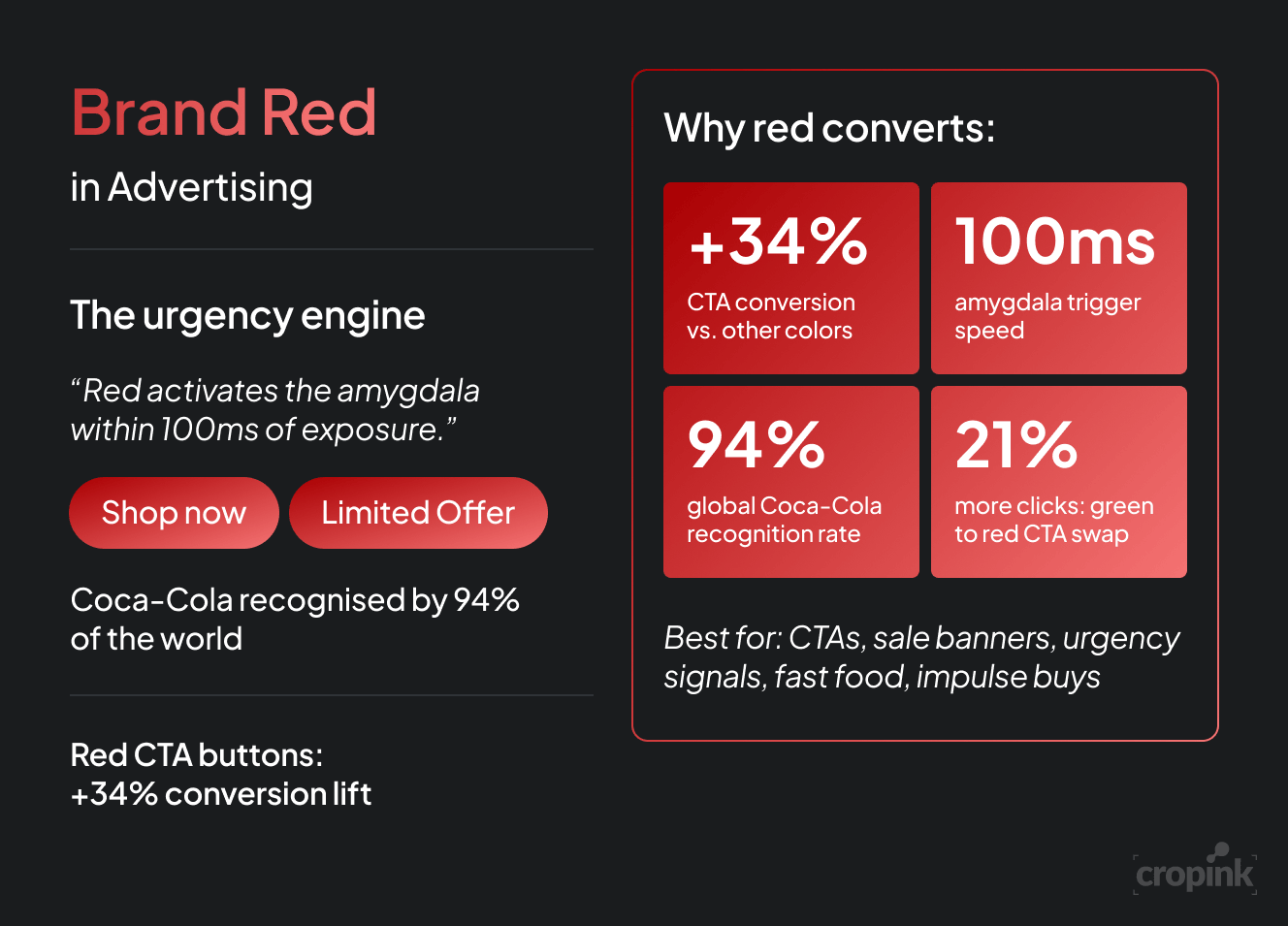
Example: Red in advertising. Coca-Cola's iconic red and white combination drives urgency, appetite, and instant brand recognition across every format.
2. Blue: PayPal and the architecture of trust
Blue is the dominant color in financial services, technology, and healthcare for one simple reason: it is the most trusted color in the world. 54% of consumers globally prefer blue for brands they buy from.
Approximately 40% of Fortune 500 companies use blue as their primary logo color.
When PayPal built its entire visual identity around blue, it was solving the hardest problem in fintech: getting strangers to hand over their payment details.
Blue does not rush you. It says: slow down, this is safe, we have been here before. In B2B environments, blue consistently drives higher lead quality because it attracts considered buyers rather than impulse responders.
LinkedIn, Samsung, Dell, and American Express all tell the same story with blue: reliability compounds over time. Each impression reinforces the trust signal until the brand itself becomes synonymous with the feeling.
- Blue is the default choice for finance, SaaS, healthcare, and any brand where trust is the primary barrier to conversion
- Dark navy signals authority and premium positioning; lighter blues signal openness and accessibility
- Blue performs especially well in B2B Meta and LinkedIn ads it matches the platform environment and lowers the psychological barrier to clicking
For brands running Meta catalog ads, blue overlays on product images are particularly effective for high-consideration purchases where the buyer needs reassurance before clicking.
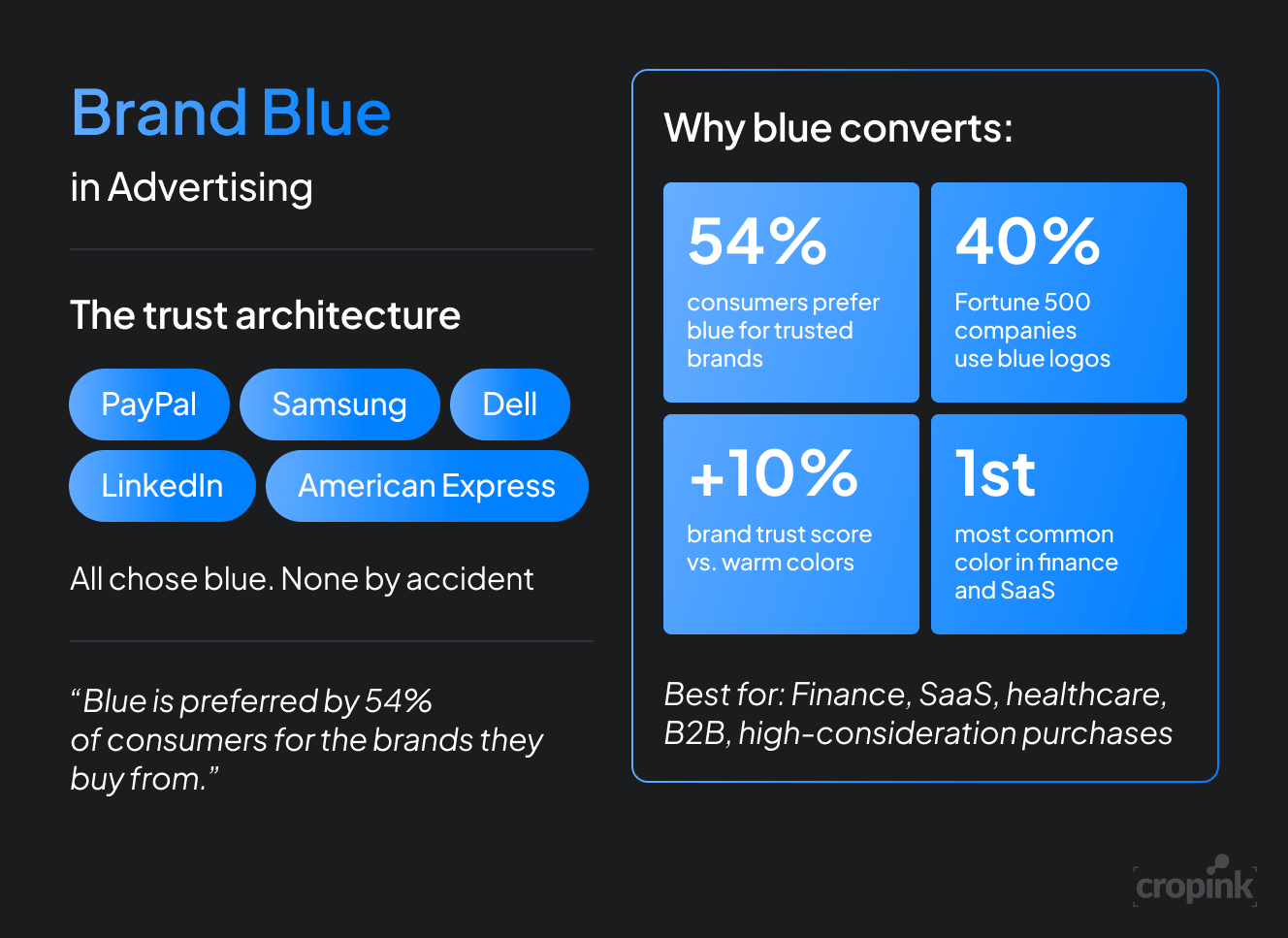
Example: Blue in advertising. PayPal's blue-dominant identity solves the core fintech problem getting users to trust a brand with their money.
3. Orange: Amazon and the conversion sweet spot
Orange is psychologically unique. It combines the urgency of red with the warmth and friendliness of yellow, creating what researchers describe as the optimal psychological trigger for purchase decisions. In 2026 eCommerce conversion data, orange CTA buttons outperform green by 2.4% and blue by 3.1% on average.
Amazon's "Add to Cart" and "Buy Now" buttons are orange. That is not a coincidence. Amazon runs thousands of A/B tests and that orange button has survived every single one.
Home Depot built an entire retail identity around orange because it signals accessibility, value, and action without the aggression of red or the passivity of yellow.
For eCommerce brands, orange is the safest bet for CTA testing when the current button color is blue or green. It creates contrast, triggers action, and does not carry the price-sensitivity associations of red (which can make buyers feel they are being pressured).
- Test orange against your current CTA color before any other change it consistently delivers the highest conversion lift in eCommerce
- Orange works especially well for value-positioning brands and mid-price-point products
- Avoid orange for luxury or premium positioning it reads as accessible, not aspirational
This is directly relevant to dynamic product ads where the CTA button color is part of the ad template. Testing orange in your Cropink templates is a low-effort, high-ROI experiment.
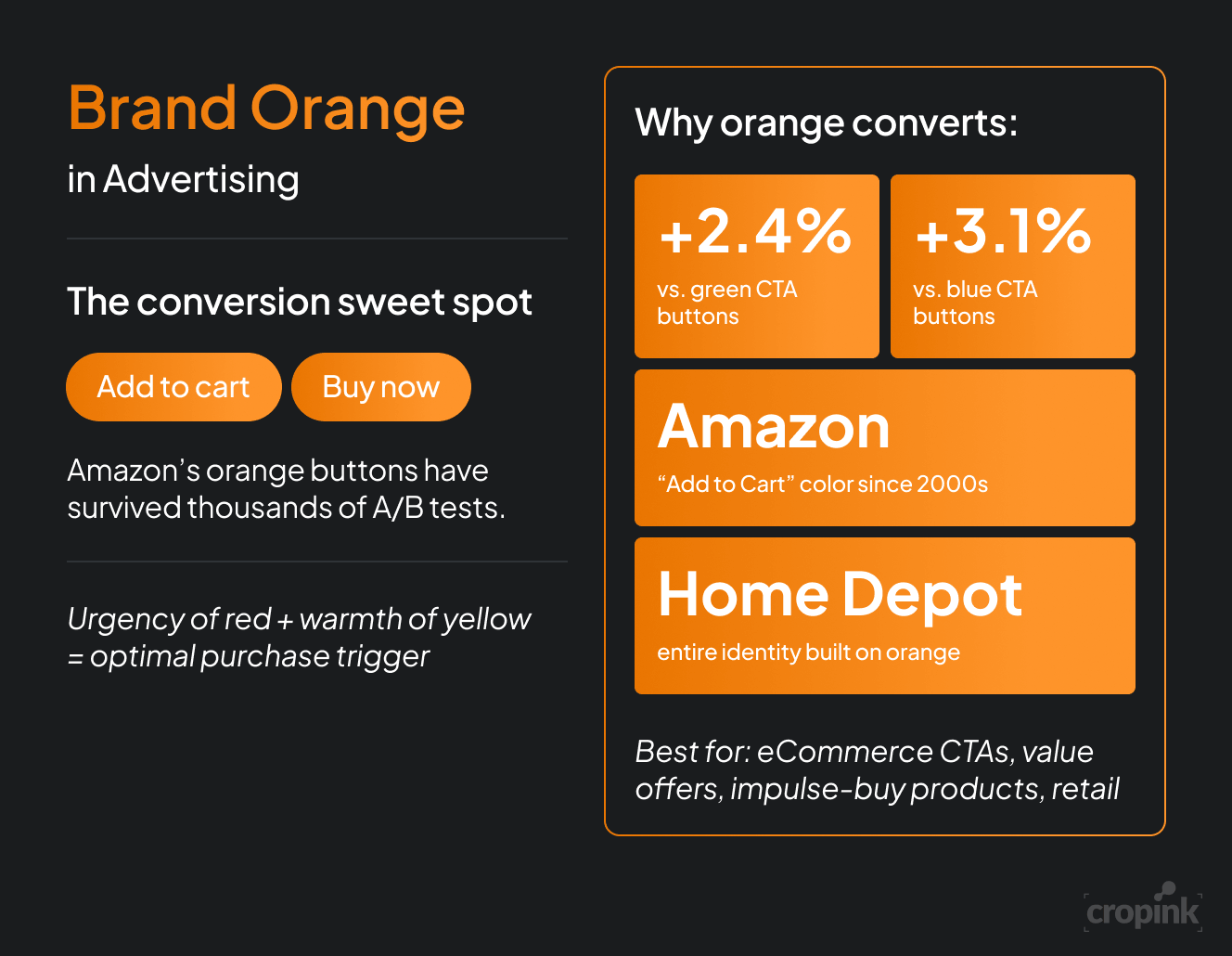
Example: Orange in advertising. Amazon's persistent orange CTA buttons have survived thousands of A/B tests outperforming green by 2.4% and blue by 3.1% in eCommerce conversion data.
4. Yellow: McDonald's and the happiness hook
Yellow is the highest-visibility color in the spectrum. The human eye notices yellow faster than any other color in peripheral vision, which is exactly why road signs and taxis use it. In advertising, it is the attention-grabber before the message kicks in.
McDonald's golden arches are visible from a distance specifically because of this.
Paired with red, yellow creates a combination that triggers appetite, signals speed and accessibility, and creates an association with positive emotional experiences.
Snapchat built its entire identity on yellow because its target demographic, millennials and Gen Z, associate it with energy, creativity, and informality. The platform now reaches 75% of millennials and Gen Z.
Yellow has a critical limitation: it is almost invisible on white backgrounds. Its power comes entirely from contrast. On dark backgrounds, yellow becomes a dominance statement. On light backgrounds, it disappears.
- Yellow is ideal for sale banners, flash offer badges, and any "new" or "limited" label that needs to be seen first
- Always pair yellow with dark text or dark background yellow on white is functionally invisible
- Yellow appeals strongly to younger audiences; use it cautiously in premium or professional contexts
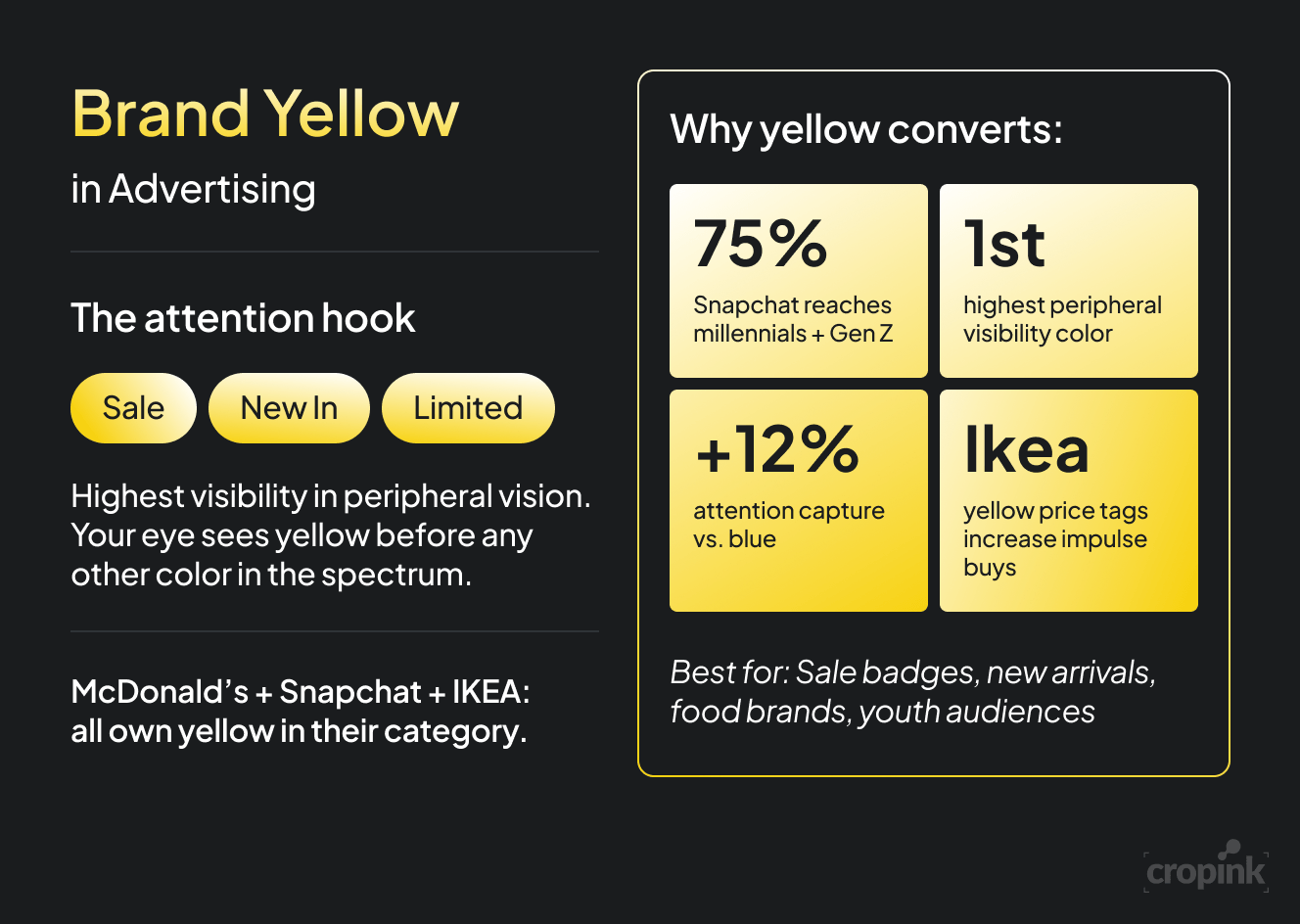
Example: Yellow in advertising. McDonald's golden arches exploit yellow's highest-visibility position in the spectrum visible at distance before any other design element registers.
5. Green: Whole Foods and the permission signal
Green carries two distinct meanings in advertising, and both of them convert.
The first is the "go" signal. Traffic lights have trained the human brain to associate green with permission, safety, and forward movement.
In digital ads, green CTAs and checkmarks exploit this conditioning directly. The second is the nature-health-sustainability association.
Whole Foods, Starbucks, and Spotify all use green to signal that their product is good for you, natural, or in harmony with the world. This resonates especially strongly with millennials and Gen Z buyers who consistently rate sustainability as a purchase driver.
In 2026, green has expanded beyond eco-friendly signaling.
Brands focused on mental health, financial wellness, and personal growth are all reaching for green because it also now signals restoration and calm a response to years of high-stimulation advertising environments.
- Green is the strongest color for health, wellness, food, and sustainability brands
- Use green checkmarks near the add-to-cart button or in the benefits list of any product ad it triggers subconscious "yes" responses
- Dark forest green signals premium; bright lime green signals energy and youth; mid-range greens signal health and nature
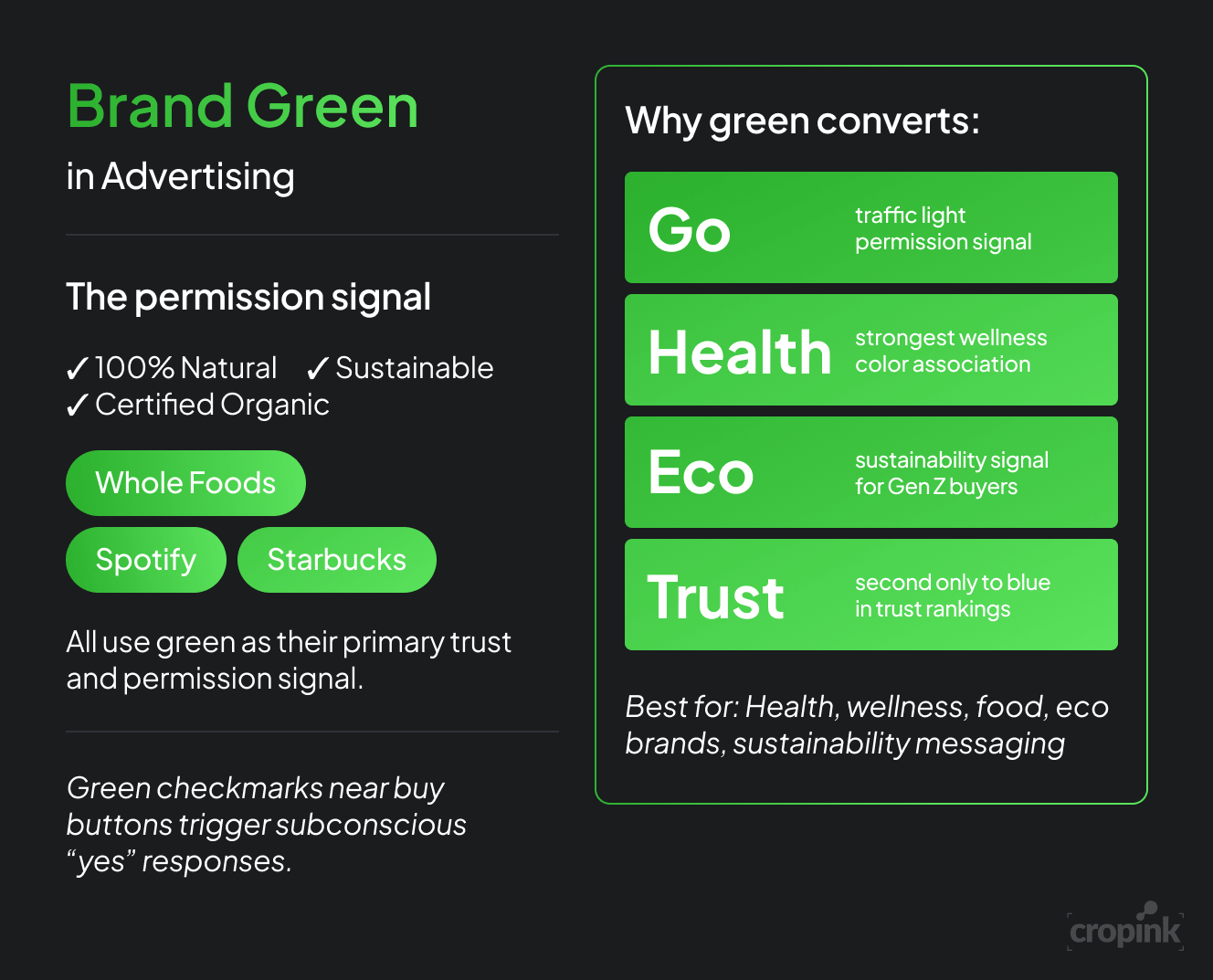
Example: Green in advertising. Whole Foods uses green to signal health, sustainability, and permission two psychological mechanisms that drive both trust and impulse buying in the health and wellness category.
6. Black: Apple and the premium signal
Black is the color of authority, luxury, and restraint. It does not try to appeal to everyone, and that selectivity is the point. When a brand uses black as its primary ad color, it is communicating: this product is not for everyone, it is for people with taste.
Apple's advertising uses black and white almost exclusively. The message is not "buy this phone."
The message is "this phone belongs in a world of refined, minimal, premium things." A luxury watch retailer testing five Instagram ad background colors in early 2026 found that deep navy outperformed white by 31% in CTR and 22% in conversion rate.
The dark background made products appear more exclusive and justified premium price points in viewers' minds.
Black also reduces visual noise. In a feed full of bright, competing colors, a clean black-background ad creates contrast through restraint. It stops the scroll differently from orange or red not through stimulation but through elegance.
- Black is the correct default for luxury, fashion, premium tech, and high-ticket eCommerce
- Black-and-gold combinations are the strongest visual signal for exclusivity and premium positioning
- Test dark backgrounds in your catalog ads before dismissing them the data consistently shows premium products convert better against dark backgrounds
For fashion and premium eCommerce brands, Cropink's fashion ad examples and clothing store ad templates show how dark-background catalog creatives are structured for maximum premium impact.
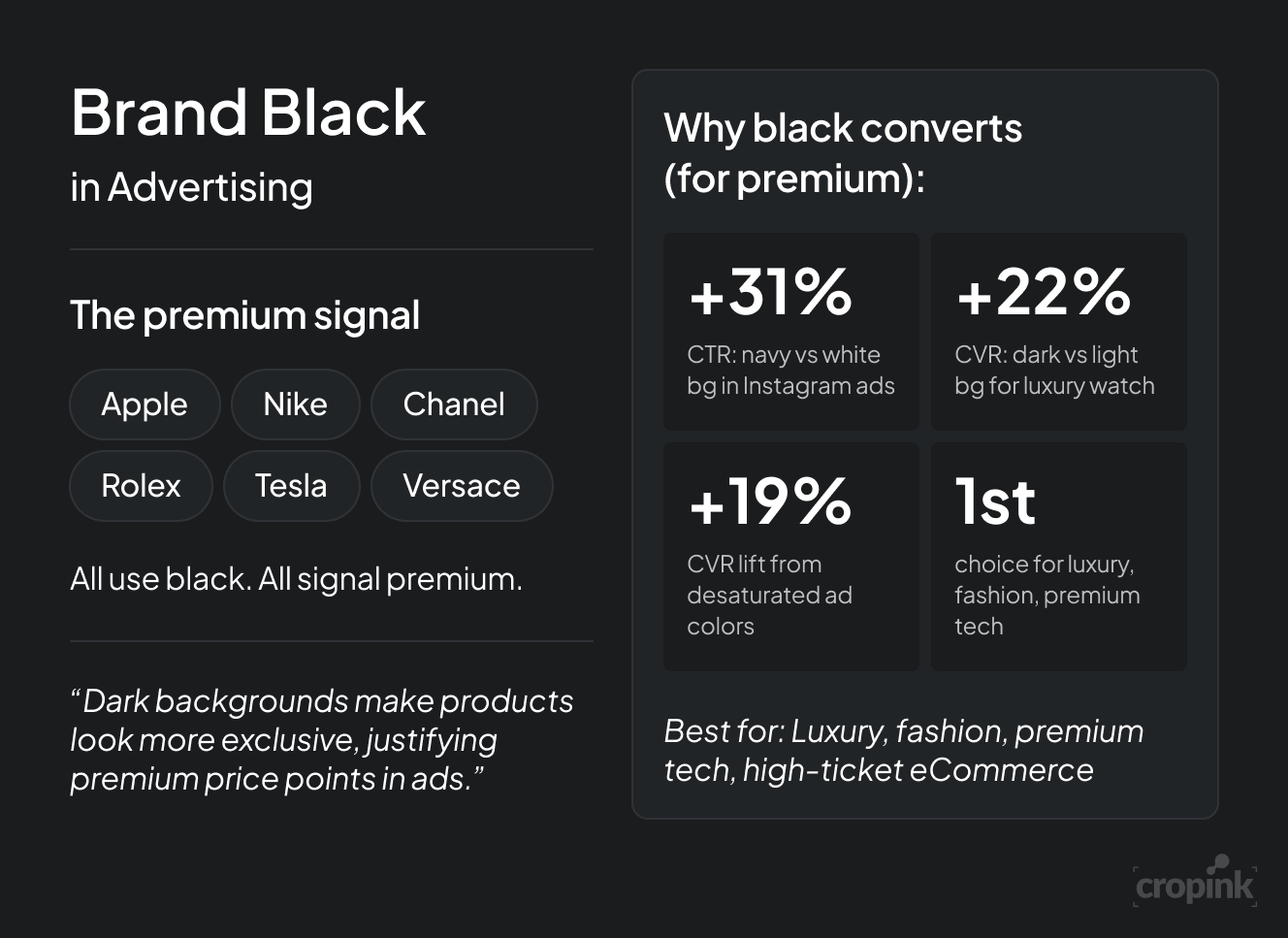
Example: Black in advertising. Apple's near-monochromatic ad palette communicates premium restraint stopping the scroll through elegance rather than stimulation.
7. Purple: Cadbury and the royalty association
Purple has the strongest historical association with royalty, wisdom, and exclusivity of any color in the spectrum. For centuries it was literally the most expensive pigment to produce, which is why it was reserved for kings and clergy. That cultural memory still lives in our subconscious response to purple today.
Cadbury owns purple in the confectionery category so completely that it has successfully trademarked its specific shade of purple in multiple markets. When you see that deep Cadbury purple, you do not need to read the brand name.
The color IS the brand. In beauty and skincare advertising, purple consistently outperforms other colors for anti-ageing and premium product lines because it triggers associations with wisdom, sophistication, and transformation.
Purple is also the go-to color for brands that want to signal creativity and imagination Hallmark, Crown Royal, and Cadbury all sit in this space. It is a powerful differentiator in categories dominated by blue and red.
- Purple is the strongest choice for beauty, anti-ageing, premium confectionery, and creative/spiritual brands
- Deep purples signal royalty and premium; lighter lavenders signal calm and femininity
- In a category dominated by blue competitors, a purple brand identity creates instant visual differentiation
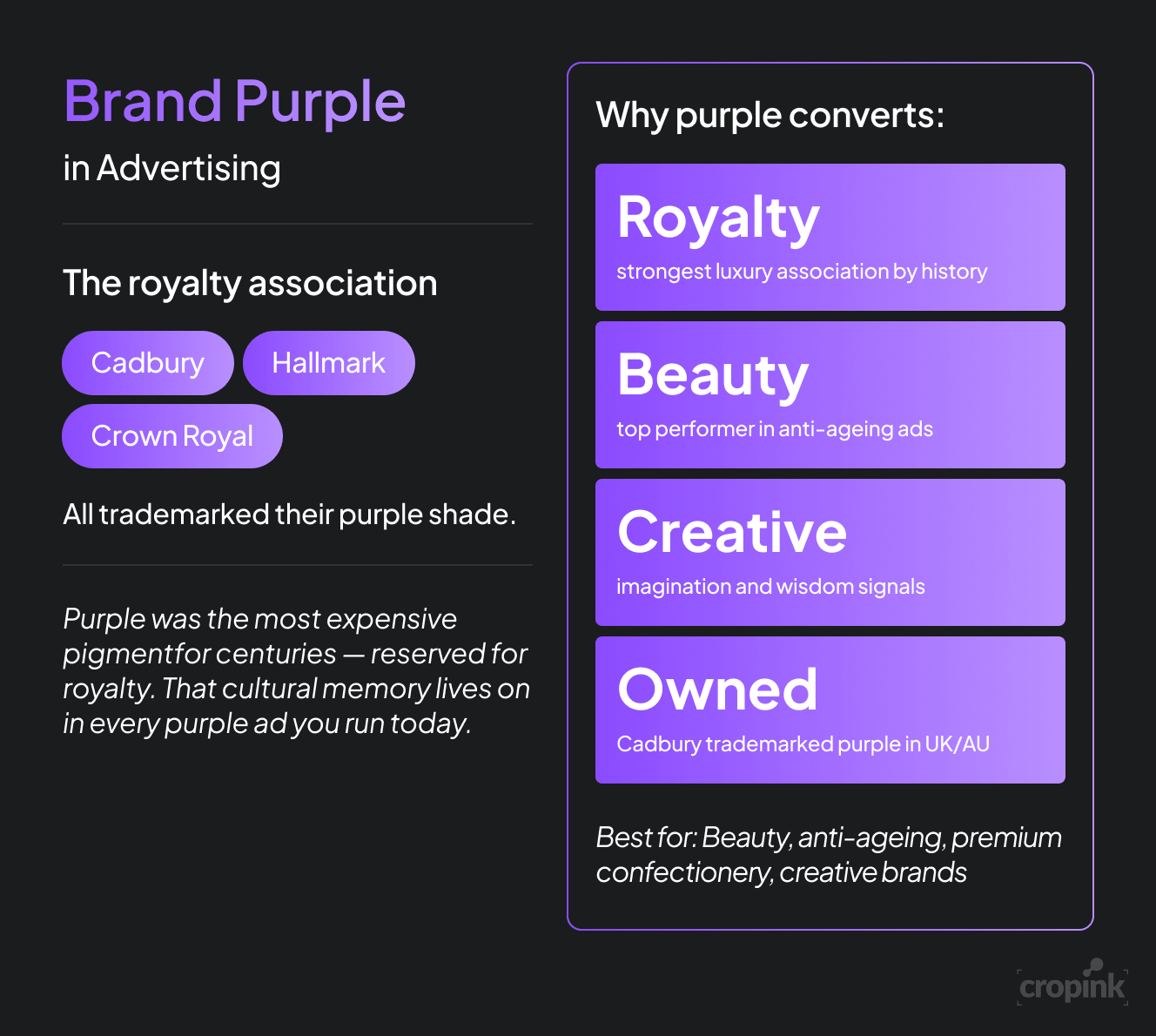
Example: Purple in advertising. Cadbury's trademarked purple is so deeply embedded in the confectionery category that the color alone communicates the brand no logo required.
8. Color combinations: McDonald's red-and-yellow vs. Pepsi's blue-and-red
Individual colors are powerful. Color combinations are a system.
McDonald's red-and-yellow is the most studied color combination in marketing history. Red creates urgency and appetite. Yellow creates happiness and visibility.
Together they create a cocktail of "I need this right now and it will make me feel good." It is specifically engineered for impulse purchasing and it has been running in the same configuration for over 60 years because it works.
Pepsi's blue-and-red is an entirely different story. The blue says: refreshment, reliability, calm. The red says: energy, fun, excitement. The combination positions Pepsi as the youthful, energetic alternative to Coca-Cola's heritage red the challenging brand rather than the establishment one. Color combinations can encode competitive positioning just as powerfully as copy.
- Complementary color pairs (opposite on the color wheel) create maximum contrast and visual energy ideal for high-attention ads
- Analogous color pairs (adjacent on the wheel) create harmony and comfort ideal for brand-building and trust campaigns
- Test your CTA button color against the background using contrast ratio tools a minimum 4.5:1 ratio improves readability, and 7:1 or higher increases conversion by 15% in readability-dependent formats
Color combination decisions are especially critical in catalog ad design, where the product image, background, badge, and CTA button all compete for attention in a single frame.
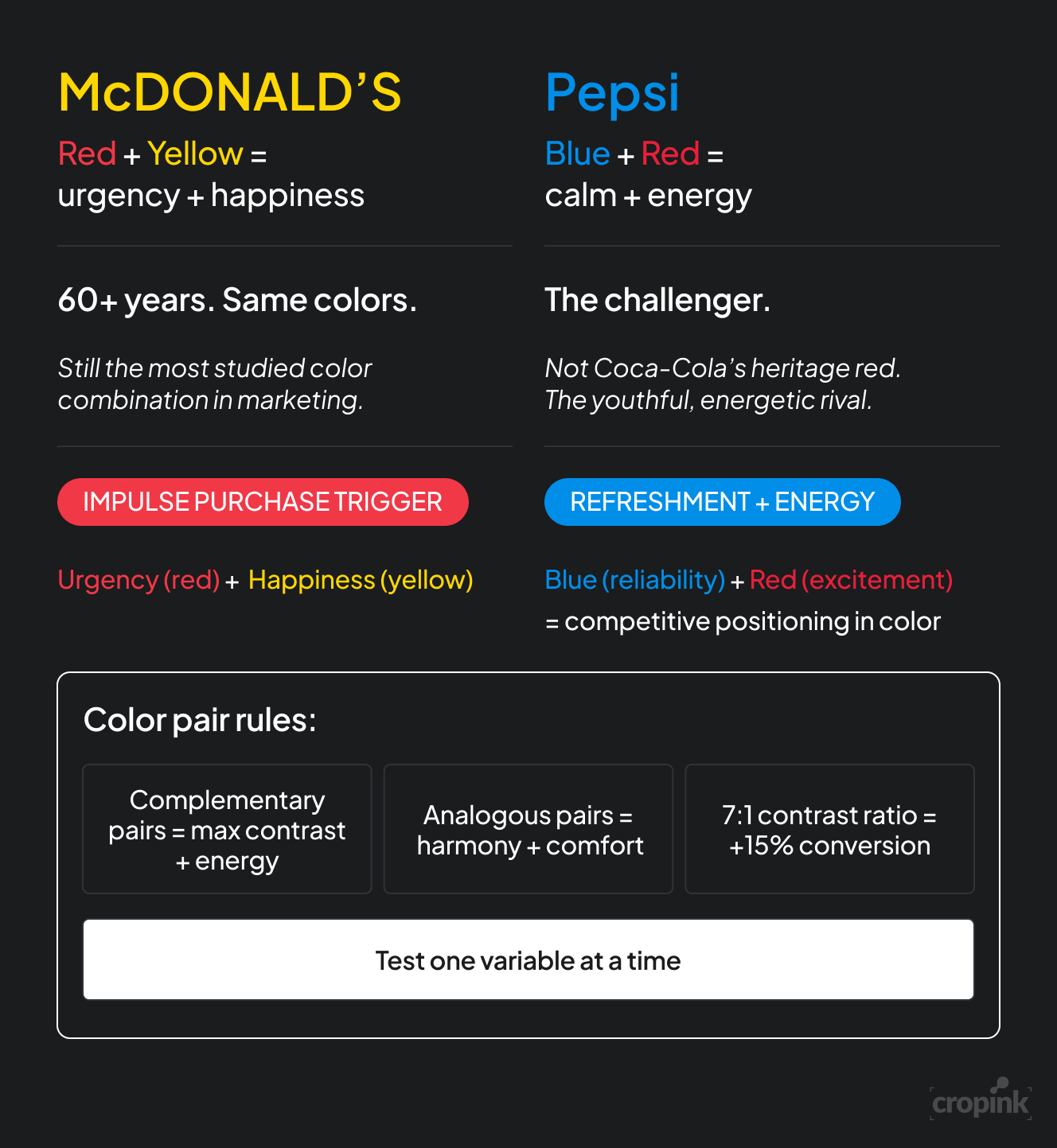
Example: Color combination theory in advertising. McDonald's red-and-yellow encodes urgency plus happiness. Pepsi's blue-and-red encodes reliability plus energy. Both combinations are decades-old and still running because they work.
The Color Mistakes That Hurt Ad Performance
Color psychology only works when it is applied consistently and deliberately. Here are the most common ways brands undo the value of good color choices:
| The mistake | Why it hurts and what to do instead |
|---|---|
| Inconsistent color across platforms | Brand recognition requires repetition. Inconsistency across Meta, TikTok, email, and website resets the recognition clock. Use a locked color palette with hex codes enforced across every channel. |
| Choosing colors by personal preference | Your favorite color is irrelevant. Your buyer's psychological response is everything. Use color psychology research and A/B testing, not instinct. |
| Ignoring cultural color meanings | White signals purity in Western markets and mourning in parts of Asia. Red signals luck in China and danger in the West. Always validate your color choices against your target geography. |
| Low contrast between text and background | Ads with contrast ratios of 7:1 or higher show 15% higher conversion rates. Poor contrast is invisible to most designers but destroys readability on mobile where 60% of your viewers are. |
| Chasing color trends without testing | Trending colors can lift engagement by up to 50% when they fit your brand. But switching colors to chase trends without A/B testing first destroys the recognition equity you have built. |
| Same color for CTA and background | The CTA button must be the most visually distinct element on the page. If it blends into the background or matches surrounding elements, conversion drops immediately. |
How Color Theory Applies to Your Product Catalog Ads
Understanding color theory is one thing. Applying it consistently across hundreds of product ads is another problem entirely.
Most eCommerce brands make ad color decisions once, at the brand kit stage, and then lose control of them at scale. Individual SKUs end up with different background tones. CTA button colors drift across campaigns. Badge colors clash with product imagery. The result is catalog ads that look inconsistent, feel untrustworthy, and underperform against their potential.
This is the problem Cropink solves. Cropink is a dynamic catalog ad creation platform that lets you lock your color system, including backgrounds, badge colors, CTA colors, and overlay tints, into a branded template and then apply it automatically across your entire product feed.
Every ad, every SKU, every campaign runs in the same color language.
Here is what that looks like in practice:
- Brand-locked color templates: Design your catalog ad templates with your exact hex codes, then export from Figma directly into Cropink. Your color system is enforced at template level so it cannot drift.
- Conditional color logic: Set rules so sale items automatically show red urgency badges, new arrivals show green "new" overlays, and bestsellers show gold badges. The right color signal for each product state, automatically.
- Platform-specific color variants: Build one color variant for Meta feed placements and a separate one for TikTok or Stories, without recreating the template from scratch. Color optimised for each context.
- CTA color testing at scale: Switch your CTA button color across your entire catalog in one template edit. Test orange vs. green vs. red across thousands of product ads simultaneously without manual creative work.
Leroy Merlin Poland used Cropink's branded template system to achieve a 353% increase in conversion rate and a 79% ROAS improvement. MediaMarkt achieved 9x ROAS. Color consistency was a core part of both results and every product ad ran in a locked, on-brand color system that reinforced recognition and trust across every impression. If you want to see what that looks like for your catalog, Cropink has a free plan you can start with today.
FAQs
Does color really affect buying decisions?
Yes, and the data is significant. 85% of purchase decisions are influenced by color alone. Consumers form a product judgment within 90 seconds of first exposure, and 62 to 90% of that judgment is based on color. Ads in color are read 42% more than black-and-white equivalents. Color is not decoration it is a conversion mechanism.
What is the best color for advertising CTAs?
Orange and red consistently outperform other colors in CTA A/B tests. Red delivers approximately 34% higher conversion rates than neutral-colored buttons. Orange outperforms green by 2.4% and blue by 3.1% in eCommerce-specific tests. However, the most important rule is contrast: your CTA must be the most visually distinct element on the page. A contrasting color that stands out from the surrounding design will always outperform a contextually matching one, regardless of the specific hue.
How do different colors affect consumer psychology in ads?
Red triggers urgency, excitement, and appetite within 100 milliseconds. Blue builds trust and calm, making it ideal for finance and healthcare. Orange signals value and warmth, optimised for conversion. Yellow maximises attention capture in peripheral vision. Green triggers permission, health, and sustainability associations. Black signals premium and exclusivity. Purple activates royalty and creativity associations. White reduces friction and signals clarity. Each color works as a psychological shortcut that operates before conscious reasoning begins.
What is the most trusted color in advertising?
Blue. It is preferred by 54% of consumers for brands they purchase from and used as the primary logo color by approximately 40% of Fortune 500 companies. In digital advertising, blue consistently produces higher trust scores, lower bounce rates, and stronger long-term brand recall than any other single color. It is the default choice for finance, technology, healthcare, and any brand where credibility is the primary conversion barrier.
How should I choose ad colors for my eCommerce brand?
Start with your product category and the emotional response you need to trigger. High-urgency, impulse-buy products perform best with red and orange. Premium and luxury products convert better with black and deep navy. Health and sustainability brands should own green. Then define your full color system: a primary brand color, a secondary color, a neutral, and a CTA color that contrasts sharply against your background. Lock these into your ad templates and enforce them consistently across every campaign. Then A/B test your CTA color specifically this single variable typically delivers the highest measurable ROI from any color change.
Find more creative ad inspiration:
- 7 Misleading Advertising Examples
- Brand Slogan Examples
- 10 Advertising Techniques Examples
- Product Ads to Borrow From
- Enriched Catalog Ads Inspiration
- Cropink Case Studies
Final Thoughts
Color is the fastest communication channel you have in advertising. It lands before your headline, before your product image, before your price. And in a feed where every brand is competing for the same 1.7 seconds of attention, the brand with a deliberate, consistent color system wins before the buyer has read a single word.
The brands that understand this Coca-Cola's red, Apple's black, Amazon's orange have not changed their core color systems in decades. That is not laziness. That is the compounding power of color recognition at work: every impression reinforces the last one until the color itself becomes the brand.
For eCommerce teams, the challenge is applying this at scale across hundreds of SKUs without losing consistency. That is exactly what Cropink is built for. It lets you lock your color system into dynamic catalog ad templates and apply it across your entire product feed automatically so every ad runs in the same visual language, on every platform, for every product. If you want to see what color-consistent catalog ads look like at scale for your brand, Cropink has a free plan you can start with today.
Sources
- Jasmine Directory. The Psychology of Color
- Pulse Advertising. Why Color Trends Signal a Strategic Shift for Brand Marketing
- Amra and Elma. Best Color Psychology in Branding Statistics
- Straits Research. Influence of Colors on Brand Recognition and Consumer Behavior
- Tenet Branding. 50+ Branding Statistics That Explain Brand Loyalty
- Vivid Creative. The Psychology of Colour in Branding: Mood-Driven Palette
- SocialTargeter. Understanding the Psychology Behind Color Choices in Digital Marketing Ads
- Ironmark. Color Theory in Branding and Marketing
Ansherina helps brands create powerful digital marketing and performance marketing strategies. With a passion for ad design and audience engagement, she is dedicated to making brands more visible and impactful.
Leszek is the Digital Growth Manager at Feedink & Cropink, specializing in organic growth for eCommerce and SaaS companies. His background includes roles at Poland's largest accommodation portal and FT1000 companies, with his work featured in Forbes, Inc., Business Insider, Fast Company, Entrepreneur, BBC, and TechRepublic.
Related Articles


How Can Cropink Help?
Start with Cropink is easy and free
No credit card required