What Is Modular Design in Creative Production?
Brands today are expected to run ads across more platforms, more formats, and more audience segments than ever before. We show you how you can speed up that process with modular design systems, so you can produce creatives at scale off a single system without proportionally increasing your workload.



If you run a campaign on Meta today, you need a 1:1, a 4:5, and a 9:16 ad format. Add Google Display, and now you have six more sizes to channel out. If you throw in a retargeting audience, you now need another ad variation for people who've already seen the product.
By the time you've mapped out one campaign properly, you're looking at 20+ pieces of creative, and that's before you've touched a second product.
This is the reality for most ecommerce brands right now.
While media buying has become highly automated, creative production has not kept pace.
Modular design is how the best brands are closing that gap, and once you understand how it works, you'll see why it changes the entire way you think about building ads.
Key takeaways
- Modular design means building ads from interchangeable pieces (such as headlines, images, and CTAs) that can be reused, swapped, and rearranged.
- One modular design can scale into hundreds of ad variations across formats and audiences.
- Separating layouts, assets, and content blocks makes creatives flexible and easy to update.
- Modular design maintains brand consistency automatically while reducing design costs and repetitive work.
What does modular design mean?
Modular design is a process where each part of an ad is built to be reused or reformatted easily. The concept has roots in modularity, which is the idea that any system works better when it's broken into distinct, manageable parts.
In advertising, those parts are called modules.
Each module can function independently, but it's also designed to fit into a larger structure.
A module could be a headline, a product image, a price block, a CTA, a customer rating, or a background. Each one lives as its own element, and so any of them can be rearranged, swapped, resized, or reused across formats, and the ad would still be functional and relevant.
In modular design, rather than rebuilding an ad every time you need a different size or layout, you're only reconfiguring the same set of modules. The same content block that works in a 4:5 layout can be restructured for a 9:16 layout.
The best thing about modular design is that you'll have a library of modules you can mix and match to produce multiple creatives across multiple layouts, without starting from scratch each time.
If you're a business with a huge catalog, that would be hundreds or thousands of unique ads in half the time without your design team grinding through each one manually.
Modular design vs static design
With static ad design, every element on a page is created to work with the others around it.
The headline is sized for that specific layout, the image is cropped for that exact space, and the CTA sits where it sits because everything else was designed around it.
If you were to change one thing, the entire ad would need to be reworked.
That rigidity has a high cost.
If you wanted to run ads across multiple ad formats or audiences in a traditional static setup, you would be forced to commission a new ad for every other variation.
Modular design flips that narrative entirely.
Because each component is built to be independent, the structure is flexible by default.
You can swap a headline, change a background, or resize the layout, and the ad would still work.
Reusable templates are not a compromise. They are infrastructure. They let designers focus on what actually needs taste — hierarchy, message, hooks, standout moments — not on rebuilding the same layout 37 times. Good templates just give designers a system that makes output faster, cleaner, and easier to test. Creativity without structure is art direction. Creativity with structure is scale.

CEO & Co-founder at Cropink.com and Feedink.com
Key components of modular design in creative production
So what makes modular design work?
It's these three core components, and how well they're constructed, that determine how much mileage you get out of the system.
1. Modular layouts
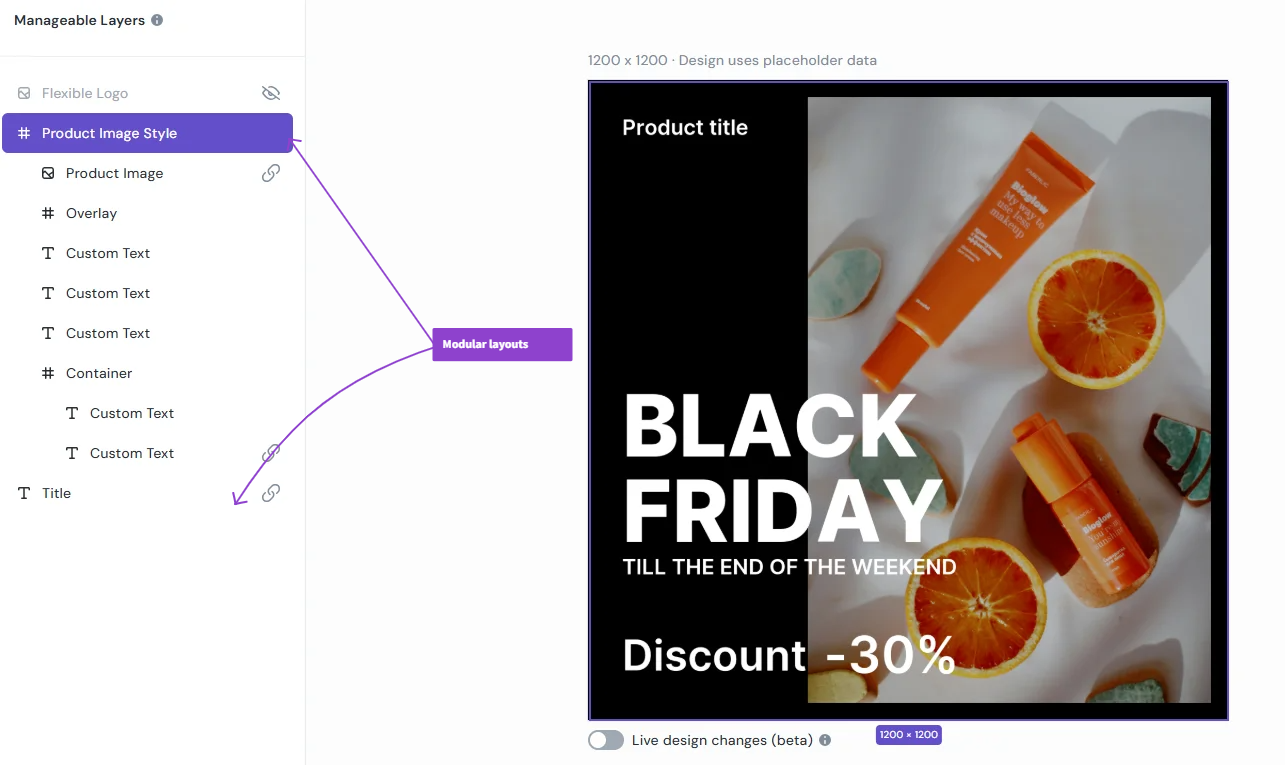
A modular layout is a grid-based structure with pre-defined zones. In the design, one area is reserved for the product image, another for the headline, another for the price, and so on. Each zone has its own rules for sizing and placement, so when you swap the content within it, the layout stays intact.
These zones are often devised with flexible proportions or responsive rules, which allow the layout system to adapt across formats.
That adaptation can happen through reflowing, rearranging, or resizing elements.
For a brand running the same campaign across Meta, TikTok, and Google Display, this means one layout system can serve multiple formats and designers do not have to refit every ad manually.
2. Modular assets
A modular asset is any individual creative element that can be pulled into a layout, swapped out, and reused across different ads.
In an ecommerce brand, that covers a lot of ground. Product images, logos, sale badges, discount labels, customer ratings, icons, etc., can all be created and stored as standalone elements, ready to be dropped into any layout or format the campaign requires.
The main point is that none of these assets is tied to a particular ad.
A sale badge made for a Meta campaign can work just as well in a Google Display banner or a TikTok creative. That portability is what makes the asset library useful rather than just a well-organized folder of one-off files.
3. Modular content blocks
Content blocks are groups of assets paired together to deliver a message within the ad.
Unlike traditional static ads, you won't assemble every element from scratch. You typically create combinations that are meant to work together as one unit inside the ad.
For example:
- [Pain point] + [Product benefit]
- [Social proof] + [Product name] + [CTA]
- [Urgency offer] + [Product image] + [CTA]
Each of these groups is a complete message.
If you want to test whether urgency outperforms social proof, you swap one block for another while everything else stays the same.
Content blocks speed up iteration and give you a structured way to refresh creatives before ad fatigue sets in.
Creating a modular design system
The modular design system brings all three components together so you can automate most of your creative production.
There are plenty of tools you can use to materialize the modular design system, but for this example, we'll stick with Cropink.
Cropink is a catalog ad creation tool built on modular design principles, which means the templates are already set up with interchangeable modules.
You can swap a headline, change a background, drop in a different product image, and the ad stays functional, on-brand, and relevant to whoever is seeing it.
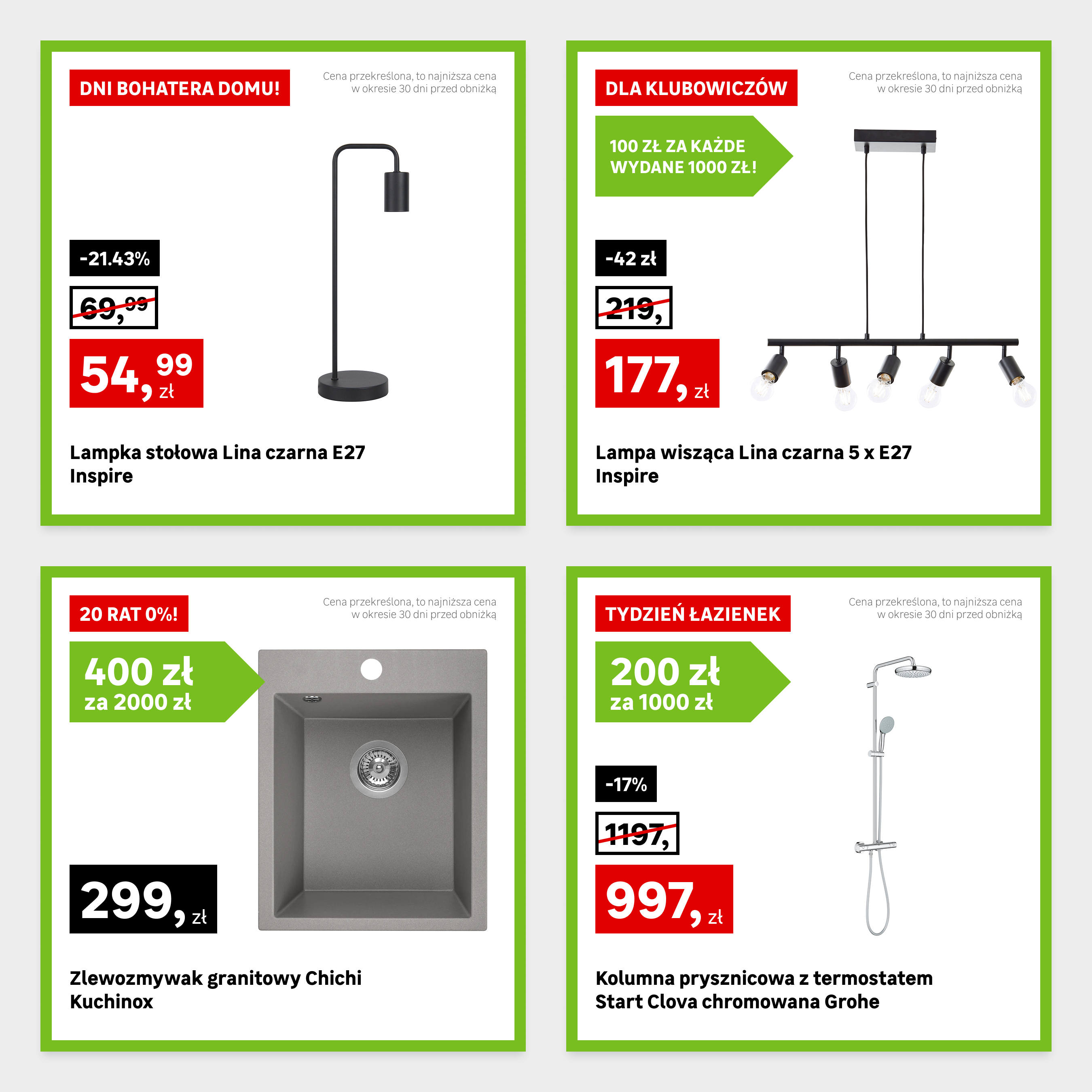
The above Leroy Merlin ads are a good illustration of this.
Look across the four ads, and what you notice first is how different each one feels.
There are different products, different colors, and different promotional angles. One leads with a discount offer, another with a loyalty reward, and another with an installment offer.
However, the underlying structure is identical across all of them.
The grid, product image placement, price block, and badge positions are all consistent.
That is modular design doing its job.
The brand is not building four separate ads but running four variations off the same system, and yet the ads are unique and easily scaled.
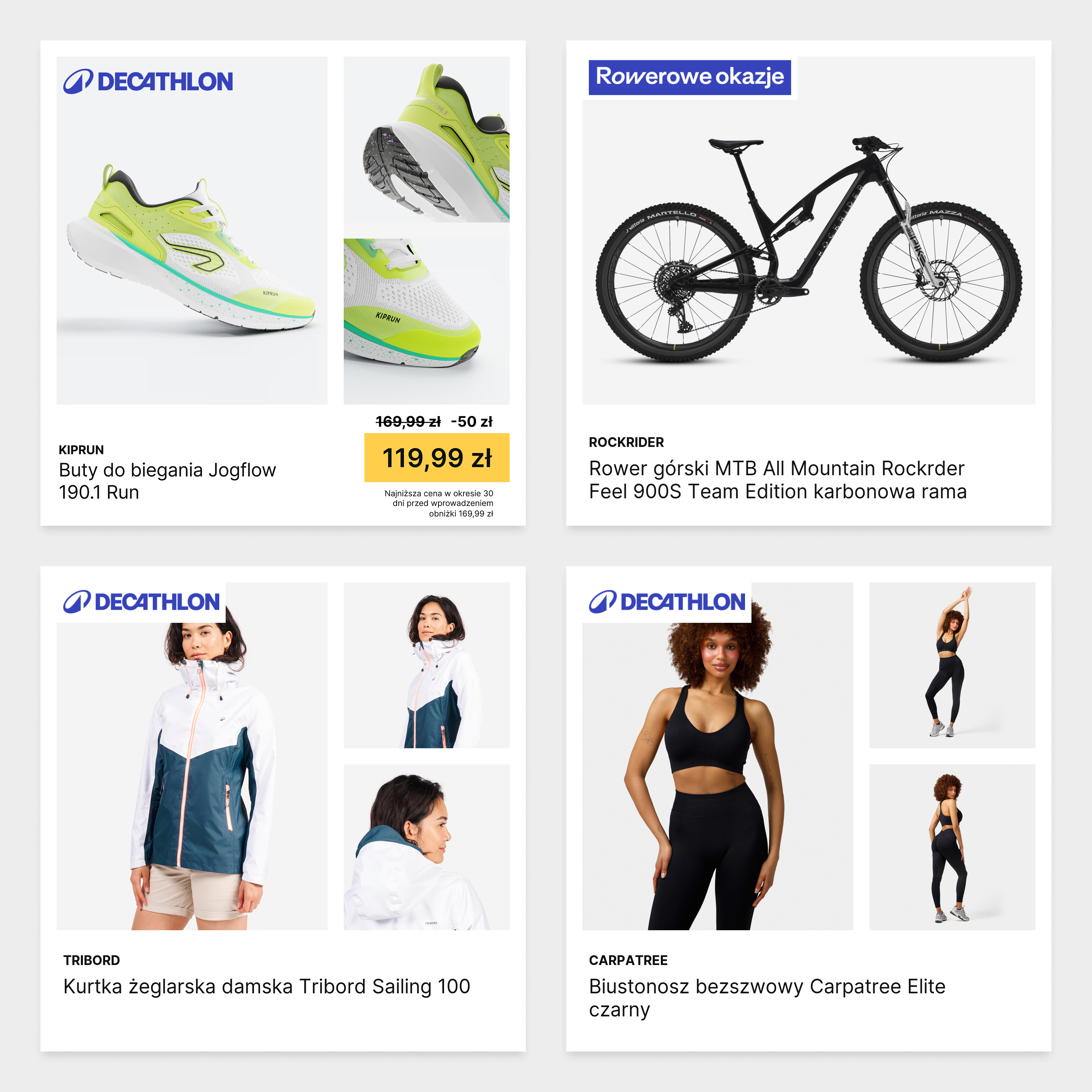
In this other example, you can see that the Decathlon catalog spans wildly different product categories, but every ad feels like it belongs to the same brand.
The modular layout adapts to whatever the product needs, whether that is a single hero shot, a multi-angle view, or a lifestyle image.
Why modular design is critical for scaling creatives
- Speed: Every time a campaign goes live, there are more formats to cover, more audience segments to serve, and tighter deadlines to hit. Modular design can significantly reduce the production cycle because your team is assembling existing components rather than building new ads from scratch.
- Scalability: One modular template can power hundreds or thousands of ad variations without a proportional increase in design work.
- Consistency: When every ad is created from the same set of components, governed by the same rules, the brand stays intact across variations, formats, and platforms. There is no risk of an off-brand color slipping through because a designer was working from an outdated file.
- Cost Efficiency: Design hours are expensive, and repetitive production work accounts for much of them. Modular design removes the bulk of that repetition. Once you have the modules, the heavy lifting is done. What used to require a full production round per campaign becomes a matter of swapping and publishing.
Find more creative ad inspiration:
- Enriched Catalog Ads Inspiration
- Cropink Case Studies
- Instagram Catalog Ads
- Marpipe vs. Feedr
- 5 Christmas Ads Ideas
- Shopify Stores
Final thoughts
Modular design will help you save time, test more, spend less, and free up your team to concentrate on the work that requires a higher level of creative judgment.
However, for the modular system to run smoothly, you need to get the fundamentals right.
Make sure you define rules for each module, build flexible layouts, map your data correctly, and set up your variations before the campaign demands them.
Check out how Cropink can help you modularize your ad creatives to improve efficiency and scale creative production.
FAQs
Modular design is a process where each part of an ad is assembled to work independently, so it can be reused, swapped, or reformatted without rebuilding the entire creative.
Flexibility is a significant characteristic. In modular designs, each component is created to function on its own, which means changing one element does not break the rest of the ad. You can swap a headline, update a background, or resize a layout, and everything still holds together.
A modular design system makes creative production faster, more scalable, and easier to test without increasing the workload every time you need a new variation.
The first step to creating modular designs is breaking your brand's creative into distinct components: layouts, assets, and content blocks. Next, define the rules for how they work together, build a library of options for each, and use a tool like Cropink to map your product data to the right zones and generate variations automatically.
Sources
Damaris is a Digital Marketing Specialist who writes about digital marketing and performance marketing. At Cropink, she creates data-driven content to help businesses run better ad campaigns for better performance and ROI.
Leszek is the Digital Growth Manager at Feedink & Cropink, specializing in organic growth for eCommerce and SaaS companies. His background includes roles at Poland's largest accommodation portal and FT1000 companies, with his work featured in Forbes, Inc., Business Insider, Fast Company, Entrepreneur, BBC, and TechRepublic.
Related Articles


How Can Cropink Help?
Start with Cropink is easy and free
No credit card required