What Are Enriched Catalog Ads and How Do They Help Stores Sell More?
Enriched catalog ads turn ordinary product listings into high-converting ads. Learn how they drive more clicks, increase ROI, and simplify campaign management for ecommerce brands.


If a type of ad could help you achieve 514% ROAS growth and 910% CR growth in just a few months of promoting your ecommerce products, would you take up the chance?
It would be unreasonable to pass on that opportunity.
The good news is that it's not as complicated as those numbers suggest.
The ad format providing these results is enriched catalog ads, and they're accessible to any ecommerce brand willing to put in the setup work.
In today's guide, we show you what enriched catalog ads are, how they work, and how you can create them for your entire catalog in just a few minutes.
Key takeaways
- Enriched catalog ads dynamically surface product attributes like reviews, pricing, and stock status based on each shopper's intent and behavior.
- These ads drove 514% ROAS growth and 910% CR growth for one ecommerce brand by showing the right details to the right people at the right time.
- There are three layers that power catalog enrichment: feed and creative enhancements, audience and intent signals, and dynamic creative logic.
- Google Shopping, Meta, Bing Shopping, Pinterest, TikTok, and Amazon all support enriched catalog ads.
- You can automate enriched catalog ads at scale using Cropink.
What are enriched catalog ads?
Enriched catalog ads are shopping ads that pull in product attributes and contextual signals to show prospects why a product fits their needs, not just what it is.
Standard catalog ads show a product image, name, and price. Enriched catalog ads add layers of detail that help someone decide whether to click.
This type of ad populates elements dynamically based on what drives conversion for different user segments. These elements may include customer reviews, shipping speed, stock status, color options, fabric type, and more.
If you sell hoodies, a standard catalog ad will show 'Blue Hoodie - $49'. An enriched ad, on the other hand, might add customer ratings, an organic material badge, a sale badge, and so on, and they adapt dynamically.
It's the same product, but the ad will adapt to what that specific buyer cares about.
A standard catalog ad answers the question, 'What is this product?'
An enriched catalog ad answers 'why this product, for this user, right now'.
The difference between the two is how much context you can surface at impression time.
Standard ads rely on the product feed you upload and mostly just work with the title, image, and price. Enriched ads layer in behavioral signals, creative variations, and real-time attributes to match intent.
In a few minutes, we'll show you how this type of ad gives you an edge as an ecommerce business.
Which platforms support enriched catalog ads?
Most of the top social commerce platforms support enriched catalog ads. Therefore, if you advertise on any of these platforms, you are good to try enriched catalog ads.
- Google Shopping ads
- Meta catalog ads
- Bing Shopping
- Pinterest ads
- TikTok catalog ads
- Amazon
You can also use enriched catalogs for email marketing.
What makes a catalog ad enriched?
These are the #3 layers that determine what shows up in the ad creative, who sees it, and why.
Feed and creative enhancements
This layer controls what the ad looks like to different users.
You can make the following enhancements to your enriched catalog ads.
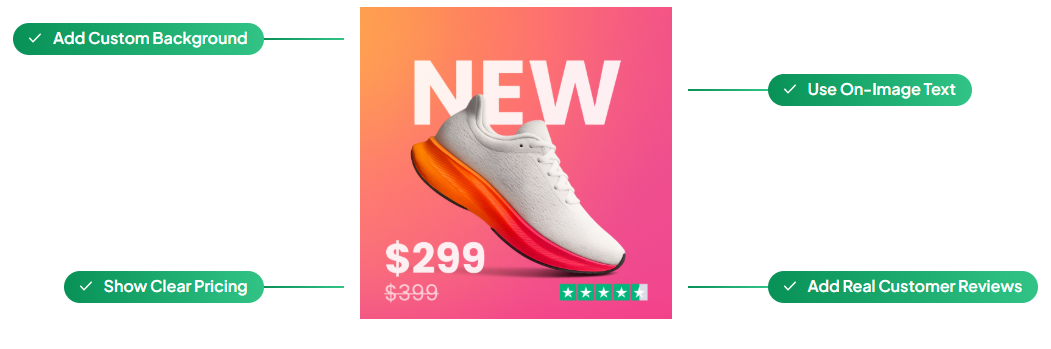
- Enhanced product images and visual overlays let you swap in multiple product angles, customize backgrounds, or use lifestyle imagery instead of white-background product shots.
- Dynamic pricing, discounts, and availability enable badges and price strikethroughs to update based on a user's progress or the current season. A prospect browsing during a flash sale sees the discount, while someone checking back a week later sees the regular price.
- Additional product attributes and metadata surface reviews, USP badges, or shipping promises directly on the creative.
An example of how you can enrich your catalog ad creatives.
Audience and intent signals
Enrichment isn't just what you show. It's who sees it and when.
Therefore, you'll also consider the buyer's journey and intent signals when deciding what to surface in the ad creative.
Someone who viewed your product page yesterday but didn't buy might see urgency messaging, whereas a first-time visitor sees benefit-led highlights instead.
Dynamic and creative logic
This is the operational layer that turns your product feed into a relevant ad for each person.
Below are three examples of operational rules marketers use to create enriched catalog ads.
- Rule-based or algorithmic message selection to decide which attributes to prioritize. You set the rules, for example, show free shipping to cart abandoners, show reviews to first-time visitors, or let the algorithm test and optimize.
- Real-time insertion of USPs, such as fast delivery or free returns, is added to the creative at impression time. You're not creating 50 versions of the same ad because the system assembles the right combination on the fly.
- Automatic prioritization of high-margin or high-conversion SKUs to help push products that are most likely to drive revenue.
Due to this operational logic, two users can view the same product with completely different value propositions presented. One sees price and reviews, and the other sees scarcity and free shipping.
Benefits of using enriched catalog ads
Enriched catalog ads give you three advantages over standard product ads.
1. Improved engagement and click-through rates
Enriched catalog ads enable you to highlight the value proposition that matters most to each prospect at the moment they see your ad.
Consumers today scroll past hundreds of ads daily.
Most of these ads blend because they all look the same. Enriched catalog ads break through that monotony by dynamically overlaying information that's relevant.
A shopper who's comparison shopping sees reviews and ratings. Someone price-sensitive sees a discount badge, while another shopper, worried about shipping, sees 'Free delivery in 2 days'.
With this type of ad, you're showing each person the details that move them closer to a purchase decision.
Just how much impact does this personalization have on performance?
When Cropink helped Leroy Merlin implement enriched catalog ads in March 2025, the retailer achieved a +514% ROAS growth in July 2025 and a +910% CR growth in June 2025.
When you show relevant details at the right moment, prospects engage more and convert faster.
See more case studies of what these brands achieved with enriched catalog ads.
2. Better product discovery for shoppers
Enriched catalog ads surface products people didn't know they were looking for.
After all, when you layer in attributes like color options, material type, or compatibility details, shoppers can evaluate fit without necessarily going back to your landing page.
The extra details that you provide, thanks to enrichment, help people discover products that match their needs faster than scanning through landing pages.
3. Scalable campaign management for advertisers
Enriched catalog ads automate the work that would otherwise require building hundreds of creative variations manually.
With the right platform, you input your product feed once, set the attributes you want to surface, and define the rules for when each element appears.
The system handles creative assembly, testing, and optimization.
For instance, when working with Cropink, you configure enrichment rules at the catalog level. Our platform then generates ad variations for every SKU, eliminating the need for you to create individual ad creatives for each product you want to sell.
Common use cases for enriched catalog ads
Enriched catalog ads are most effective in scenarios where user intent, timing, and product relevance need to align. Below are a few good examples of such cases.
Ecommerce retargeting campaigns
Retargeted users convert 43% more than first-time visitors.
Now imagine you pair retargeting with enriched catalog ads that show people exactly why they considered your product in the first place.
Such enrichment will remove last-mile friction for mid- to lower-funnel users with demonstrated intent.
You'll increase the chances of them completing the purchase since you are now addressing the objection that stopped them from buying.
Seasonal and promotional campaigns
Whenever you're running time-sensitive offers or need themed creatives at scale, enriched catalog ads are your best bet.
These ads can automatically display discount percentages, countdown timers, or low stock signals. And that's perfect and scalable since you won't need to manually update hundreds of SKUs when a sale goes live.
The ad adapts to what's relevant at that moment, whether it's a flash sale or a shipping deadline.
Cross-sell and upsell strategies
Enriched catalog ads are also effective after a purchase or when intent is already high.
At this stage, the goal isn’t to push more products but to show why an upgrade or add-on makes sense.
For instance, a customer who recently bought a Canon camera might see an enriched ad highlighting a lens that’s compatible with their exact model or a bundle that improves performance.
Rather than relying on generic recommendations, enriched attributes connect the next product directly to what the shopper already owns or is considering.
Enriched catalog ads examples
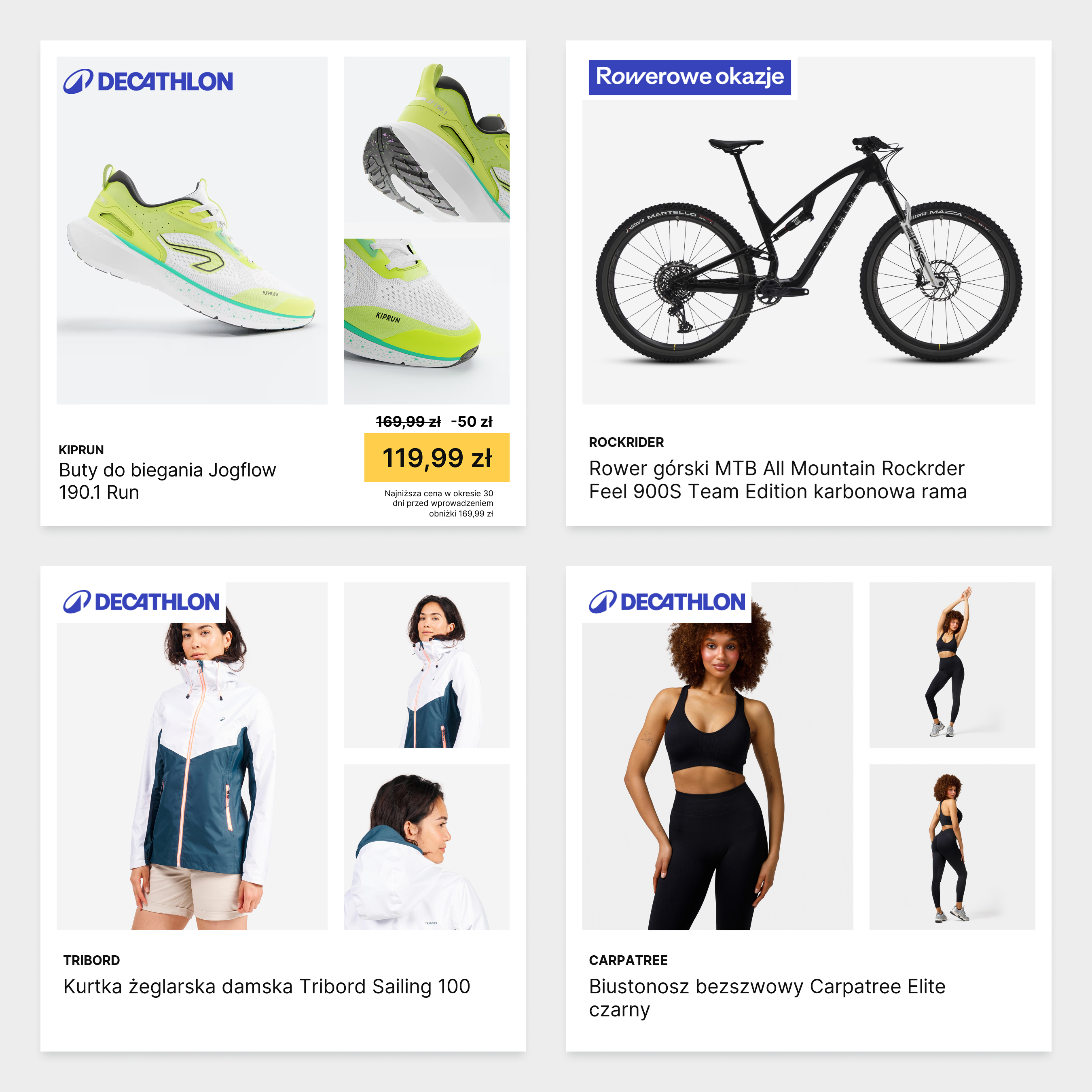
The examples above illustrate how enriched catalog ads provide more detailed decision-making information within a single placement.
With the running shoe ad, there are multiple product angles and a price drop, which makes the value and condition visible at first glance.
Contrarily, the apparel examples use multiple images to show fit, structure, and real-world wear. Close-ups highlight fabric and construction, while lifestyle shots communicate how the product looks in use. This gives shoppers enough context to judge comfort, performance, and style directly from the ad.
Each example uses enrichment to answer questions upfront.
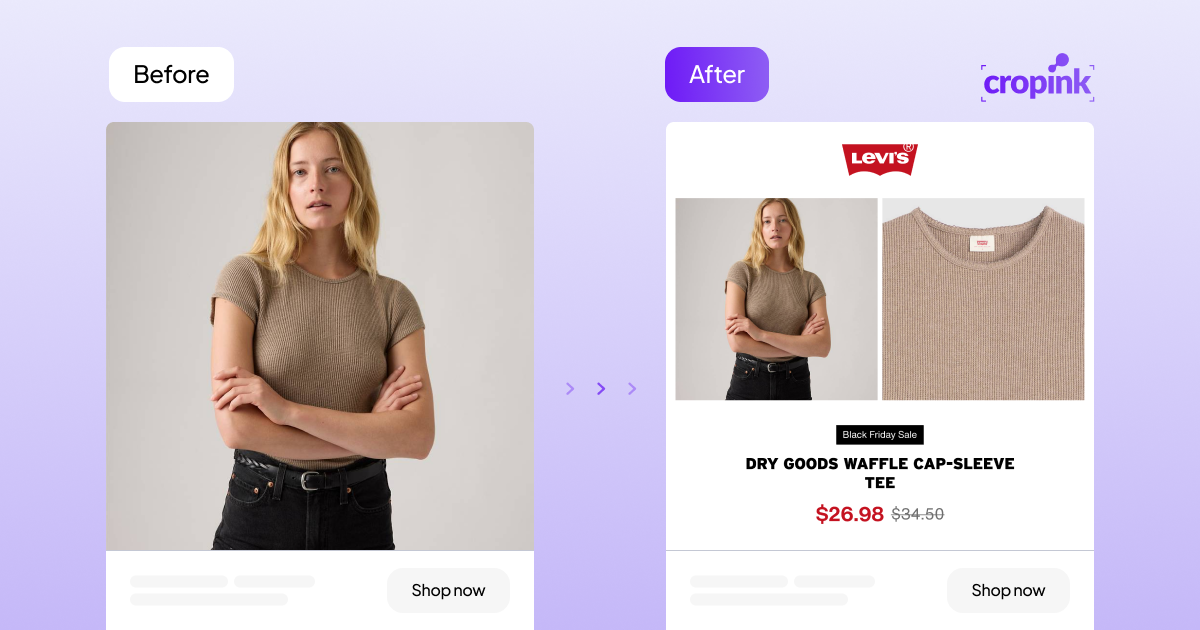
In this other example below, you can see how an ad can go from standard and boring to enriched and thoughtful of the shopper’s needs.
How can you create enriched catalog ads?
To illustrate the process, we’ll use Cropink as an example, as it offers a free plan that allows you to create and test enriched catalog ads without any upfront cost.
Let’s get into it.
- Prepare your product feed
Upload your product catalog as an XML file or connect directly from Shopify/Meta to give Cropink all your product data.
- Pick a template
Choose a dynamic ad template that fits your brand style. The template will automatically retrieve product information, including images, prices, and product names. We have hundreds of templates to choose from.
- Add enrichment elements
Make your ads stand out and more informative by adding:
- Dynamic text overlays: Show prices, discounts, or product details directly on the image
- Badges and frames: Add SALE, NEW, or discount stickers
- Conditional logic: Show or hide elements based on product attributes, like only showing a discount if it exists
- Branded visuals: Add logos, brand colors, fonts, or backgrounds
- Multiple image layers: Use icons or decorative elements over the product photo
- Conditional styling: Adjust font size, color, or placement depending on the product
- Generate ads automatically
Cropink creates enriched versions of every product in your feed and applies your chosen style, overlays, and conditional elements across all SKUs.
- Export and connect to platforms
You can now export the enriched catalog feed to the platform you want to advertise on. If you're working with Meta, Cropink has a direct integration for that.
Check out this guide for a more detailed review of how to use Cropink for your enriched catalog ads.
Get started with enriched catalog ads
Enriched catalog ads are a must-use for any ecommerce brand that wants to increase its sales while keeping ads relevant to each shopper.
Setting them up requires upfront effort, but once the system is in place, the process runs automatically. The work you put in upfront pays off in better engagement, higher conversion rates, and less time spent on campaign management.
See how these brands benefited from enriching their catalogs.
And if you're ready to test enriched catalog ads for your store, sign up for a free trial on Cropink.
FAQs
An enriched catalog ad is a shopping ad that dynamically surfaces product attributes like reviews, pricing, stock status, or shipping details based on who's viewing it. It shows prospects why a product fits their needs, not just what it is.
Standard catalog ads only show basic product information, while enriched catalog ads layer in contextual details, such as discount badges, customer ratings, or compatibility callouts, that adapt to each shopper's intent and behavior.
Not necessarily. You use the same product feed you already have. Enrichment occurs through platform logic or third-party tools that extract additional attributes from your feed and dynamically apply them to the ad creative.
Google Shopping, Meta, Bing Shopping, Pinterest, TikTok, and Amazon all support enriched catalog ads.
While they work well for retargeting, enriched catalog ads are also effective for seasonal campaigns, cross-selling, upselling, and prospecting.
Damaris is a Digital Marketing Specialist who writes about digital marketing and performance marketing. At Cropink, she creates data-driven content to help businesses run better ad campaigns for better performance and ROI.
Leszek is the Digital Growth Manager at Feedink & Cropink, specializing in organic growth for eCommerce and SaaS companies. His background includes roles at Poland's largest accommodation portal and FT1000 companies, with his work featured in Forbes, Inc., Business Insider, Fast Company, Entrepreneur, BBC, and TechRepublic.
Related Articles


How Can Cropink Help?
Start with Cropink is easy and free
No credit card required