What Is a Good Frequency for Facebook Ads?
Ad frequency can make or break your Facebook campaigns, but there's no magic number that works for everyone. In this article, we explain how frequency affects performance and how to find the right level for your specific campaign objective.


If you ask ten advertisers what the ideal Facebook ad frequency is, you’ll get ten different answers. Some will insist it should stay under two, while others argue that the higher the frequency, the greater the chance of a conversion.
The truth is more nuanced.
Ad frequency can increase recall, amplify purchase intent, and improve performance. However, it can also tank your CTR, inflate CPCs, cause ad fatigue, and ultimately lead to poor brand perception.
That's why, when you're evaluating your ad frequency, you'll need a good understanding of the context, campaign objective, audience size, and creative strategy.
In today's blog, we're explaining what frequency for Facebook ads means, how it affects performance, and how to determine the right level for your campaigns.
Key takeaways
- Frequency measures how often the same person sees your ad, but the average Meta reports can mask overexposure within specific audience segments.
- There is no universal ideal frequency. The right number depends on your campaign objective, ad format, placement, and audience size.
- Top-of-funnel campaigns generally perform best at a frequency below 2 per week, while retargeting campaigns can sustain a frequency of 3 to 8 per week.
- Frequency numbers are meaningless without a time context. A frequency of 4 per month is very different from a frequency of 4 per day.
- If frequency is climbing and performance is holding, there is no urgent reason to intervene. However, if performance is declining alongside rising frequency, refreshing your creative should be your first move before touching targeting or budget.
What is ad frequency on Meta?
Ad frequency on Facebook ads refers to the number of times a viewer has seen your ad.
It's normal and often beneficial for viewers to see an ad more than once. That’s because repeated exposure can improve brand recall and keep your offer top of mind. But if you push that frequency too high, it will start working against you.
Facebook calculates frequency as:
Frequency = Impressions ÷ Reach
It's worth noting that the frequency figure Meta reports is an estimate, an average across all users in your audience. That distinction is important because ad fatigue can set in even when your average looks healthy.
Consider this example.
- Audience size: 10,000
- Total impressions: 20,000
- Average frequency: 2
But the actual distribution might look like this:
- 3,000 users saw the ad once
- 4,000 users saw it twice
- 3,000 users saw it five times
The average stays at 2, but that last group of 3,000 people has already been overserved. They're the ones most likely to experience ad fatigue, and your aggregate metric won't flag it.
How frequency affects performance, engagement, and budget
The relationship between frequency and performance is more of a slow burn than a linear one. At first, higher frequency works in your favor. Then, gradually, it starts costing you.
Ad fatigue is the clearest sign that things have gone too far.
When your audience has seen the same ad too many times, one of two things happens: they stop registering it entirely (banner blindness), or they get annoyed enough to hit 'hide this from my feed.'
Either way, your campaign suffers.
If you notice performance declining as frequency climbs, that's your signal to refresh your creative or revisit your targeting.
In fact, according to AdEspresso, once frequency exceeds 4, CTR drops by up to 23.34% and CPC increases by 68.02%. By the time frequency hits 9, CTR has fallen by nearly 50% while CPC has more than doubled, rising by 161.15%.
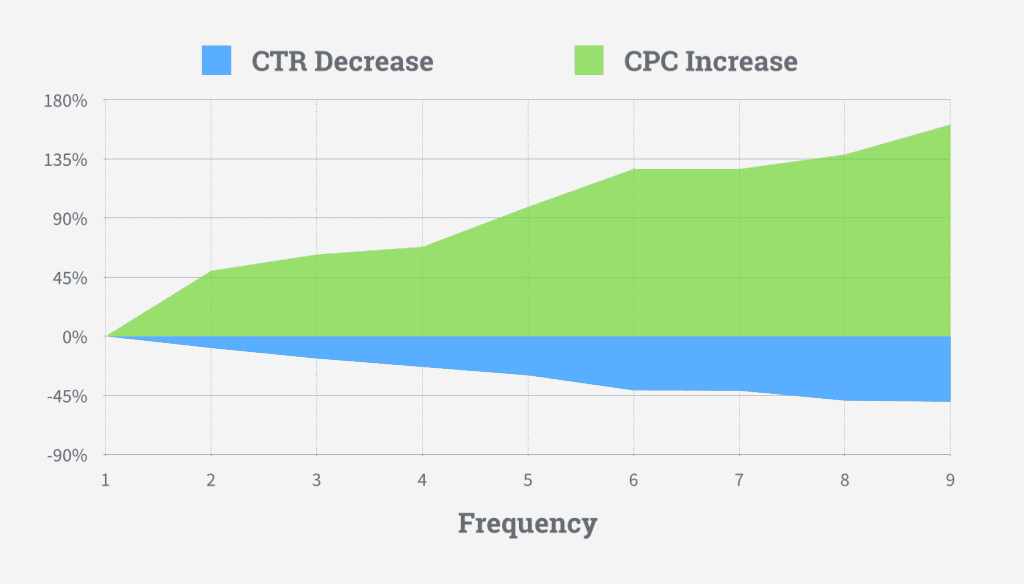
The chart above illustrates exactly how these two metrics diverge over time: as frequency scales up, you're paying significantly more for clicks that are becoming increasingly rare.
That cost dynamic is important from a budget standpoint.
A deteriorating CTR combined with an inflating CPC means you're spending more to achieve less. And that's a problem that can drain your budget before the performance drop is obvious enough to act on.
And now to the most important question:
What is the optimal Facebook ad frequency?
It depends, and that's not a cop-out answer.
As you'll see below, there's no one-size-fits-all answer. The right frequency for your campaign will be influenced by several factors, and finding your sweet spot will require some testing on your end.
That said, Meta's own research gives us a useful starting point.
In an experiment examining how often people need to see an ad before it makes an impact, they found that as frequency increased, both ad recall and purchase intent improved, but at different rates.
Ad recall started to level off at around one impression per week. Beyond that point, additional exposures added very little memory lift.
Purchase intent behaved differently.
It kept climbing past one impression per week and only began to slow down closer to 1.5 impressions per week.
Takeaway: helping someone remember your ad requires fewer exposures than convincing them to buy.
Beyond that baseline, Facebook recommends adjusting your frequency targets based on three categories of factors.
| Factor category | Lower frequency | Higher frequency |
|---|---|---|
| Market factors | New brand Low market share Short purchase cycle Frequent product usage Low share of voice | Established brand High market share Long purchase cycle Less frequent usage High share of voice |
| Message factors | Low message complexity High message uniqueness Existing campaign or familiar message | High message complexity Low message uniqueness New campaign or new message |
| Media factors | Low season Long campaign duration Continuous scheduling Multiple media channels | High season Short campaign duration Pulse or flight scheduling Facebook only |
It's also worth noting that ad format plays a huge role in ad frequency.
For dynamic ads, such as catalog ads for an ecommerce store, a high frequency isn't always a red flag.
Because the viewer is seeing different creatives depending on the time of day, their behavior, and a changing product feed, repetition feels less like repetition.
The campaign objective is another factor to consider when determining whether your Facebook ad frequency is ideal. Meta Ads Strategist Jason Gan recommends the following benchmarks.
For top-of-funnel campaigns, ideally over a 7-day period, you want your frequency to be below two because the goal is to reach as many new people as possible. For retargeting, it depends on your journey and product. Over seven days, the ideal frequency can be anywhere from three to eight. There's no fixed best number. Every campaign has its own sweet spot, so you have to test to find what works.

Meta Ads Strategist at Tribeup
Note that frequency numbers are meaningless without a time context.
A frequency of 4 per month is very different from a frequency of 4 per day.
Checking your ad frequency on Meta Ads Manager
In most cases, especially when you're running reach and engagement campaigns, Facebook will provide frequency data directly on your Meta Ads Manager reporting dashboard.
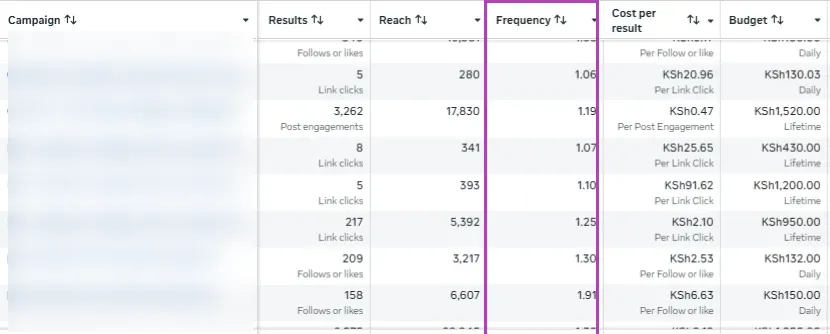
If you don't see it there, you can add it manually in a few steps.
- In your Ads Manager, click Columns to add that metric to your dashboard.

- Then select Customize columns.
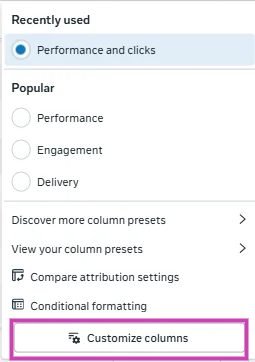
- From there, search for frequency and add it to your reporting view.
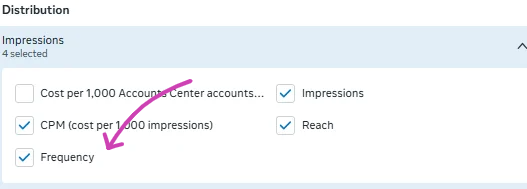
Frequency data is most meaningful when you're looking at it within a defined time window. Reviewing frequency over your campaign's full lifetime can flatten out spikes that would otherwise prompt you to act. Filtering by a shorter date range, such as the last 7 or 14 days, will give you a more accurate picture of how your audience is currently experiencing your ads.
How to reduce Facebook ad frequency
If your frequency is climbing and your performance is starting to show it, here's what you can do about it.
1. Consider setting a frequency cap
Managing how often people see your ads is part of running efficient Meta campaigns.
One option is to set a frequency cap during campaign setup, which works best when you already know the exposure level that performs well in your industry and for your specific offer.
Frequency controls are available in reservation campaigns, and they come in two forms.
A frequency cap lets you set the maximum number of times a person will see your ad within a defined time period.
Target frequency, on the other hand, lets you choose the average number of times per week you want someone in your audience to see your ads.
Both options are available under Awareness and Engagement objectives when using the Maximize Reach or ThruPlay performance goals.
You set frequency controls at the ad set level.
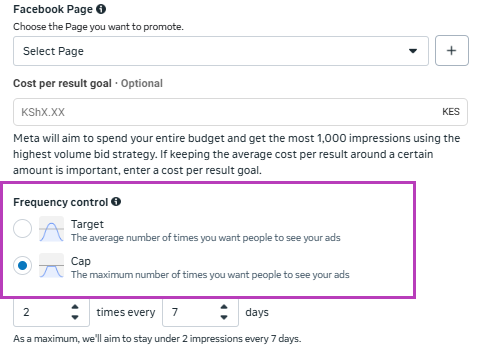
You can also define the number of frequencies and the date range for which those frequency counts would be ideal.
2. Rotate your creatives
Even if your targeting is dialed in, showing the same ad creative repeatedly will wear out your audience.
The fix is to build enough creative variety that viewers don't feel like they're seeing the same ad on a loop.
This means varying your visuals, ad copy angles, and formats across your active ads.
A user who has tuned out a static image ad may still engage with a video covering the same offer. Rotation also gives you useful performance data, since you'll quickly learn which creatives hold attention longer before fatigue sets in.
As a general rule, if your frequency is rising and your CTR is dropping, refreshing your creative should be your first move before adjusting targeting or budget.
3. Exclude audiences who have already converted
Continuing to serve ads to people who have already taken the action you're optimizing for is both a budget drain and a brand perception issue. Someone who just purchased from you doesn't need to see a 'buy now' ad the next day.
You can prevent this by building exclusion audiences from your website data, customer lists, or CRM.
Set these exclusions at the ad set level so that anyone who has already converted is automatically removed from your targeting pool. That will keep your frequency numbers healthier and your ads relevant to the people who still need to see them.
4. Expand your audience
Often, high frequency isn't a targeting problem or a creative problem. It's simply a reach problem. When you're working with a small audience, the algorithm has limited room to spread impressions, so the same people end up seeing your ad repeatedly.
Expanding your audience will give the algorithm more space to work with, which naturally brings frequency down.
Two ways to do this are lookalike audiences and interest-based targeting.
Lookalike audiences let you reach new people who share behavioral and demographic traits with your existing customers. This audience type is a good option when you want to scale without sacrificing relevance.
Interest-based targeting, on the other hand, lets you layer in broader segments that may not have encountered your brand yet but fit your ideal customer profile.
Either way, a larger audience pool means more unique users seeing your ads, fewer repeat impressions, and a healthier frequency overall.
Final thoughts on Facebook ads frequency
Ad frequency can significantly impact your campaigns, but there is no universal ideal frequency to aim for.
The ideal frequency will depend on your objective, placement, and ad format.
If frequency is climbing and performance is declining, that's your signal to make adjustments. That said, if frequency is high and your campaign remains profitable and scalable, it doesn't warrant concern.
For advertisers who rely on creative rotation to keep frequency in check, having a consistent pipeline of fresh assets is essential. And for that, you’ll need a creative automation platform such as Cropink.
Cropink allows you to generate hundreds of ad designs directly from your product feed, so your audience always sees something fresh without your team burning time building each creative manually.
There’s an entirely free plan you can try today. Check it out. You don’t even need a credit card to sign up.
FAQs
There is no single number that applies to every campaign. As a general benchmark, a frequency of 1 to 2 over a 7-day period works well for top-of-funnel campaigns where the priority is reaching new people. For retargeting, a frequency of 3 to 8 over the same period is more appropriate. The most important thing is to monitor performance alongside frequency and adjust when you see signs of fatigue.
Frequency refers to the average number of times a person in your target audience has seen your ad within a given time period. It is calculated by dividing total impressions by total reach.
Frequency controls are available in reservation campaigns under Awareness and Engagement objectives. You can set either a frequency cap, which limits the maximum number of times someone sees your ad, or a target frequency, which sets the average number of times per week you want someone to see it. Both options are configured at the ad set level during campaign setup.
When the algorithm has a limited pool of people to serve your ads to, it will naturally show your ad to the same users more often. Expanding your audience gives the algorithm more room to distribute impressions, which keeps frequency at a healthier level.
Damaris is a Digital Marketing Specialist who writes about digital marketing and performance marketing. At Cropink, she creates data-driven content to help businesses run better ad campaigns for better performance and ROI.
Leszek is the Digital Growth Manager at Feedink & Cropink, specializing in organic growth for eCommerce and SaaS companies. His background includes roles at Poland's largest accommodation portal and FT1000 companies, with his work featured in Forbes, Inc., Business Insider, Fast Company, Entrepreneur, BBC, and TechRepublic.
Related Articles


How Can Cropink Help?
Start with Cropink is easy and free
No credit card required