What Are Showcase Shopping Ads, and Are They Relevant in 2026?
Showcase Shopping ads helped retailers capture early-stage buyers, generating 25–30% of mobile ad impressions before being retired in 2021. This guide explains what Showcase Shopping ads were, why Google removed them, and how Performance Max and Demand Gen now replicate their discovery impact.


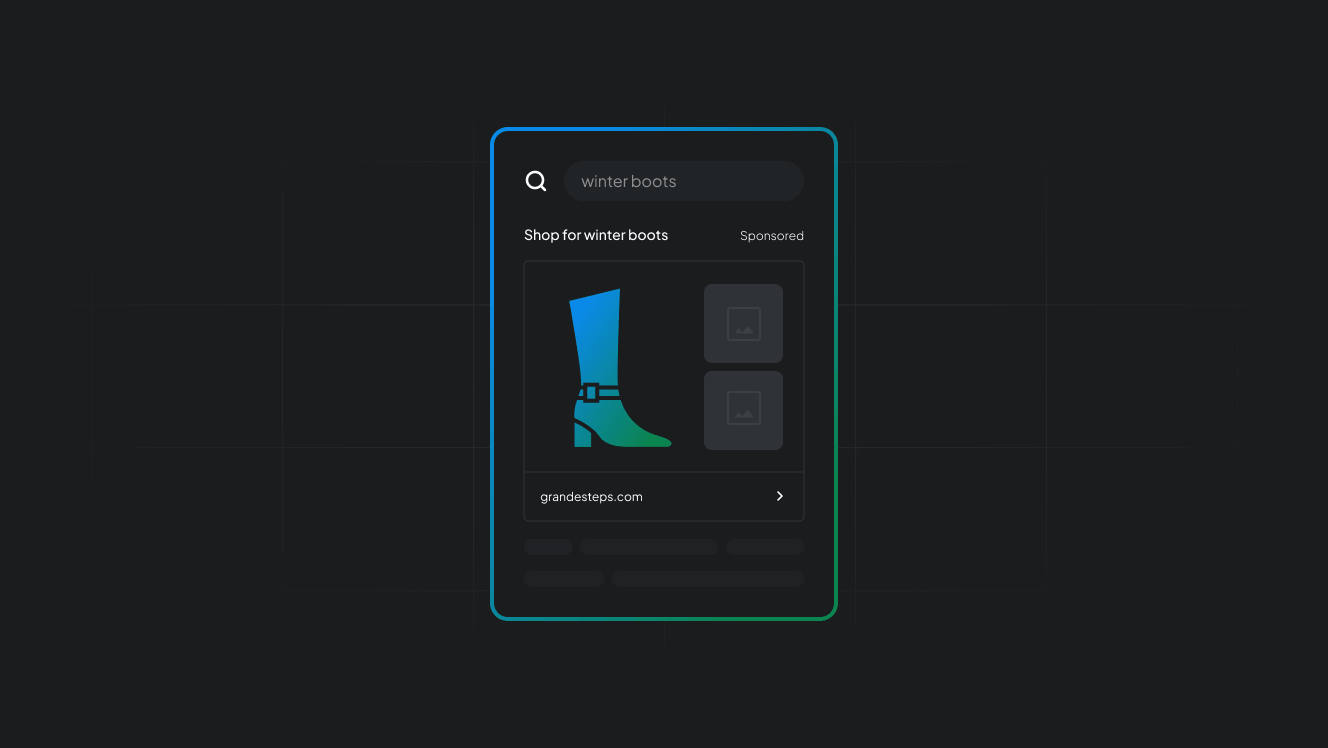
Showcase Shopping ads were all the rage five years ago.
If you ran Google Ads for an ecommerce store at the time, you probably used them to catch browsers who weren't ready to buy yet but wanted to explore what you had to offer.
Then they disappeared.
Google deprecated Showcase Shopping ads, and the format is no longer available as a standalone campaign format.
If you've been searching for them in your Google Ads dashboard or trying to figure out what happened, you're not the only one.
The good news is that Google didn't just delete Showcase Shopping functionality and walk away.
They incorporated the elements that made these ads effective into two newer campaign types.
Today, we'll walk you through what Showcase Shopping ads were and how to achieve the same upper-funnel discovery results using the tools available today.
Key takeaways
- Showcase Shopping ads were deprecated in April 2021 and are no longer available.
- Their functionality has been absorbed by Performance Max (PMax) and Demand Gen campaigns.
- Showcase Shopping ads accounted for 25-30% of all mobile ad impressions for retailers using them.
- Performance Max campaigns reportedly deliver 20% more conversions and 75% lower cost per acquisition compared to older campaign formats.
What are Showcase Shopping ads?
Showcase Shopping ads were a Google Ads format created for shoppers in research mode. These ads displayed a curated collection that expanded when someone clicked on it.
They were like a mini product catalog triggered by broad search terms.
If someone searched for 'running shoes' or 'office furniture,' they would see a Showcase Shopping ad highlighting a brand or category.
Google's own documentation noted that this format performed best with general searches rather than specific product queries. The primary objective of the ads was to catch people before they knew exactly what product they wanted.
Google launched the showcase format in 2016.
Over the next few years, the company expanded where these ads could appear.
Google introduced video capabilities in 2018, and by 2019, the ads were appearing in Google Images, the Discover feed, and YouTube. Gmail became another placement option in early 2020.
At their peak, Showcase Shopping ads accounted for roughly a quarter to a third of all mobile ad impressions for retailers using them.
You paid using a cost-per-engagement model, which meant you only got charged when someone interacted with your ad beyond the initial impression.
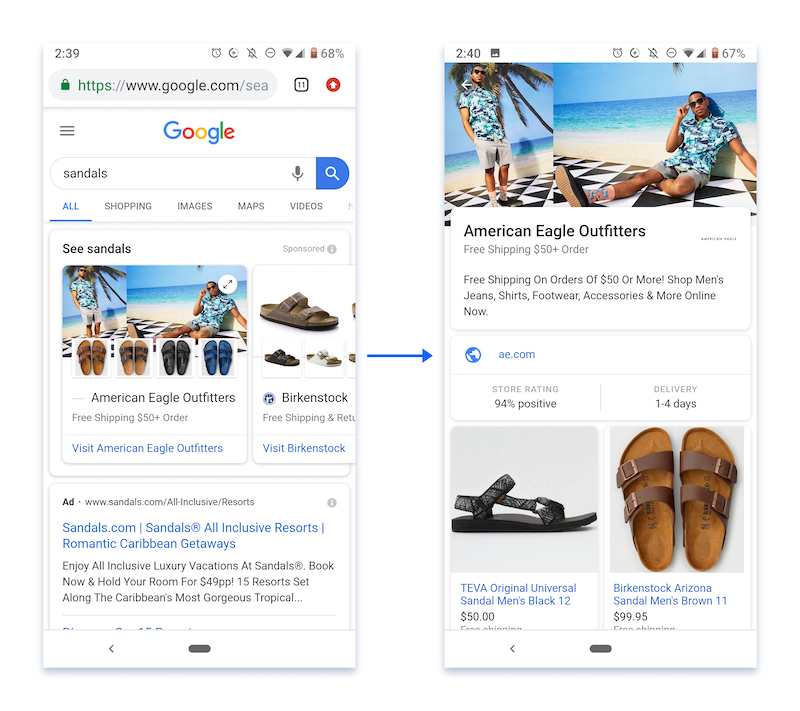
This is how the Google Showcase Shopping Ads looked.
What happened to Showcase Shopping ads?
Google ended Showcase Shopping ads as a standalone campaign format in April 2021.
The company sent notices to advertisers explaining that the format would stop serving ads entirely.
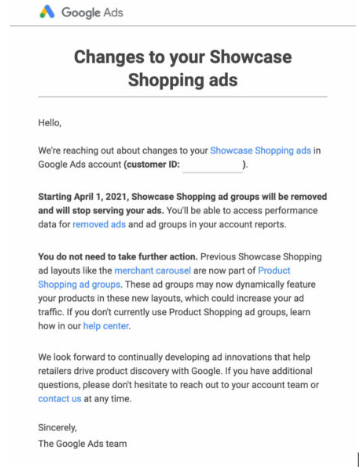
Accounts could still access historical performance data for removed ads and ad groups, but you couldn't create new Showcase campaigns or run existing ones.
Google didn't leave advertisers completely stranded.
They explained that previous Showcase Shopping ad layouts would automatically transition into Product Shopping ad groups.
The merchant carousel element became part of standard Product Shopping ads, and these new ad groups could dynamically feature products in updated layouts.
When and where were Showcase Shopping ads used?
Retailers turned to Showcase Shopping ads in three main scenarios.
- First, if you sold multiple products within the same category, these ads allowed you to display your range instead of betting on a single item. For example, a furniture store could show an entire living room collection rather than just one sofa.
- Second, they worked well for products that shoppers typically compare before buying. Categories like electronics, fashion, and home goods fit this pattern.
- Third, brands used them to build awareness among shoppers who were unfamiliar with them. The expanded catalog format gave brands space to introduce their business and product selection to cold traffic.
Retailers created these ads within standard Shopping campaigns in Google Ads.
Once live, they could appear across Google Shopping, Google Search results, and Google Search Partners.
Google served these ads for broad, non-branded searches where someone was exploring options rather than hunting for a specific product or brand.
If you’re still interested in the showcase capability of these ads, you can consider running TikTok Dynamic Showcase Ads or Shoppable Ads.
Showcase Shopping ads vs. Standard Shopping ads
Standard Shopping ads and Showcase Shopping ads serve different parts of the buying journey.
Standard Shopping ads target shoppers who are ready to buy. They display a single product with its price, image, and a direct link to purchase.
On the other hand, Showcase Shopping ads targeted browsers.
They displayed a product range and let shoppers explore a retailer's catalog before committing to any one item. The format worked for people still comparing options and figuring out what they needed.
Another difference is that with Showcase Shopping ads, the initial click to expand the catalog didn't cost advertisers anything.
Google only charged when someone clicked through to a specific product in the ad's expanded view.
What replaced Showcase Shopping ads?
Google didn't build a direct replacement for Showcase Shopping ads.
Instead, the company rolled that functionality into two campaign types: Performance Max and Demand Gen.
These two campaign types can help you reach shoppers in research mode and showcase product collections. They just do it differently.
Performance Max (PMax)
Performance Max automatically runs your ads across Google's entire network.
The network in this case includes Search, Shopping, YouTube, Display, Gmail, Discover, and Maps.
On your end, you feed the system your product catalog, creative assets, and campaign goals. Google's AI then handles the bidding, placement, and audience targeting.
PMax campaigns reach over 90 percent of active Google users.
Some reports have also suggested that Performance Max campaigns deliver 20 percent more conversions and 75 percent lower cost per acquisition compared to older campaign formats, though results vary by industry and setup.
See our detailed guide on PMAX campaigns.
Use Performance Max when:
- You want automated, all-channel coverage with minimal manual input
- You have a diverse product catalog and want Google to find the best placements
- You're prioritizing conversions and revenue, even at the discovery stage
- You have limited resources for creative production
Demand Gen campaigns
Demand Gen campaigns were created for upper-funnel engagement.
These ads use videos, images, and carousels to build awareness and consideration. They appear on YouTube (including Shorts), Google Discover, and Gmail feeds.
Like Showcase Shopping ads, Demand Gen ads are best used when you want to win the attention of target audiences still in the discovery phase.
When is it best to use Demand Gen campaigns?
- Brand awareness and consideration are your primary goals
- You have excellent visual creative assets (videos, lifestyle imagery)
- You want more control over the upper-funnel narrative
- You're willing to accept longer conversion timelines for higher-quality brand engagement
How to Replicate Showcase Shopping ads with modern Google campaign types
Showcase Shopping ads were effective because they caught browsers with broad searches and showed them a curated selection of products.
You can recreate that experience using Performance Max and Demand Gen. However, the execution will be a bit different this time.
With Performance Max
First, ensure that you upload high-quality images that showcase your products from multiple angles.
Google's AI will pull from this product feed to create ads across its network.
Next, organize related products into asset groups.
Think in categories like 'summer dresses' or 'running shoes' rather than individual SKUs. This will mirror how Showcase Shopping ads grouped products by theme or search intent.
Lastly, use audience signals to direct the algorithm toward shoppers most likely to interact with your ads.
Don't just target people ready to buy.
You should also include broader interest categories and lookalike audiences based on past browsing behavior.
Google's AI will now automatically distribute your ads across Google Search, Google Shopping, Google Display, YouTube, and Google Discover.
And since these are high-visibility channels, you'll be able to win the attention of audiences that are already in a browsing and discovery mood.
With Demand Gen
Build visually rich carousels that showcase your product collections.
Specifically, use lifestyle imagery and video to demonstrate how your products fit into someone's life.
Also, set up Search Themes using broad, category-level terms, such as 'outdoor furniture' or 'workout gear.'
Finally, target lookalike audiences and in-market segments that indicate research behavior.
Your ad creatives should lean more on brand storytelling over product specs.
Demand Gen appears in feeds where people scroll for inspiration, so your ads need to match that browsing mindset.
Since Demand Gen campaigns zero in on top-of-funnel awareness rather than bottom-funnel conversions, run them only when you're already profitable with other campaign types.
The one constant: Your creatives
No matter which campaign type you use to replace Showcase Shopping ads, one thing has not changed.
Creative quality still has a huge say in whether shoppers engage with your ads.
After all, while Google’s automation can distribute ads efficiently, it cannot fix weak product imagery or inconsistent branding.
And if your creatives do not grab the audience's attention at first glance, it will be a lot harder to make them convert.
This is exactly why we recommend enriched catalogs.
When using a catalog enrichment tool such as Cropink, you can enrich your visuals with custom backgrounds, on-image text, reviews, badges, logos, and brand colors.
In turn, your ad's product imagery will be more intentional and scroll-stopping, especially in discovery-focused placements like Discover, YouTube, and Gmail.
Build stronger shopping ad campaigns:
- Pinterest Ads Formats
- 30+ Google Ads Statistics
- PMax Campaigns
- Display Ads Effective
- Facebook Dynamic Product Ads
- Instagram Dynamic Product Ads (DPA)
Final thoughts
Showcase Shopping ads disappeared in 2021, but the need they filled hasn't gone away.
Shoppers still browse before they buy, and they still want to explore collections and compare options. You, on the other hand, still need a way to reach them during that research phase.
Performance Max and Demand Gen can give you the tools to replicate what Showcase Shopping ads did as we've already shown you.
One thing that hasn't changed, though, is the need for high-quality creatives.
Fortunately, there are a ton of catalog ad creation platforms that can help you with this part.
If you're looking for a simple and easy-to-use platform, we recommend starting with Cropink.
Cropink enriches your product images with custom backgrounds, on-image text, review badges, logos, and brand colors.
You can apply these elements across your entire catalog in bulk and ensure they’re optimized for different placements.
FAQs
Showcase Shopping ads were a Google Ads format that displayed a curated collection of products when someone clicked on them. Google deprecated this format in April 2021.
Showcase Shopping ads appeared across Google Shopping, Google Search results, and Google Search Partners. By 2020, they also showed up in Google Images, the Discover feed, YouTube, and Gmail. They were designed to surface during broad, non-branded searches where shoppers were still exploring options.
Yes, Showcase Shopping ads used a cost-per-engagement (CPE) bidding model. The initial click to expand the catalog was free, and you only paid when someone clicked through to a specific product in your expanded ad view.
Performance Max works best if you want automated coverage across all Google channels with minimal manual input. Demand Gen is better, though, if brand awareness is your priority and you have excellent visual assets, such as videos and lifestyle imagery.
Sources
Damaris is a Digital Marketing Specialist who writes about digital marketing and performance marketing. At Cropink, she creates data-driven content to help businesses run better ad campaigns for better performance and ROI.
Leszek is the Digital Growth Manager at Feedink & Cropink, specializing in organic growth for eCommerce and SaaS companies. His background includes roles at Poland's largest accommodation portal and FT1000 companies, with his work featured in Forbes, Inc., Business Insider, Fast Company, Entrepreneur, BBC, and TechRepublic.
Related Articles

How Can Cropink Help?
Start with Cropink is easy and free
No credit card required