9 Real-Time Marketing Campaigns That Got It Right
From Oreo’s quick Super Bowl tweet to KFC’s bold product response, these 9 real-time marketing campaigns show how brands win by reacting fast and staying relevant. Learn how cultural timing, humor, and creative execution helped each campaign earn attention and boost engagement.


Marketers struggle to stay relevant in a world that scrolls faster than it thinks.
Blink and the moment is gone. Brands that hesitate lose attention, and attention is everything.
Real-time marketing campaigns solve this by meeting audiences in the moment, not after it.
From Oreo’s blackout tweet to KFC’s bold response, these clever moves didn’t just follow trends, they shaped them.
If you want to win in a fast-moving digital world, these 9 real-time marketing campaigns show how to do it right.
Key takeaways
- Real-time success comes from being ready. Brands like Oreo and KFC nailed their timing because they had systems and teams in place to act fast. Preparation is what makes fast execution possible.
- Timing is nothing without relevance. The most impactful campaigns connect speed with cultural or brand relevance. Being quick only works when the message actually matters to your audience.
- You don’t need big budgets to make a big impact. Many standout real-time campaigns used simple, creative ideas. With tools like Cropink, even small teams can create high-performing, on-brand content fast.
1. Oreo – “You Can Still Dunk in the Dark”
The opportunity unfolded during the 2013 Super Bowl, a high-stakes media event where brands often spend millions to air polished commercials. Unexpectedly, the stadium experienced a sudden blackout, pausing the game for more than 30 minutes. While many advertisers were left scrambling or silent, viewers immediately shifted their attention to their phones and social feeds.
This unscripted moment opened the door for brands to connect authentically with a captive audience. Oreo was ready.
Brand response
Oreo's social media team, working with their creative agency 360i, had set up a live command center to monitor and respond in real time during the event.
When the blackout occurred, the team quickly conceptualized a visual and crafted a caption that tied into both the situation and Oreo’s product identity.
The result was a simple image of an Oreo cookie against a dark background with soft lighting, captioned: “You can still dunk in the dark.”
Importantly, this wasn’t pre-planned. The team had the autonomy to execute quickly, designing and publishing the tweet while the blackout was still happening. Their real-time workflow allowed them to turn cultural relevance into brand presence within minutes.
Execution highlights
Instead of being flashy or overly clever, the brand leaned into simplicity and context.
- The image was minimal, visually echoing the blackout without feeling forced
- The caption referenced the live event while staying true to Oreo’s signature product experience
- The tone was playful and comforting, reflecting Oreo’s family-friendly voice
- The post was instantly relatable, inviting social sharing without asking for it
By avoiding gimmicks or sales tactics, Oreo’s post felt more like a shared joke than a corporate ad.
Outcome
The tweet immediately gained momentum and quickly went viral. Even though it cost nothing to run, it stood out among big-budget Super Bowl ads.
- Over 10,000 retweets within hours
- Global coverage across media outlets, blogs, and marketing publications
- Recognition in marketing textbooks and presentations as a textbook example of agile branding
- A renewed image for Oreo as a culturally aware and digitally fluent brand
At a time when other brands were frozen in the dark, Oreo stood out simply by staying present.
Strategic takeaways
The campaign succeeded because it was aligned with the brand’s identity and the audience’s mindset. Oreo didn’t try to dominate the moment but joined it with just the right tone.
The act of dunking an Oreo in milk is nostalgic and familiar. By anchoring their message to this behavior, they made the blackout feel a little less inconvenient and a bit more human.
It also showed the value of operational readiness. Oreo's team had the creative, design, and approval processes in place to move instantly. This kind of speed doesn’t happen by luck. It requires teams to prepare, rehearse, and trust each other.
Real-time marketing only works when the response is both fast and relevant. Oreo nailed both.
Why it worked
A few critical factors made this campaign a success:
- Timeliness: It was posted while the blackout was still unfolding
- Relevance: It referenced a live moment with a meaningful product tie-in
- Clarity: The message was quick to read, easy to share, and visually appealing
- Preparedness: The team had systems in place for real-time execution
- Tone: The humor was gentle and widely relatable, never alienating
More than just a viral tweet, “You Can Still Dunk in the Dark” showed that marketing doesn't always need a media budget. It needs awareness, trust in the team, and a clear understanding of the brand’s role in culture.
2. Burger King “The scariest Burger King”
In October 2016, during the Halloween season, Burger King executed one of its boldest real-time brand moments.
Instead of running a typical seasonal promotion, the brand directly engaged with cultural attention by turning a real-world location into a live marketing statement.
At a Burger King restaurant in Queens, New York, the entire building was covered with a white sheet designed to resemble a ghost.
Spray-painted across the sheet was the word “McDonald’s”, instantly signaling a playful rivalry. Burger King’s own logo remained visible through cutouts, making the reveal even more striking.
Brand response
This move went beyond seasonal humor. It reinforced Burger King’s challenger identity while using humor to keep the tone light. A sign outside the restaurant completed the message:
“Boooooo! Just kidding. We still flame grill our burgers. Happy Halloween.”
The campaign launched without prior announcements or press coordination. Instead, it relied on the physical curiosity of passersby and the viral nature of social sharing.
Photos spread quickly across platforms, turning a single location into a global conversation.
Execution highlights
While very different from Oreo’s Super Bowl tweet in format, the strategic thinking was similar. Both campaigns understood timing, simplicity, and brand voice.
Key execution elements included:
- Instead of reacting to a trend, the brand created a moment tied to a cultural event
- The visual concept was instantly understandable and highly shareable
- Humor was used to lower risk while maintaining a strong brand message
- Physical presence encouraged organic content creation by the audience
- Brand rivalry was framed as playful rather than aggressive
This approach showed that real-time marketing does not always require reacting to breaking news. With the right cultural anchor, brands can manufacture relevance that feels spontaneous.
Outcome
The campaign quickly gained traction across digital and traditional media channels.
- Major publications covered the stunt, extending reach beyond social platforms
- Millions of organic impressions were generated within days
- Fans praised the brand for its confidence and creativity
- Burger King further strengthened its reputation as a bold and culturally fluent brand
Compared to Oreo’s reactive moment, this campaign demonstrated how proactive planning can still feel immediate and timely when executed with precision.
Strategic takeaways
Burger King showed that real-time marketing doesn’t always have to start online. Sometimes, doing something bold in the real world is what gets people talking and sharing.
A single physical stunt, when done right, can light up social media faster than a perfectly designed post.
What really made it work? The brand knew exactly who it was. Instead of avoiding its rivalry with McDonald’s, it leaned into it with humor. That confidence made the message feel fun rather than aggressive.
And timing mattered. Halloween gave Burger King the perfect moment to do something playful and unexpected. When a brand moves quickly and taps into the right cultural cue, it doesn’t just join the conversation, it takes the spotlight.
Why it worked
Several factors contributed to the success of this campaign:
- High visual impact that translated instantly across social platforms
- Cultural alignment with a moment that encouraged playful behavior
- Strong brand voice consistent with Burger King’s identity
- Simple execution that avoided complexity or overproduction
- Audience participation that turned customers into distributors
3. KFC “Fixed it”
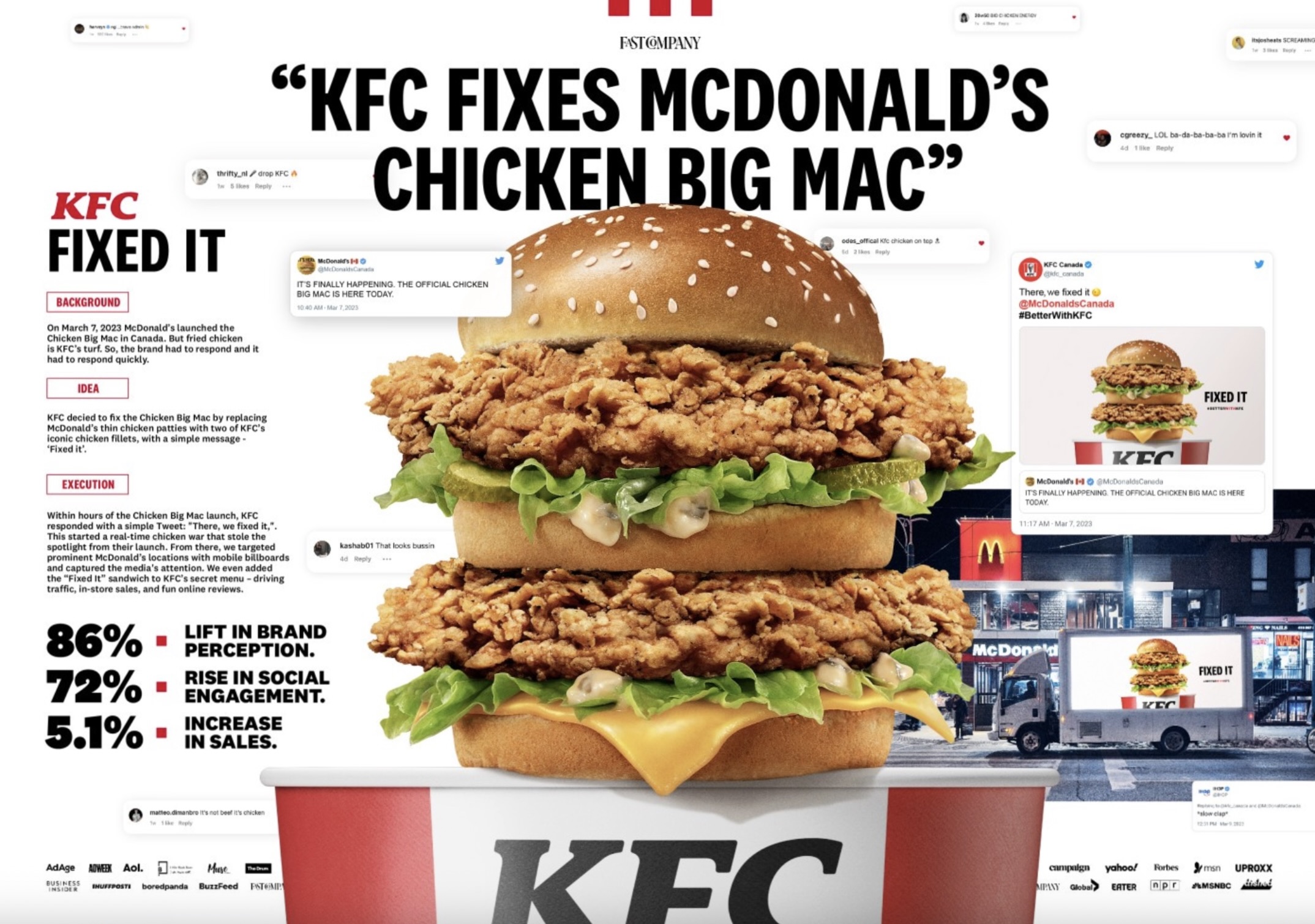
In 2023, McDonald’s Canada launched the Chicken Big Mac, aiming to build excitement around a new fried chicken offering.
However, the public response was underwhelming. Early reviews criticized the sandwich for its lack of crispiness, small size, and uninspired flavor.
What was meant to be a product highlight instead became a public misfire, and the online discourse quickly turned negative.
KFC, a brand with deep equity in fried chicken, saw an opportunity to respond.
What followed was a bold real-time intervention that directly addressed McDonald’s fumble, reclaiming the conversation through humor, confidence, and product strength.
Brand response
Rather than issuing a tweet or a press release, KFC launched a clever print ad that visually replaced the chicken in the Chicken Big Mac with KFC’s own crispy fillets.
The caption read simply: “Fixed it.” It was a statement, not just a tagline. The ad was clean, bold, and unmistakable in its jab.
KFC also deployed mobile billboards outside McDonald’s locations to reinforce the message. Each display boldly promoted KFC’s fried chicken quality, turning passive media into an active confrontation.
In the following days, KFC introduced a new sandwich called The Big Fix.
This item wasn’t just a product release. It was a response embedded into the product line, making the real-time campaign tangible for customers.
It invited curious eaters to try what the Chicken Big Mac should have been.
Execution highlights
Compared to Burger King’s Halloween stunt, which was rooted in theatrics and setting, KFC’s campaign leaned more into product and performance.
However, both campaigns shared sharp timing, cultural awareness, and a willingness to be bold.
The campaign unfolded with key strategic choices:
- Used competitor’s weakness as a launchpad without appearing petty
- Leveraged print and OOH media to give the campaign a physical presence
- Aligned messaging with product superiority rather than just humor
- Connected creative to a limited-time product offer for real impact
- Stayed visually minimal, letting the idea lead
Outcome
The “Fixed it” campaign sparked significant media attention, particularly in Canadian markets. It was widely shared on Twitter and Reddit, where users praised KFC for both the confidence and the taste.
- Social mentions and engagement around KFC surged
- Consumers who were disappointed by McDonald’s were quick to try KFC’s offer
- The Big Fix sold out in several locations during the first weeks
- The campaign was covered by local and international marketing press
- KFC strengthened its brand perception as the authority in fried chicken
While not as viral as Oreo’s tweet or as theatrical as Burger King’s Halloween moment, the campaign proved that cleverness backed by product substance can outperform stunts.
Strategic takeaways
This campaign demonstrates how real-time marketing can be used not just for brand storytelling but for direct competitive positioning. KFC didn’t wait for a cultural moment. It saw a brand stumble and inserted itself with clarity and confidence.
The move also reflects a more aggressive side of real-time marketing.
Where Oreo reacted playfully to an unexpected moment, and Burger King embraced seasonal humor, KFC made a statement that challenged its competitor directly.
Still, the tone was playful enough to avoid backlash. It framed the response as helpful rather than hostile, allowing audiences to join in on the humor rather than feel like they were witnessing a brand feud.
This balance between boldness and likability is critical in competitive RTM. It’s not about attacking. It’s about owning the moment with relevance, wit, and timing.
Why it worked
Several factors made this campaign successful:
- Tactical clarity by turning product strength into the hero of the story
- Relevance through direct engagement with what customers were already discussing
- Simplicity that made the message instantly understandable
- Follow-through by connecting the message to a new product experience
- Cultural fluency that understood the mood of the audience
4. KFC “Chicken Crisis FCK Bucket”
In 2018, KFC UK faced an unexpected crisis. A logistics issue left hundreds of locations without chicken, forcing store closures and causing a nationwide uproar. For a brand whose entire identity revolves around fried chicken, the shortage posed a reputational risk. But instead of hiding or deflecting blame, KFC owned the moment with humor, humility, and sharp design.
Brand response
The brand placed a full-page ad in major UK newspapers featuring an empty chicken bucket. But this was no ordinary bucket.
The logo had been cheekily rearranged to spell "FCK," visually capturing public frustration while signaling self-awareness.
Alongside the image was a short, sincere apology that acknowledged the issue without making excuses.
This bold creative decision transformed an operational failure into a widely celebrated act of brand accountability.
Execution highlights
Compared to the "Fixed It" campaign which challenged a competitor, this one turned the lens inward. But the impact was no less powerful. What made the execution work included:
- Visually striking use of packaging as the communication vehicle
- Bold rearrangement of the logo that walked the line between edgy and relatable
- Apology that was concise, genuine, and free from corporate jargon
- Strategic placement in national press to address public concern directly
- No attempt to spin or deflect—just an honest message and a smart creative twist
This approach echoed Oreo's campaign in terms of simplicity and tone, but the subject matter was far riskier. Yet by leaning into transparency and creativity, KFC managed to turn outrage into admiration.
Outcome
The ad quickly went viral, not only in the UK but globally. It was shared across social platforms and picked up by major media outlets.
- KFC's reputation for honesty and humor was significantly strengthened
- Customers expressed appreciation for the brand’s forthright tone
- The crisis became a case study in reputation management and creative PR
- Other brands cited the campaign as a model for crisis response
This wasn’t just a real-time reaction—it was a proactive creative pivot that re-established trust.
Strategic takeaways
This campaign showed that even when the news is bad, a brand can still lead the conversation. KFC’s self-deprecating humor and decisive communication helped prevent long-term damage.
The key was tone: by keeping the message light but sincere, the campaign felt human. It also demonstrated the power of simplicity—a bucket, a logo, and a clear message delivered in the right context.
Why it worked
- Self-awareness: The brand acknowledged the issue without being defensive
- Creativity: Turning a packaging element into a media visual was unexpected
- Tone: Humor softened the blow while sincerity built credibility
- Transparency: The brand didn’t deflect or over-explain
5. Netflix “Dynamic GIF Billboards”
Netflix has built a reputation for smart, data-driven campaigns, but in this case, they leaned into cultural mood and moment-by-moment resonance. Their "Dynamic GIF Billboards" campaign in France showcased how streaming content could mirror real-life emotions in real time.
Brand response
Instead of static out-of-home ads, Netflix deployed digital billboards equipped with preloaded GIFs from their most popular shows. These GIFs were manually updated throughout the day based on trending topics, weather, news, or social moods.
If it rained, billboards showed rainy scenes from their content. If a sports loss devastated fans, an emotional reaction from a character would appear. The campaign turned outdoor advertising into a responsive experience.
Execution highlights
Unlike the Oreo or Philadelphia campaigns, which were one-off creative hits, this campaign was built to evolve over time. Key strengths included:
- GIFs allowed emotional precision while keeping visuals short and impactful
- Local teams updated content in near real time to maintain cultural relevance
- The campaign combined digital agility with traditional billboard scale
- It was hyper-localized and adaptable, making it feel personalized for passersby
Outcome
The campaign resonated widely, particularly with younger audiences who are fluent in GIF culture:
- High social engagement from fans sharing photos of the GIFs
- Lift in brand favorability metrics across tested locations
- Proved that traditional media can behave like digital when combined with creative operations
Strategic takeaways
Netflix proved that emotional relevance can be scaled. The campaign was not about reacting to one moment, but about responding to many small moments across days and locations. This consistency created a sense of cultural presence that was always in sync with the audience.
Why it worked
- Adaptability: Constantly updated creative to reflect live cultural tone
- Format: GIFs delivered emotion in under a second
- Localization: Billboard messages felt personal to each city
- Channel fusion: Merged OOH with real-time digital behavior
6. Philadelphia “Philly Schmear Socks”
In early 2023, cultural conversations were heating up around food-inspired fashion, with brands like Nike launching themed products such as the “Montreal Bagel” sneaker.
This crossover between lifestyle and food opened an unexpected creative lane.
Philadelphia Cream Cheese, a brand typically associated with breakfasts and brunch spreads, saw a chance to enter the conversation in its own playful way.
Not with a product extension, but with a surprising limited-edition apparel release.
Brand response
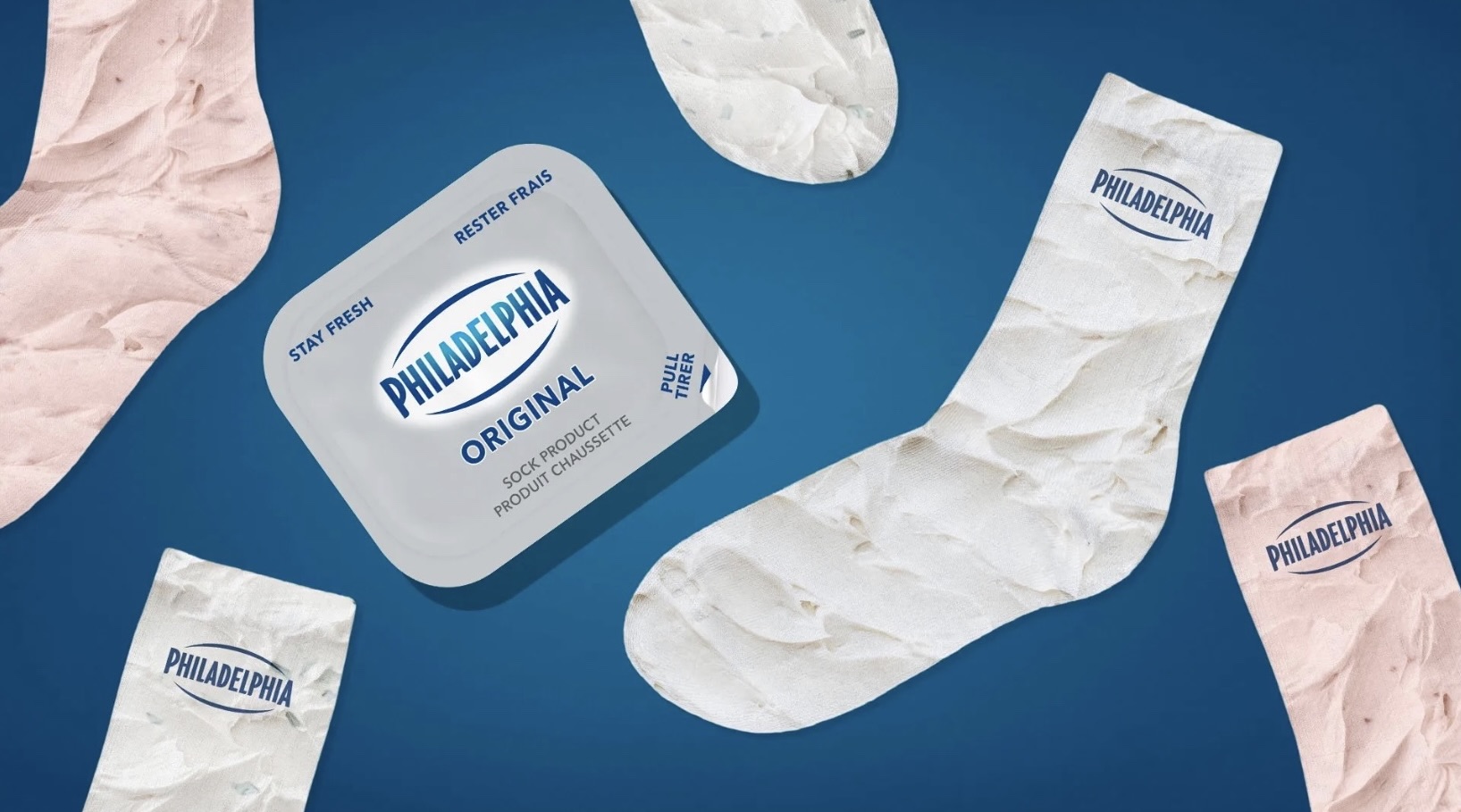
Instead of issuing a tweet or recipe collab, Philadelphia released a quirky line of branded socks called Philly Schmear Socks, each mimicking the visual texture of cream cheese spread on a bagel.
Available in “Original,” “Chive & Onion,” and “Strawberry,” each pair was packaged in mock cream cheese tubs to elevate the unboxing experience.
The idea was sparked by Nike’s bagel-themed shoe, but rather than competing, Philadelphia leaned into its role as the “schmear” in the bagel equation — completing the metaphor while riding a trending moment in design and fashion.
Fans were encouraged to share unboxings and style the socks, turning Instagram and TikTok into playful runways for this unexpected merchandise.
Execution highlights
While Oreo and KFC responded to live events, Philadelphia’s campaign focused on proactive trend hijacking. However, the campaign still demonstrated real-time agility in identifying and capitalizing on a timely cultural niche.
The strategy was grounded in:
- Building a product tie-in that elevated brand love into lifestyle territory
- Timing the launch to coincide with sneaker release buzz, adding contextual relevance
- Creating a physical product that encouraged user-generated content
- Maintaining a whimsical, approachable tone that made the campaign feel like a wink to fans
- Avoiding over-commercialization by making the socks a limited-edition novelty rather than a mass rollout
Outcome
The campaign became a viral sensation across social media and food-culture platforms:
- Unboxing content and style posts boosted brand mentions and visual visibility
- The sock line sold out quickly, with resale activity showing demand beyond initial supply
- Philadelphia earned media coverage in both food and lifestyle publications
- The campaign sparked a conversation about brand creativity and cross-category innovation
- Younger demographics engaged with the campaign, expanding Philadelphia’s traditional audience
Strategic takeaways
This campaign illustrates that real-time marketing isn’t just about reacting fast, it’s also about observing culture with a creative lens.
Philadelphia’s success stemmed from how well it read the zeitgeist and inserted itself with humor, humility, and design.
By choosing a soft format, cozy socks instead of a social post or ad, the brand expanded its image without pushing product. This subtlety built stronger brand affinity than a hard sell might have.
What stands out most is the self-awareness. Rather than trying to be "cool," the campaign leaned into quirky charm.
This authenticity made it easy for audiences to share and smile, boosting social currency in return.
Why it worked
Several aspects contributed to its success:
- Cultural awareness: The brand responded to a moment without trying to dominate it
- Format: The product created a real-world artifact that extended the digital campaign
- Brand alignment: The socks reinforced the cozy, indulgent nature of cream cheese
- User participation: Fans became the campaign’s amplifiers through social content
- Timing: The campaign was fast enough to stay adjacent to Nike’s buzz without feeling delayed
In comparison to Oreo’s blackout tweet or KFC’s roast, Philadelphia’s campaign was less confrontational and more whimsical, but no less effective. It shows that delight and cleverness can be just as powerful as speed or controversy in real-time brand building.
7. Heinz “Tomato Blood Halloween Kit”
Heinz has long embraced its role in Halloween culture, with ketchup often doubling as fake blood for costumes. But in 2022, they doubled down on the association with a fully branded Halloween kit that turned ketchup into a complete costume experience.
Brand response
Instead of simply rebranding ketchup as "Tomato Blood," Heinz released the Tomato Blood Costume Kit, which included a ketchup bottle, face paint, fake fangs, and other spooky accessories.
The kit was available in limited quantities and promoted through Halloween-themed pop-up stores and digital media.
Execution highlights
Heinz leaned into tradition and elevated it with new packaging and context:
- Recognized an existing consumer behavior and added structure around it
- Used real product but extended the narrative through accessories and storytelling
- Pop-ups provided experiential moments, ideal for social sharing
- Social ads and influencer seeding supported organic spread
Outcome
- The kits sold out quickly in both online and retail outlets
- The campaign generated earned media coverage around brand innovation
- Social media was filled with costume demos and unboxing content
- Heinz solidified its place in Halloween pop culture
Strategic takeaways
This campaign shows the power of formalizing existing behaviors.
By acknowledging that customers were already using Heinz in this way and packaging around it, the brand turned organic behavior into a branded ritual.
Why it worked
- Cultural insight: Built on an annual moment where ketchup naturally appears
- Product integration: No gimmicks, just creative extension of core product
- Experience: Turned a condiment into a costume centerpiece
- Emotional nostalgia: Tapped into childhood and DIY spirit of Halloween
Heinz’s approach mirrored Coca-Cola’s in making the consumer the center of the creative. It wasn’t about being the loudest, but being the most aligned.
8. IKEA “Team Insomniaque”
Sleep is a key part of IKEA’s product promise, but in a clever real-time twist, the brand flipped sleeplessness into an engagement opportunity.
Brand response
To mark World Sleep Day, IKEA France launched the "Team Insomniaque" campaign. Between 1AM and 5AM, users tweeting about their inability to sleep with the hashtag #TeamInsomniaque were randomly rewarded with beds, mattresses, or sleep accessories.
Execution highlights
- Leveraged social listening to identify and respond to real-time behavior
- Rewards were tangible and deeply relevant to the insomnia problem
- The late-night time window made the campaign feel exclusive and intimate
- Simple mechanics encouraged participation without friction
Outcome
- Brand mentions spiked during off-peak hours
- Earned media buzz positioned IKEA as thoughtful and responsive
- Positive sentiment from winners created organic testimonials
Strategic takeaways
IKEA proved that good timing doesn’t always mean mass visibility. By targeting a small window with high emotional resonance, the campaign earned more attention than a larger push might have.
Why it worked
- Timing: Engaged a highly specific audience when they were most emotionally vulnerable
- Utility: Gave relevant prizes that connected directly to product benefit
- Simplicity: No forms, no friction—just a tweet
- Humanity: Showed that the brand "sees" its audience, even in the middle of the night
IKEA’s campaign shared the same insight as Oreo’s blackout moment: presence matters. When brands are there in the moment, with empathy and value, they earn more than engagement—they earn trust.
9. Coca-Cola x Maroon 5 “24 Hour Live Session”
By the early 2010s, Coca-Cola was already a global icon known for emotional ads and major sponsorships. But the brand wanted something more personal, a way to connect with people in real time.
At the same time, Maroon 5 was topping charts worldwide, with a massive, engaged fan base. So Coca-Cola teamed up with the band to create a one-of-a-kind real-time marketing campaign that let fans help write a song live in just 24 hours.
It wasn’t about pushing a product. It was about turning fans into collaborators, creating a global interactive experience that felt spontaneous, creative, and genuinely exciting.
Brand response
Instead of releasing a polished single, Coca-Cola and Maroon 5 launched a bold real-time marketing campaign: a 24-hour live songwriting session streamed from a London studio. The twist was that fans could join the process.
Viewers from 139 countries tuned in and shared lyrics, beats, and ideas on Twitter. Those tweets were projected onto the studio walls, turning fans into creative collaborators in real time.
This wasn’t just a brand sponsorship. Coca-Cola became part of the experience, showing how real-time marketing campaigns can turn passive audiences into active participants and drive global brand engagement.
Execution highlights
Compared to Oreo’s concise and witty tweet or KFC’s cheeky product jab, this campaign was far more immersive and prolonged. It wasn’t about reacting to an event. It created its own moment and built live anticipation around it.
The campaign stood out for these key reasons:
- Invited user-generated content in real time from a global audience
- Used live video streaming long before it became mainstream
- Created a shared, time-sensitive event that rewarded early participation
- Translated digital interaction into physical studio feedback
- Aligned with the brand’s emotional and optimistic messaging around togetherness
Outcome
The campaign delivered both emotional resonance and measurable performance:
- Coca-Cola's Twitter engagement increased by over 1,300%
- The campaign generated 35 million Facebook impressions in less than two days
- Thousands of fans shared screenshots, lyrics, and reactions online
- The final song, “Is Anybody Out There,” became a symbolic token of participation
- Coca-Cola successfully reached younger demographics through music, creativity, and tech
- Media outlets praised the campaign as an early model of interactive branded entertainment
While it may not have had the viral humor of KFC or the cultural sting of Burger King, the Coca-Cola x Maroon 5 campaign made an emotional, collaborative mark.
It created not just engagement but involvement, where fans felt like creators, not spectators.
Strategic takeaways
This was a great example of proactive real-time marketing campaigns that don’t wait for trends but create their own. Coca-Cola didn’t just show up in the moment. It built the moment and made fans part of the story.
Unlike Oreo’s quick, witty tweet or KFC’s product clapback, this campaign took a slower, more emotional route. Fans weren’t just watching. They were co-creating. That sense of ownership made the experience stick and gave people a reason to share.
Even more impressive? Coca-Cola tapped into digital behaviors that feel totally normal now on platforms like TikTok and Twitch. But at the time, letting fans shape a brand moment in real time was ahead of the curve.
Why it worked
Several factors aligned to make this campaign a real-time success:
- Relevance: Music and Coca-Cola are both cultural universals
- Tech integration: Live-streaming and real-time social feeds created immersive access
- Emotional payoff: Fans got to hear their ideas turned into lyrics and melodies
- Global accessibility: Time zones and geography weren’t barriers — fans from over 130 countries participated
- Social proof: Tweets projected in-studio showed participants they were seen, heard, and valued
Compared to the high-impact shock of KFC or Burger King, Coca-Cola’s strategy was softer and more human. But that didn’t mean it lacked strength. In fact, it showed that real-time marketing can be collaborative, not just reactive.
And when done well, it deepens brand meaning and drives sustained conversation long after the campaign ends.
How to make your own real-time marketing campaign
Want to create a real-time marketing campaign that actually works?
Start with three basics: timing, relevance, and creative flexibility.
Whether you're reacting to a cultural moment or launching your own, success often comes down to how fast you can turn an idea into a visual.
That’s where tools like Cropink come in. With smart templates, instant product feed connections, and real-time design updates, you can turn product data into scroll-stopping catalog ads in minutes, no design team needed.
Start simple:
- Monitor trending topics or seasonal events your audience cares about
- Prepare ad templates or visual assets in advance
- Use flexible tools to adapt quickly when opportunity strikes
You don’t need a Super Bowl budget to stand out. You just need the right idea, the right timing, and a platform like Cropink that helps you move fast and stay on brand.
Frequently Asked Questions
Examples of marketing campaigns include social media campaigns, email marketing, influencer partnerships, and user-generated content activations. Real-time campaigns, like Oreo’s Super Bowl tweet or KFC’s product clapback, are great for brands that want to respond quickly to trends — tools like Cropink help make that speed possible.
Jollibee’s marketing strategy focuses on emotional appeal, targeting families and young adults by emphasizing themes like happiness, nostalgia, and togetherness. It blends localized content with consistent branding, similar to how a dynamic platform like Cropink helps global brands stay relevant across markets.
Nike’s “Just Do It” campaign is built around empowerment, urging audiences to take action and chase their goals. The simplicity and emotional drive behind this campaign are what make it iconic — a reminder that impactful messaging, when combined with consistent visuals, can create long-term brand loyalty.
Explore related ad strategy resources:
- Cropink for Agencies
- 35 Most Popular Social Media Platforms
- 10 Strategies for Better Performance
- 40+ Targeted Advertising Statistics
- Restrict Audience Meta Ads
- Facebook Dynamic Product Ads
Final Words
Real-time marketing campaigns thrive on speed, creativity, and cultural awareness.
From Oreo’s blackout brilliance to Coca-Cola’s global co-creation, the best moments happen when brands meet audiences where they are, in the moment.
Whether reactive or proactive, what matters most is staying relevant, relatable, and ready to move.
If you're looking to bring that same agility to your own product ads, Cropink makes it easy. From enriching your catalog creatives to automating campaign updates, it's built for marketers who want to stand out without slowing down.
Ready to move fast and convert faster?
Sources
Ansherina helps brands create powerful digital marketing and performance marketing strategies. With a passion for ad design and audience engagement, she is dedicated to making brands more visible and impactful.
Leszek is the Digital Growth Manager at Feedink & Cropink, specializing in organic growth for eCommerce and SaaS companies. His background includes roles at Poland's largest accommodation portal and FT1000 companies, with his work featured in Forbes, Inc., Business Insider, Fast Company, Entrepreneur, BBC, and TechRepublic.
Related Articles


How Can Cropink Help?
Start with Cropink is easy and free
No credit card required