Social Proof Ad Examples That Actually Convert in 2026
Social proof turns hesitant browsers into buyers. With 93% of consumers saying reviews influence their decisions and ads featuring testimonials earning 4x higher CTRs, the data is clear. This guide breaks down 10 real social proof ad examples across Meta, TikTok, and more, with actionable tips to apply them using Cropink.


93% of consumers say reviews are decisive in their purchase decisions, yet most catalog ads still run without a single trust signal.
Social proof is the gap between an ad that gets scrolled past and one that converts.
This guide breaks down 10 real social proof ad examples, what makes each one work, and how eCommerce brands can apply them at scale across every major ad format.
Key takeaways
- Social proof ads outperform standard ads by up to 4x on click-through rates, according to 2026 data.
- 93% of consumers say reviews influence their purchase decisions, making social proof the most trusted ad asset you have.
- Video testimonials drive an 80% lift in conversions vs. text-only reviews.
- TikTok UGC-style ads outperform polished brand creative by 2 to 3x in conversion rate.
- Cropink lets eCommerce brands embed star ratings, review text, and customer quotes directly into dynamic catalog ads, at scale, with zero dev work.
What Is Social Proof in Advertising?
Think about the last time you bought something online. Did you read the reviews first? Of course you did. That instinct is social proof in action.
Social proof is the psychological pull we feel when we see others have already done something. In advertising, it is any signal that says: real people tried this, trusted it, and came back for more. A star rating. A testimonial. "12,000 sold this month." A friend's text recommending a product.
It works because 70% of people trust online reviews, but only 40% trust a paid ad. That trust gap is your biggest conversion lever, and it connects directly to why dynamic product ads drive conversions at scale: when social proof travels with every personalised product impression, the trust signal hits at the exact moment of intent.The Numbers That Make the Case
Before we get into examples, here is why social proof is worth prioritising above almost any other creative element:
- 93% of consumers say online reviews are decisive in their purchase decisions.
- 4x higher click-through rates for ads featuring customer reviews vs. ads without any social proof.
- 80% conversion lift from video testimonials over text-only reviews.
- 270% more conversions when five or more reviews are visible on a product.
- +98% conversion boost from real-time social proof notifications like live purchase activity.
- 2-3x better conversion rate for UGC-style TikTok ads vs. polished brand creative.
These are not marginal gains. These are the numbers that separate brands spending the same budget and getting wildly different results. For a broader look at the consumer psychology behind these figures, the conversion rate optimization statistics resource is worth reading alongside this guide.
The 6 Types of Social Proof Used in Ads
Not all social proof hits the same. Here is how each type performs and where it belongs:
| Type | What it is | Best platform | Conv. lift |
|---|---|---|---|
| Customer reviews | Star ratings and verified buyer testimonials in the creative | Meta Feed, Catalog ads | +37% |
| Video testimonials | Real customers on camera, unscripted | TikTok, Instagram Reels | +80% |
| User-generated content | Organic customer photos, videos, and posts repurposed as ads | TikTok, Instagram | +29% |
| Expert endorsements | Influencers or industry figures recommending the product | Instagram Stories, YouTube | +41% |
| Social numbers | Purchase volumes, customer counts, bestseller badges | Catalog ads, Meta Feed | +62% |
| Real-time proof | Live notifications: "14 people viewing this", stock countdown | Dynamic catalog, DPA | +98% |
10 Social Proof Ad Examples That Actually Work
Real campaigns. Real results. Here is exactly what each format does, why buyers respond to it, and what you can steal immediately.
1. The five-star rating overlay ad
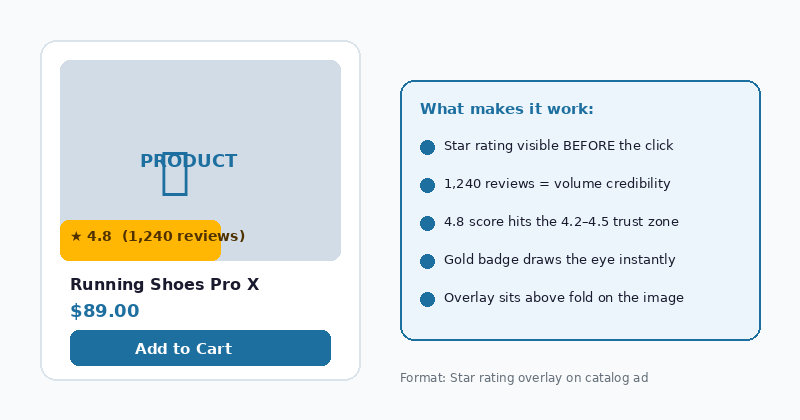
A product image with a star rating, say 4.8/5 from 1,240 reviews, stamped right on the creative. Simple. Devastating.
Star ratings are the single most recognisable trust signal on the internet. When a buyer sees 4.8 stars before they even click, the decision is already half made. And the number of reviews matters as much as the score: 4.8 from 12 people reads differently from 4.8 from 12,000.
One critical nuance: the sweet spot is 4.2 to 4.5 stars, not 5.0. Perfect scores trigger scepticism. A slightly imperfect rating with volume says this is a real product with real buyers.
- Lead with your most reviewed SKU in the first test, not your favourite product
- Show both the score and the review count together, never one without the other
Cropink application: Cropink pulls your product rating and review count directly from your product data feed and maps them dynamically onto every ad template. Each SKU gets its own live rating, with zero manual creative work.
Five-star rating overlay on a dynamic product catalog ad. The score and review count are pulled live from the product feed.
2. The UGC video testimonial ad
A 15 to 30-second video. Real customer. Phone camera. No script. Maybe a kitchen counter in the background.
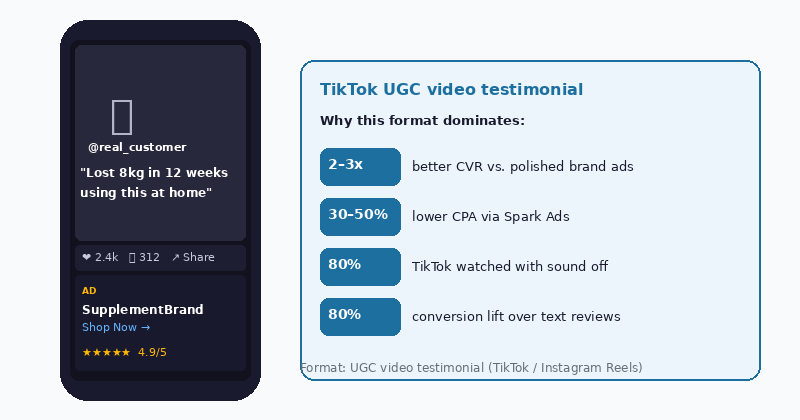
This format outperforms polished brand creative by 2 to 3x on TikTok, according to TikTok's own Creative Center data. The messiness is the message. It bypasses the viewer's built-in ad detector because it looks and feels like content, not advertising.
TikTok Spark Ads take this further: when you boost an existing organic post as a paid ad, the original likes, comments, and shares come with it. The social proof is baked into the ad unit itself before a single paid impression runs. That is why Spark Ads deliver 30 to 50% lower cost per acquisition than standard In-Feed ads.
- Start with the outcome: "I lost 8kg in 12 weeks" stops the scroll. "I bought this supplement" does not
- Keep it under 30 seconds. Completion rate drops sharply after that
- Add captions. 80% of TikTok is watched with the sound off
For brands already running TikTok catalog ads, pairing this UGC format with a live product feed means the authentic social proof and personalized product delivery land in the same creative at the same moment.
UGC video testimonial ad format on TikTok. Unscripted, phone-shot, outcome-first hook, 2–3x better CVR than polished brand creative.
3. The customer quote static ad
No product photo. No headline. Just a verbatim customer quote filling most of the frame.
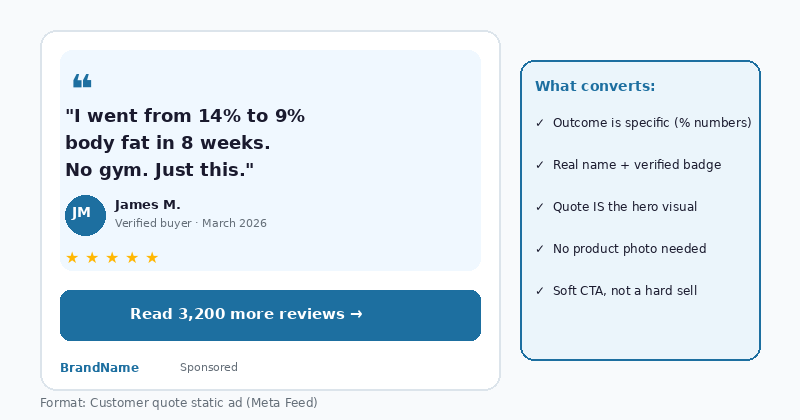
"I went from 14% to 9% body fat in 8 weeks." That one sentence does more conversion work than three paragraphs of feature copy. Specificity is everything. Vague enthusiasm, "I love this product!", converts poorly. Concrete outcomes convert consistently.
Jones Road Beauty built significant Meta performance on exactly this format. A strong quote, a clean background, a name. That is it.
- Use the most specific, outcome-based quote you have, not the most enthusiastic
- Include the customer's first name and real photo if they have given consent: this adds around 40% more credibility than an anonymous quote
- A soft CTA works better here: "Read 3,200 more reviews" outperforms "Buy Now" in this context
This format travels across sectors. Whether you are running fashion ad campaigns, beauty, or fitness, a specific outcome quote on a clean background earns clicks that brand copy never will.
Customer quote static ad. The verbatim outcome quote is the hero visual, no product image, no headline, just proof.
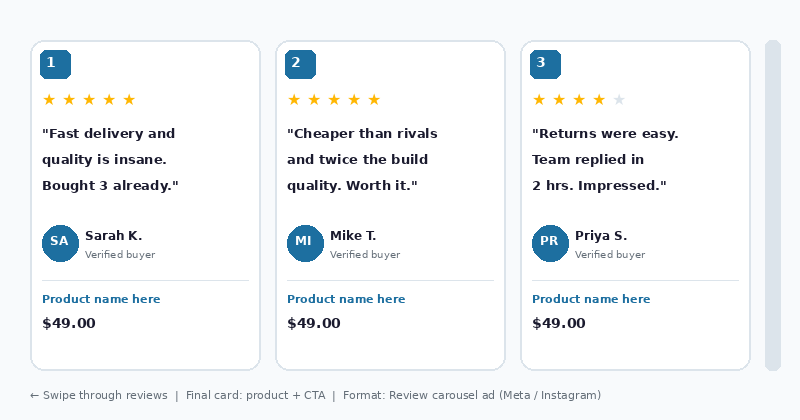
4. The review carousel ad
Each card in the carousel is a different customer review: a quote, a star rating, maybe a photo. The product only appears on the final card with the CTA.
This format works because it mirrors what buyers do naturally before purchasing. They read one review, then another, then another. Swiping through the carousel is that same behaviour inside the ad unit itself. By the time they hit the final card, the decision is made.
Emails with customer reviews already see 25% higher CTRs. The carousel applies the same layering effect but lets buyers self-select their pace through the proof.
- Use reviews that each tackle a different objection: price, quality, delivery, and results
- Two to three lines per review maximum. Any longer and mobile readers drop off
- Final card: product image, aggregate star score, and one clear CTA
The Facebook and Instagram carousel ad examples collection shows how leading brands handle the design and sequencing of this format in practice.
Review carousel ad. Each card = one customer review. The final card reveals the product and CTA. Buyers self-select their pace through the proof.
5. The social number badge ad
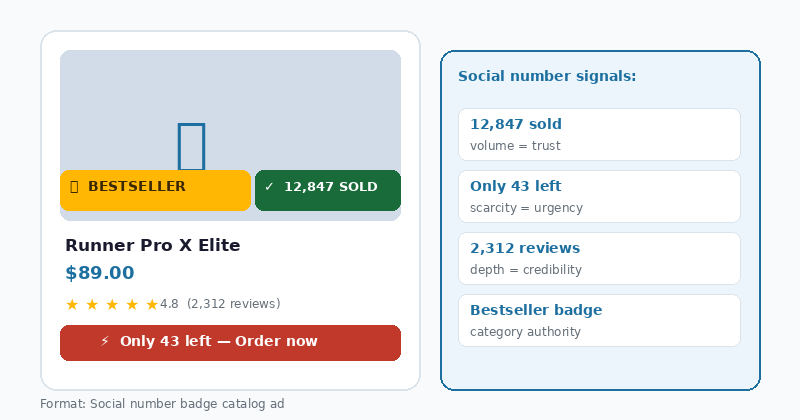
A catalog ad with a badge overlaid on the product image. "800,000+ customers." "Bestseller: 12,000 sold this month." "Trusted by 700+ brands."
Volume creates a shortcut in the buyer's brain: this many people cannot all be wrong. It is the bandwagon effect applied to advertising, and it is one of the most reliable trust mechanisms in eCommerce. When five or more reviews are visible on a product, conversions increase by up to 270%. Combine that with a purchase volume badge and you are stacking two proof signals on a single creative.
One rule: be specific. "8,214 orders this month" is more believable than "8,000+". The precision signals real data, not a marketing claim.
- Pair volume with scarcity: "8,214 sold, only 43 left" compresses the decision timeline
- Pull numbers live from your feed so they never go stale. A badge showing last year's figures actively hurts trust
This approach is described in detail in the analysis of bandwagon advertising, which covers exactly how volume signals compress the buyer's consideration phase.
Social number badge catalog ad. Bestseller label, sold count, and scarcity signal stack on a single product creative, three proof layers in one frame.
6. The text exchange ad
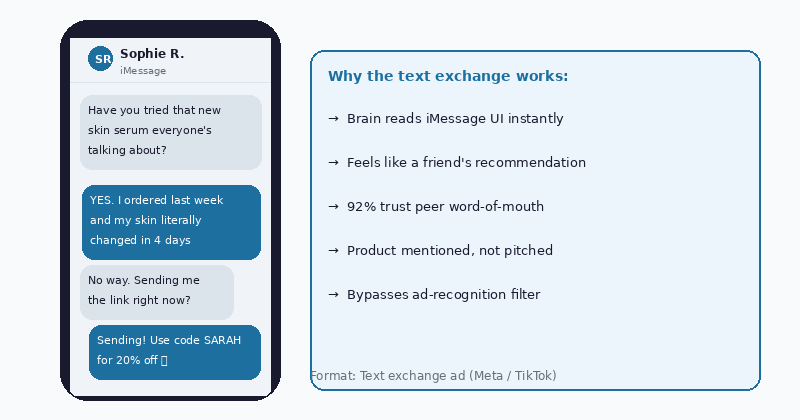
An ad formatted to look like an iMessage thread. Friend A texts Friend B: "Have you tried this?" Friend B responds with an outcome. The product gets mentioned naturally, not pitched.
92% of people trust a recommendation from a friend above any other form of marketing. This format is engineered to feel exactly like that. Your brain recognises the iMessage UI instantly and switches into reading mode before the ad filter kicks in.
Creative strategist Savannah Sanchez, whose clients include Dr. Squatch and Fabletics, calls this one of her most consistently high-performing formats precisely because the social proof is delivered inside the most trusted channel the viewer knows: a conversation with someone they care about.
- Two to four messages maximum. More than that and it reads like a script
- Put the real pain point in the first message, not the product name
It is one of several high-performing ad creative formats that bypass ad fatigue by wrapping social proof in a familiar, trusted everyday context.
Text exchange ad. The iMessage format triggers instant recognition, the viewer reads it like a message from a friend, not an ad.
7. The expert endorsement ad
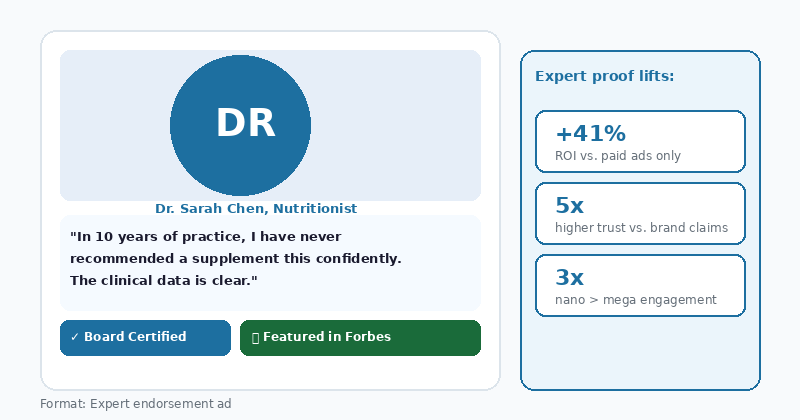
A doctor recommended a supplement. A professional chef using a pan. An athlete wearing a shoe. The expert's credibility transfers directly to the product.
Brands using influencer partnerships report 41% stronger ROI than those relying on paid ads alone. But the key word is relevance: the expert's domain needs to match the product's value proposition precisely. A random celebrity holding a product is just advertising. A relevant expert validating it is social proof.
Nano-influencers (1K to 5K followers) now see engagement rates over 5%, which is 3x higher than mega-influencers. For most eCommerce brands, a highly trusted voice in a tight niche will outperform a broadly known one with a disengaged audience.
- The quote should describe an outcome, not a feature: "I slept better in two days" beats "I love the materials"
- Match domain to product precisely. A nutritionist recommending protein makes sense. The same nutritionist recommending luggage does not
The full data behind what drives influencer ROI is in the influencer marketing statistics resource, including the breakdown of why nano-influencers are increasingly outperforming celebrities on a cost-per-conversion basis.
Expert endorsement ad. Domain-matched credentials and a specific outcome quote transfer the expert's authority directly to the product.
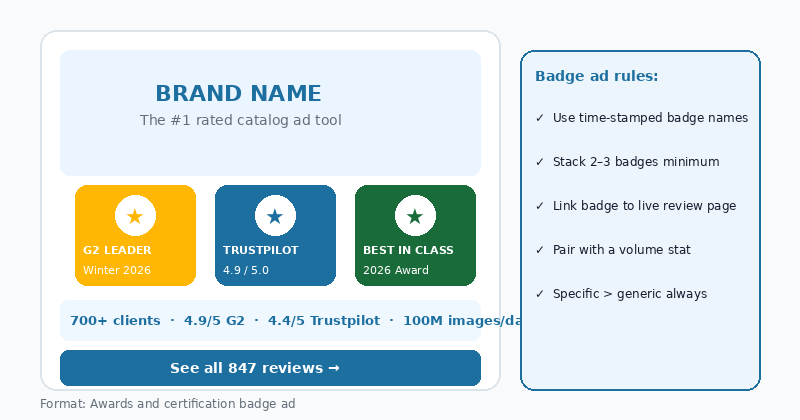
8. The awards and certification badge ad
A G2 Leader badge. A Trustpilot score. A Bestseller designation. Third-party recognition displayed as a central element of the ad creative.
This is expert social proof without needing a person. The badge says: an independent organisation evaluated this and endorsed it. For B2B brands, a G2 score in the ad cuts the credibility-building work that would otherwise take multiple touchpoints. For eCommerce, a Bestseller badge or press mention signals quality before the buyer has read a single word.
The execution rule is specificity: "G2 Leader, Winter 2026" is a provable, time-stamped claim. "Award-winning" is a vague one. Buyers know the difference.
- Stack multiple smaller badges rather than one large one. Layered proof compounds
- Link any badge in the ad footer to the live review page. It shows you have nothing to hide
Award and trust badge creative slots naturally into a broader Facebook ads strategy where different proof signals are layered across prospecting and retargeting campaigns.
Awards and certification badge ad. Stacked G2, Trustpilot, and category badges with a volume stat, expert social proof without needing a spokesperson.
9. The before and after results ad
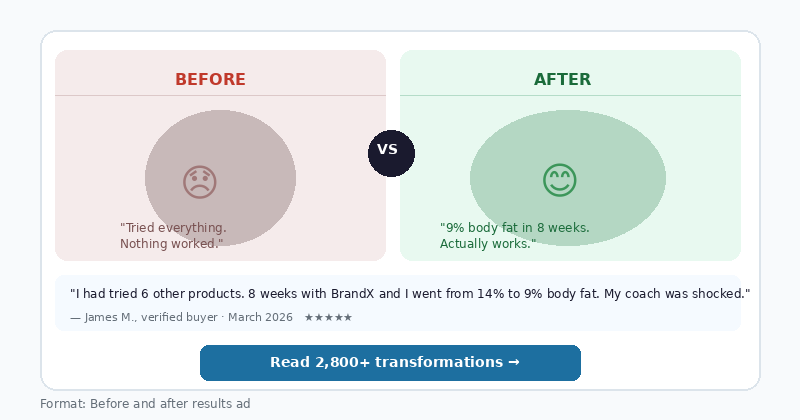
Side by side. Before on the left, after on the right. A real customer's real transformation. Their quote underneath.
This format works because it does not ask buyers to imagine a benefit, it shows them one. The viewer sees the outcome and projects themselves into it. Combined with a real quote from the customer who lived it, the ad addresses both the logical question ("does this actually work?") and the emotional one ("will it work for me?") in a single frame.
Authenticity matters more than production quality here. A real customer photo taken on an iPhone converts better than a studio shot on Meta and TikTok. The roughness confirms it is real.
- The 'after' must match the precise aspiration of your target buyer, not a generic improvement
- Keep claims specific and provable to stay inside platform ad policy
For category-specific inspiration, the skin care ad examples collection shows how before-and-after visual proof is executed at a high level in beauty and wellness, where this format consistently dominates.
Before and after results ad. The visual outcome plus a specific verified customer quote answers both "does it work?" and "will it work for me?" in one frame.
10. The real-time activity notification ad
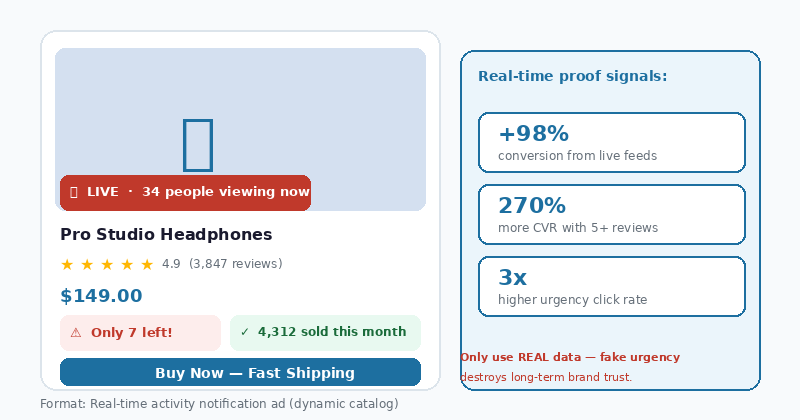
"34 people viewing this right now." "Booked 15 times in the last 6 hours." "Only 3 left in stock."
This is social proof and scarcity combined, and that combination is one of the highest-converting mechanisms in paid advertising. Live activity feeds boost conversions by up to 98% in documented implementations. The logic is dual: if others are actively looking and buying, the product is validated. And if supply is limited, hesitation is expensive.
Booking.com pioneered this on-site. The next frontier is deploying it at the ad level, so the urgency signal reaches the buyer before they ever click through.
- Only use real data. Fabricated urgency is increasingly detectable and permanently damages brand credibility
- Test scarcity signals ("Only 3 left") against popularity signals ("900 sold this week") separately. They perform differently by category and audience
This is the core promise of enriched catalog ads: product-level social signals embedded directly in the ad creative, not just sitting on the landing page where most buyers never see them.
Cropink's hourly feed sync keeps your stock levels, purchase counts, and availability signals live across all running ads automatically. The social proof stays accurate and never creates brand risk from stale data.
Real-time activity notification ad. Live viewer count, sold volume, and scarcity signal stack onto the product creative, social proof and urgency in a single dynamic frame.
The Social Proof Mistakes That Are Killing Your Conversions
Getting the format right is half the job. The other half is avoiding the errors that flip social proof from a conversion driver into a trust destroyer:
| The mistake | Why it hurts and what to do instead |
|---|---|
| Fake or generic testimonials | 95% of consumers detect inauthentic reviews. Use only verified quotes with real names. One specific real quote beats ten polished fakes. |
| Only showing 5-star reviews | Perfect scores raise red flags. The 4.2 to 4.5 range drives the highest purchase likelihood. Show the mix. |
| Tiny social numbers | "Join 12 customers" is negative social proof. If your numbers are small, lead with one powerful specific quote until volume builds. |
| Stale or outdated proof | "Verified buyer, 2021" in a 2026 ad reads as abandoned. Sync dynamically and flag recency. "Purchased March 2026" builds more trust. |
| Social proof below the CTA | Placement is everything. Social proof needs to sit directly next to or above the decision point, not buried in small print. |
| Not optimising for mobile | 60% of social ad viewers are on mobile. A star rating that is not legible at 375px wide is invisible where it matters most. |
How Cropink Puts Social Proof Into Every Catalog Ad, Automatically
Here is the honest problem most eCommerce teams run into: you understand social proof, you want to use it, and then you realise you have 800 SKUs.
Manually creating individual ad variants with review overlays, rating badges, and customer quotes for 800 products is not a marketing strategy. It is a full-time job for three people.
Cropink solves this. It is a dynamic catalog ad creation platform that connects your product feed via Shopify, Meta, XML, or CSV and pulls live data into every ad template automatically. Including all the social proof elements.
Here is what that looks like in practice:
- Dynamic review overlays: Your star ratings and review counts map from your product feed into every ad template. Each SKU shows its own live rating, not a generic score applied across the catalog.
- Conditional social proof: Cropink's logic engine can show a testimonial quote on your top-reviewed products and switch to a bestseller badge on newer ones with fewer reviews. The right proof for each product, automatically.
- Live urgency signals: Hourly feed sync keeps stock levels, purchase counts, and availability signals accurate across all running ads. No stale numbers. No brand risk.
- Brand-consistent execution: Your colours, fonts, and design system apply to every ad so the social proof looks like a deliberate creative choice, not an afterthought.
- Figma to live ads: Design your social proof templates in Figma, export to Cropink, and the dynamic data mapping handles the rest.
The results are documented. Leroy Merlin Poland used Cropink to run a Meta catalog ad structure that combined sales performance and branding in a single campaign, achieving a 353% increase in conversion rate and a 79% ROAS improvement. MediaMarkt achieved 9x ROAS.
Neither result came from a bigger budget. Both came from making social proof visible, accurate, and consistent across every product ad.
And that combination is especially powerful when paired with retargeting: the retargeting statistics show that retargeted audiences already know the brand, so a well-placed review overlay on a Facebook retargeting ad is often the only nudge they needed.
FAQs
Does social proof actually increase ad conversion rates?
Yes, and the data is not subtle. Ads with customer reviews get 4x higher CTRs. Video testimonials produce an 80% conversion lift over text-only ads. Showing five or more reviews on a product drives up to 270% more conversions. Real-time activity notifications boost conversions by up to 98%. Across all touchpoints, consistent social proof increases revenue per customer by 62% on average. The question is not whether it works. It is whether you are using it.
What social proof formats work best on Meta vs. TikTok?
On Meta, the strongest formats are the customer quote static ad, the review carousel, and star rating overlays on product catalog ads. Retargeting ads on Facebook with social proof convert at 11.4%, nearly double standard prospecting campaigns. On TikTok, UGC video testimonials dominate, outperforming polished brand creative by 2 to 3x in conversion rate. Spark Ads (boosted organic UGC) deliver 30 to 50% lower CPAs than standard In-Feed ads because the organic social proof travels with the ad. A comprehensive breakdown of what top brands are doing on the platform lives in the Meta ads examples collection.
How do I add social proof to my catalog ads?
Three options. Manually build individual creative variants for each product, which works but breaks at scale. Use Meta's native catalog overlay tools, which are limited in design control. Or use a dynamic catalog ad platform like Cropink, which maps live review scores, ratings, and social signals from your product feed onto branded ad templates across your entire catalog automatically. The third option is the only one that works at volume.
Can showing a negative review actually help performance?
Yes. Products with 4.2 to 4.5 star averages outperform those with perfect 5.0 scores in purchase likelihood studies. Perfect scores read as curated or fake. Some brands, notably HexClad, have run ads that surface a negative comment and then directly refute it with evidence. It disarms the objection and demonstrates confidence at the same time. Authenticity beats perfection every single time.
What is the difference between UGC ads and testimonial ads?
UGC ads use organic content created by real customers: their own photos, videos, or posts repurposed as ad creative. Testimonial ads use curated, often text-based quotes designed into a clean ad layout. UGC outperforms TikTok and Reels because the roughness signals authenticity. Testimonials outperform in Meta Feed placements where a legible, specific quote can be displayed as the visual centrepiece. The best-performing strategies use both, matched to the right platform and funnel stage.
Final Thoughts
Ad costs are rising. Consumer trust in brand messaging is at historic lows. And the gap between brands that show proof and brands that just show products is getting wider every quarter.
Social proof is not a creative technique. It is a business decision. The 10 examples in this guide all share the same underlying logic: let your customers do the persuading, and then get out of their way.
That is where Cropink comes in. It connects directly to your product feed and lets you map live ratings, review counts, bestseller badges, and stock signals onto branded ad templates automatically, across your entire catalog, on Meta, TikTok, Snapchat, and more.
If that sounds like something worth trying, Cropink has a free plan you can start with today.
Sources
- Incremys. Digital Marketing Statistics: Key Figures to Know
- WiserReview. 51 Insightful Social Proof Statistics
- Genesys Growth. Social Proof Impact on Conversions
- The Jonas Agency. Paid Social and Video Media Benchmarks
- Motion (Thumbstop). How to Use Social Proof in Facebook and TikTok Ads
- Confect. 22 Great Ads Using Social Proof
- Trustmary. 6 Examples of Using Social Proof in Advertising
- Influee. Average Facebook Ads Conversion Rate
Ansherina helps brands create powerful digital marketing and performance marketing strategies. With a passion for ad design and audience engagement, she is dedicated to making brands more visible and impactful.
Leszek is the Digital Growth Manager at Feedink & Cropink, specializing in organic growth for eCommerce and SaaS companies. His background includes roles at Poland's largest accommodation portal and FT1000 companies, with his work featured in Forbes, Inc., Business Insider, Fast Company, Entrepreneur, BBC, and TechRepublic.
Related Articles

How Can Cropink Help?
Start with Cropink is easy and free
No credit card required